

Space economy, defense, and the money behind them. Writing Space Worthy, a weekly brief. Ex @boeing @google @openstreetmap. Proudly 🇪🇺
The Internet
Joined January 2008
- Tweets7.5K
- Following1.4K
- Followers1.9K
- Likes1.7K




Pinned Tweet
European launchers: the full series in one place.
Opener: teapawt.org/simonecortesi/status/2…
1 Isar Aerospace: teapawt.org/simonecortesi/status/2…
2 PLD Space: teapawt.org/simonecortesi/status/2…
3 MaiaSpace: teapawt.org/simonecortesi/status/2…
4 Rocket Factory Augsburg: teapawt.org/simonecortesi/status/2…
5 Ariane 6: teapawt.org/simonecortesi/status/2…
6 Avio and Vega C: teapawt.org/simonecortesi/status/2…
7 HyImpulse: teapawt.org/simonecortesi/status/2…
8 Orbex and Omnidea: teapawt.org/simonecortesi/status/2…
9 Latitude and Sirius: teapawt.org/simonecortesi/status/2…
10 Skyrora: teapawt.org/simonecortesi/status/2…
11 Wrap-up: teapawt.org/simonecortesi/status/2…
Only Isar has reached orbit so far. PLD Space and MaiaSpace are next, both aiming for 2027.

European launchers, part 4: Rocket Factory Augsburg.
Rocket Factory Augsburg, or RFA, was founded in 2018 in Augsburg, Germany. Its majority owner is OHB, the satellite maker from Bremen. RFA One is a three-stage rocket, about 30 metres tall, with nine Helix engines on the first stage. The current version is built for up to 500 kg to sun-synchronous orbit. It will launch from SaxaVord in Shetland, which would be the first vertical orbital launch from the United Kingdom.
RFA One has not flown. In August 2024 a first stage was destroyed in a ground test at SaxaVord. A new rocket stood on the pad in July 2026, but after a week of tests RFA found an issue and took it down. The August launch window was cancelled. There is still no new date.
The money keeps coming. In August the European Space Agency signed a €186.9 million contract that requires an orbital launch before 2028. In September it added €2.7 million for test stands at SaxaVord. On 5 October Alexander Dahm, from Hensoldt and Airbus, became CEO.
RFA has the funding and a spaceport, but its first flight has no date after two setbacks on the pad. Isar is already in orbit and PLD targets the first half of 2027, so RFA is behind both.

On October 30 Canada and the EU agreed to start exploratory talks on Canadian access to IRIS², Europe's secure satellite network. The same day MDA Space announced a first contract worth more than $72 million to build digital antennas in Montreal for the first 66 IRIS² satellites, due to launch in 2029.
Carney told Politico that Canada has kept its defenses off a satellite system a billionaire could switch off, and that Canada's own constellation, Telesat Lightspeed, should be working in 2028.
Canadian industry is already earning money from Europe's network. A working alternative to Starlink for Canada is still at least a year and a half away.

ESA has opened a call for companies to fly reusable rocket boosters: recover a first stage after launch, then fly it again. It is called BEST!2 Flight Demonstrations, published October 27 as an advance notice, with no budget or timeline yet.
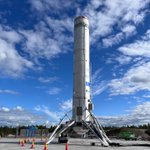
This is Themis, Europe's reusable demonstrator, on its stand in September 2025. It still hasn't made its first hop. ESA's director of space transportation, Géraldine Naja, said winter at Esrange could push that hop into 2027.
SpaceX first landed a Falcon 9 booster in December 2015. Asking industry to fly real hardware is the right move. Until ESA attaches money and dates to it, Europe remains years away from flying the same rocket twice.

Northwood Space raised $375 million yesterday at a $2 billion valuation, co-led by Andreessen Horowitz and DFJ Growth. Its previous round was $100 million in January. In under three years the company has gone from a $6.3 million seed round to more than $500 million raised.
Northwood builds ground stations, the antennas that talk to satellites, and wants to rent them out as shared capacity the way cloud providers rent servers.
In February it said it would have 18 ground sites running by the end of 2026. Now it says it has six, on two continents.
The money is moving much faster than the network. At $2 billion investors are paying for the Torrance factory and the Space Force contract, and in 2027 the site count has to catch up.

26 years ago today the first crew moved into the International Space Station: Bill Shepherd, Yuri Gidzenko and Sergei Krikalev. Since 2 November 2000 there has always been at least one person aboard.
The station is due to retire at the end of 2030. The first commercial replacement, Vast's Haven-1, was meant to launch in May 2026. It now targets the first quarter of 2027, and it hosts four people for two weeks at a time.
Vast's station with a permanent crew, Haven-2, is planned for the end of 2030. That is the same date the ISS retires, with no room for another slip.
My read: a gap in Western human presence in orbit after 2030 is now likely, while China keeps Tiangong crewed.

Viasat added about $1.1 billion in market value last week on a non-binding memorandum.
On Oct 28 Viasat, Space42 of the UAE and Canada's Terrestar signed it in Ottawa. Terrestar's planned Canadian satellite network would connect to Equatys, the shared satellite-to-phone platform Viasat and Space42 set up in September with up to $1 billion of equity.
Terrestar holds Canadian licences in 2000-2020 and 2180-2200 MHz until 2035. In the US those same frequencies are the band SpaceX agreed to buy from EchoStar for about $17 billion.
Viasat rose 11% that day and 25% over the week. SpaceX fell 9%.
Canada wants a phone-from-space option it controls, and Viasat is offering one. But nothing is binding yet, and Equatys plans no service before the end of 2029. The market is already paying for a network that does not exist.

NASA's two ESCAPADE probes leave for Mars this week. Blue fires its engine for 9.5 minutes on November 7, at its closest pass to Earth. Gold does the same on November 9. Both should arrive in September 2027.
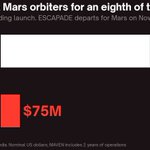
The whole mission cost about $75 million, including a $20 million launch on Blue Origin's New Glenn. MAVEN, NASA's last Mars orbiter, cost about $582 million to build, launch and run for two years. Both study how Mars lost its atmosphere.
The probes got here the hard way. They were first meant to fly with NASA's Psyche in 2022, then were pulled from New Glenn's first flight in 2024. Since launch in November 2025 they have looped around a point 1.5 million km from Earth, waiting for Mars to line up. Along the way they flew about 2 million km down Earth's magnetic tail, farther down it than any spacecraft before.
Two Mars orbiters for about an eighth of one MAVEN. If next week's burns work, NASA has proof that Mars science can be done on a small-mission budget.

The US Justice Department asked a federal court on Wednesday to throw out Ligado's $50 billion lawsuit. Its argument: an FCC spectrum license gives no protection when another federal agency wants the same airwaves.
Ligado says secret Pentagon systems have blocked the L-band license the FCC approved in 2020. The DOJ compares a spectrum license to a fishing license. It lets you fish, and the government can still close the water.
This reaches satellite-to-phone money. AST SpaceMobile agreed to pay Ligado $550 million, plus at least $80 million a year, to use that same L-band. SpaceX agreed to pay about $19.6 billion for EchoStar spectrum and about $8 billion for Grain's 800 MHz licenses.
Buyers who paid at an FCC auction probably stand on firmer ground, and Ligado never bid. Still, the US government is now telling a court that another federal agency can override these licenses without paying. Until the judge rules, every satellite-to-phone spectrum deal carries that risk, and AST's L-band deal carries the most.

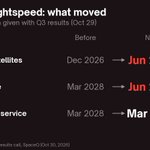
A correction to my Telesat post on Thursday. I wrote that Lightspeed service starts around the end of March 2028. That date now holds only for the Arctic service for Canada's military. Global service slipped three months, to the end of June 2028.
The first two test satellites were due to launch this December. They now fly no earlier than June 2027, sharing another customer's Falcon 9. CEO Dan Goldberg said that even with a rocket available today, the satellites would not be ready.
Goldberg also said SpaceX's role in Ukraine has "animated various governments" toward Lightspeed. All 14 Lightspeed launches under contract are on Falcon 9.
Lightspeed is sold as the alternative to Starlink, and it still needs SpaceX to reach orbit.

SpaceX has until tomorrow, November 2, to answer four US senators on Ukraine's Starshield service.
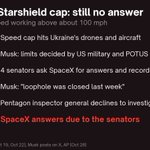
Between October 12 and 14, Starlink and Starshield terminals in Ukraine stopped working on anything moving faster than about 100 miles per hour. That cut off drones Ukraine uses to intercept Russian drones. Starshield is the military version of Starlink.
Musk has given two explanations. On October 14 he wrote that Starshield limits are decided by the US military and ultimately the President. On October 24 he wrote that Ukraine had used commercial Starlink for offensive drone strikes and that "loophole was closed last week."
On October 27 the Pentagon's inspector general declined to investigate.
Three weeks on, nobody has said on the record who ordered the cap. Any military that relies on one company's satellites can lose service the same way, without warning.

On Monday the Pentagon's Office of Strategic Capital signed a conditional commitment to lend Stoke Space $150 million for a second pad at Cape Canaveral.
The loan is not closed. Stoke still has to pass financial, legal and technical tests. The new pad is for Nova Block 2, about 15 metric tons to low Earth orbit, aimed at 2029. Stoke has not reached orbit yet.
Its Series E in September put total capital raised near $2.3 billion. That money is in the bank. The $150 million might be. Space Worthy #19 has the details.
simonecortesi.substack.com/p…

Two weeks ago I guessed that if only one Moon lander was ready for Artemis III, it would be Starship. Jared Isaacman just ruled that out.
He told NASASpaceflight that SLS will not launch until Blue Origin's Blue Moon is already in orbit and checked out. "We're not going to launch without Blue Origin in it."
The order is New Glenn with Blue Moon first, then SLS and Orion with four astronauts, then Starship. Blue Moon can wait in orbit for about 30 days.
Asked what drives the schedule, he said: "For sure, the lander. We don't have a fully assembled Blue test article yet." New Glenn has not flown since it exploded on its pad in May, and NASA has sent hundreds of people to help rebuild the pad.
The target is still a launch between May and September 2027. Artemis III now runs on Blue Origin's clock, and SpaceX can't speed it up.

On Thursday the Federal Communications Commission voted unanimously to look at nearly 500 megahertz more of mobile spectrum for satellites that talk straight to ordinary phones.
Eligible bands would go from five to thirteen. Nobody got spectrum yet. The SpaceX request for the 902-928 megahertz band was left out, and the comment clock starts only when the notice reaches the Federal Register.
Same week, Amazon Leo got approval for about 25 megahertz of Globalstar spectrum, a purchase reported at $11.5 billion.
Satellite-to-phone service just moved from talk to paperwork, and the paperwork will take a while. More in Space Worthy #19.
simonecortesi.substack.com/p…

The Defense Intelligence Agency just published the sharpest public photo yet of China's reusable spaceplane. A commercial imaging satellite took it in 2024. Payload-bay doors open, solar arrays out.
China has flown it four times since 2020. The one up now launched February 7, and according to Jonathan McDowell's public catalog it released a small satellite and took it back, twice, between June and September.
A classified craft in low Earth orbit can now be inspected by a camera that also sells pictures of parking lots. That is the story in Space Worthy #19.
simonecortesi.substack.com/p…

A commercial imaging satellite caught China's classified spaceplane in orbit with its bay open and solar arrays out, and on Monday the Defense Intelligence Agency made the picture public. It's the same kind of camera that sells pictures of parking lots.

From April 2027, Britain can require foreign defense suppliers to put the full value of a contract back into the UK.
The new UK Offset Policy, published Friday, covers Ministry of Defence contracts of £50 million (about $67 million) or more. The standard commitment is 100% of the contract value over 10 years, through UK jobs, factories, suppliers or technology transfer. Milestones are 30% by year three and 50% by year five. A missed milestone costs at least 10% of the shortfall.
Space is on the list of priority areas, along with cyber, electronic warfare and AI.
Since 2016 the UK has spent £35.2 billion (about $47 billion) on defense contracts with overseas industry, 11% of the ministry's direct spending with industry.
US companies bidding for UK military satellites now have to price in a decade of investment in Britain. That adds cost to their bids and gives UK space companies a better shot at the work.

China laid out its first crewed Moon landing in detail today in Beijing.
Wang Xiang, chief designer of China's lunar program, said it takes two Long March 10 launches. The first sends the Lanyue lander into lunar orbit. The second carries three astronauts in the Mengzhou spacecraft. They dock in lunar orbit, two land, and one waits in orbit. The goal is a landing before 2030.
An uncrewed Lanyue mission will first rehearse the full sequence, from docking to landing to takeoff.
NASA's two landers need more launches. Blue Moon needs four New Glenn launches plus SLS. The Starship lander needs about 22 Starship flights to fill its tanks in orbit, according to NASA's safety panel. SpaceX says 6 to 8.
The full Long March 10 has not flown yet. Still, two launches and no refueling in orbit is the simplest plan of the three, and that makes China's 2030 date credible.

SpaceX closed at $134.72 on Friday. The IPO price in June was $135, so the stock now sits just below what new investors paid.
On October 6 it closed at $171.92 and the company was worth more than $2.3 trillion. Now it is about $1.8 trillion. That is over $500 billion lost in less than a month.
The drop lines up with the lockup. On October 21 the stock jumped about 8% after third-quarter results. The next day 1.3 billion shares became free to sell and it fell 9%. Friday's 6% fall came with the whole tech sector down.
The next release is December 8: up to 797.6 million more shares.
My read: early holders selling are setting the price right now, and that pressure has one more big round to go in December.

Hubble has no engine. Since its last reboost in 2002 it has dropped from 583 km to about 470 km.
NASA's new request for information, published October 29, puts numbers on the clock: a 10% chance of reentry by September 2032 and 50% by December 2033. NASA wants a mission by 2032 that boosts it to at least 600 km, services it, or brings it down in a controlled way. The company would supply the rocket, the servicing spacecraft and the operations. NASA has no money set aside yet. Answers are due November 30.
This was tried in 2022. Jared Isaacman offered a mostly privately funded Dragon mission, eight teams answered a similar NASA request, and in 2024 NASA said no. Now Isaacman runs NASA, and crewed Dragon is set to retire by 2030, so this round is about robotic servicers. NASA already gave Katalyst $30 million and nine months to rescue the smaller Swift telescope. It launched on time and got within about 10 km.
Hubble has no replacement for its visible and ultraviolet work before the 2040s. A robotic reboost is the cheapest way to keep it, and NASA should pay for one.

Shaun Maguire of Sequoia posted his bottom-up SpaceX model last night. Revenue goes from $51.5 billion in 2026 to $274 billion in 2027 and $731 billion in 2028.
Most of that growth comes from data centers on the ground. Terrestrial compute is $569 billion of the 2028 total, about 78%. Orbital compute is $31 billion.
The model takes SpaceX from 1.7 gigawatts of compute today to 21 gigawatts by the end of 2028, earning $40 billion per gigawatt per year. It also needs $290 billion of capital spending in 2027, and cash falls by $123 billion that year.
Sequoia is a major SpaceX shareholder, and he says so. The bull case for SpaceX right now is a bet on AI data centers on Earth.

Google's Project Suncatcher satellite just ran its first AI prompt in orbit.
The prototype, built with Planet, launched October 1 on SpaceX's Transporter-18 rideshare. It carries four Google TPUs (tensor processing units, its AI chips) and makes up to 1 kilowatt of power.
After about three weeks of commissioning, engineers sent a prompt to a Gemma model and got a haiku back over Svalbard. Each TPU can only run for about 15 to 20 minutes at a time because of power and heat. Next come radiation and thermal tests, then two linked satellites in 2027.
A data center chip works in orbit. Orbital compute at useful scale is still years away.
