

Electronic trading systems architect | 20yr production HFT. I advise trading firms on the architecture decisions that commit capital.
New York City 🗽
Joined January 2010
- Tweets7.6K
- Following2K
- Followers4.1K
- Likes846







Electronic Trading Architect | Strategic Advisor retweeted

The tape looked quiet for 40 of 61 OTR spikes; the book was not.
That is 65.6% vs 33.1% at matched moments, proven on a full NASDAQ day. Inside VisualHFT Terminal you see the quoting war your prints never record.
#visualhft
Electronic Trading Architect | Strategic Advisor retweeted
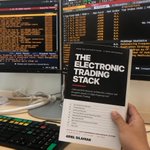
My last book is a collection of all the articles I've been writing in the past year.
Rearranged for easy reading.
All printed in a book and in one place.
Stays next to my desktop for reference.
(online articles remain fully for free, so having this book is not necessary for reading them)
The book:
The Electronic Trading Stack: Collected Field Notes on Architecture, Latency, and Execution Quality in High-Frequency and Institutional Trading
Find it on Amazon now!!

Electronic Trading Architect | Strategic Advisor retweeted

[Download 585-page PDF eBook]
Game Theory: arxiv.org/abs/1512.06808
—————
#GameTheory #Gamification #Mathematics #Statistics #Probability

Electronic Trading Architect | Strategic Advisor retweeted

Asked Claude to take a look at the security of my production PHP 5 projects
Electronic Trading Architect | Strategic Advisor retweeted

Never forget when this Forex guru told his students to short CPI.

Electronic Trading Architect | Strategic Advisor retweeted
IDXX 12:58 ET: 5 at 487.35 bid, 367 offered, mid flat. Offer 487.59 became best with no trade, mid fell 8.5 cents, opening spread 41 cents. Top-fifth Touch Weighted called the next tick 73.9% on hold-out names, vs 51.7%, and a price-only rule tied.
visualhft.com/blog/from-sign…

Electronic Trading Architect | Strategic Advisor retweeted

This is f*cking gold..
Chinese researchers just released a paper with a brutal title: "The End of Prediction".
The case is simple: an AI that outputs BUY or SELL is finished as a product.
Any signal a model can read is priced in before it finishes reading, and active managers already lose to the index over any multi-year window.
The question a model answers well is different: what changed, and what is the evidence that it is real rather than noise.
So the architecture flips. Plain code finds the anomaly, a million-token model compares eight quarters in one pass, and the heavy reasoning model is spent only on arguing against the result.
10,000 companies a day become 40 deep reads and 8 reasoning passes -- about $450 of inference where a naive full pass costs $60,000.
Flagged events hit 37% precision against a 15 to 20% base rate. A real edge, and still nowhere near a forecast.
The output has no score and no call. Only what changed, sourced, and what contradicts it.
That is exactly the pipeline I built and wrote up below: Robinhood data, Kimi K3 for the reading, GPT-6 Astra for the counter-thesis.
The entire paper in one line: you are selling research velocity, not prediction ↓


Electronic Trading Architect | Strategic Advisor retweeted

Our latest research paper explores the growing connection between AI and digital assets and explains why broad AI adoption may drive new demand, utility and applications across the digital asset economy. blackrock.com/us/individual/…


Electronic Trading Architect | Strategic Advisor retweeted

Jev Founder, Diogo Amogo, just released 12-page PDF on building a Jev Harness for coding agents
this is a 10-step blueprint on how to make your coding agents 200× faster and 400× cheaper:
step 1 → meet Jev: the LLM writes, the harness executes, Jev decides what each turn sees, where it routes and whether it runs
step 2 → ask the question that breaks every agent: how would you design one if LLMs had no KV cache?
step 3 → stop routing blind: Opus → Sonnet → Opus costs 6.19 vs 4.15 for pure Opus, because handing back reprocesses the whole context
step 4 → follow the tokens: reading and searching take 56.2% of tool turns and 46.5% of tokens. Writing code is under 10%
step 5 → score every chunk per query: hide, short summary, long summary or full. Compress after the question, not before
step 6 → disclose tools in tiers: one-line snippets for 100s of tools, schema on demand, docs for one-off queries. Batteries stop costing context
step 7 → load instructions by condition: touching *.tsx loads the style guide, billing/ loads its gotchas file, and compaction can't erase either
step 8 → route by trust, not just difficulty: secrets and infra stay on first-party frontier models, public docs go to the cheapest one
step 9 → share one retrieval pass: cross-model review, eval generation, ELI5 explainers and live progress pages all run read-only in the background
step 10 → gate every command: programmable allow / ask / deny policies that read a script before it runs, not just its name
Send this PDF and the article below to your Claude Code or Codex instance and start shipping 200× faster.


Readers added context they thought people might want to know
The post wrongly identifies "Diogo Amogo" as Jev founder; TypeSafe AI (Jev's developer) was founded by Diogo Almeida. The shared PDF is independently compiled and explicitly disclaims any affiliation with or endorsement by TypeSafe.
typesafe.ai/team
typesafe.ai/blog/introduci…
drive.google.com/file/d/17h982x…
pbs.twimg.com/media/HSv6c7rX…
Electronic Trading Architect | Strategic Advisor retweeted

Anytime the government talks about crypto or AI, I picture this image

Electronic Trading Architect | Strategic Advisor retweeted

Project - HFT orderbook trading simulator benchmarked in Python and C++
Versions benchmarked:-
->V1 (Python baseline): Dict-based order book; rebuilds top-5 by sorting the full book on every snapshot correct reference, slow snapshots.
->V2 (Python top-5 cache): Same dict book as V1, but keeps an incremental top 5 cache so snapshots are fast without sorting the whole book.
->V3A (Python direct array, scan): Orders and price levels stored in arrays (FPGA-style direct indexing); snapshots scan the full price range fast updates, slow snapshots.
->V3B (Python direct array + cache): Same array book as V3A, plus a maintained top 5 cache combines direct indexing with fast snapshots (best Python version in our full pipeline).
->V4 (C++ map baseline): Same logic as V1 in C++ (unordered_map + std::map) validates correctness and gives much lower native-code latency.
Github repo in comments


Electronic Trading Architect | Strategic Advisor retweeted
So the count is worth reading twice, about a minute apart.
The whole ladder runs in that time, so two readings separate a recovery in progress from its result.
How VisualHFT draws it, and what each reading calls for:
visualhft.com/blog/the-healt…

Electronic Trading Architect | Strategic Advisor retweeted
A feed starts to degrade. The message rate says something is wrong. The latency says the same thing.
Neither of them says which kind of wrong.
The two counters that do separate them show nothing at all on a normal day. How to read them:

Electronic Trading Architect | Strategic Advisor retweeted
VisualHFT Founders Beta: See order flow in real time. Founders Beta is now open.
producthunt.com/products/vis… via @producthunt

Electronic Trading Architect | Strategic Advisor retweeted
A market data feed that stops does not raise an error.
Nothing throws. Every number downstream keeps computing on the last messages that arrived. The book just looks quiet.
A stale feed looks exactly like a calm market.
Four failures wear that disguise. Thread: