

creator @nuronos, @0xprivateparty, https://teapawt.org/t.co/w1msYXLQgO, https://teapawt.org/t.co/batr1xlO1Z, https://teapawt.org/t.co/4W8rVtGLKJ email: [email protected]
sha256
Joined December 2020
- Tweets1.8K
- Following39
- Followers1.5K
- Likes958




Pinned Tweet
Introducing Factoria, the simplest way to do NFT collections without relying on a centralized 3rd party, and without wasting tons of time & money.
You no longer have to be a coder to deploy your own contract.
Just open Factoria. Add files. And launch.
youtube.com/watch?v=B2c1FkMb…
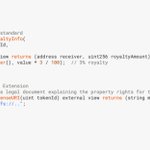
Legally speaking, NFT creators really have no right to demand Opensea or other marketplaces to respect NFT royalties, because there's nothing on the smart contract that says "respect royalty" to begin with.
The solution is to clearly express it onchain:
teapawt.org/skogard/status/1592913…


nft controlled nft

very cool. forked with a slight variation: how about guardianship based on time lock + NFT ownership👍
make the NFT non-transferrable for a fixed guardian.
otherwise, guardian is whoever holds the NFT.
gist.github.com/skogard/0751…

1
skøgard retweeted

New security module: "OwnedWithTimer".
Many contracts are governed by an "owner", like a wallet or distributed, via DAO or multisig.
They might lose keys though. This is bad.
So, having timer allow new owners into role makes sense to avoid deadlocks👍:
gist.github.com/z0r0z/1d6737…


The main point I'm making with Ricardian extension standard is, currently there's nothing to comply to because nobody expressed anything to begin with, just like public domain open source code.
Therefore marketplaces are not breaching anything.
This quoted post is unavailable.
If a marketplace disagrees with a licensing model of a certain NFT contract, they can simply decide not to list it, making this market driven instead of centralization.
And all of this can be automated onchain because licenseURI() is an onchain method.
teapawt.org/skogard/status/1592913…
Here's the proposal. Please check it out and share feedback!
ethereum-magicians.org/t/eip…

the core assumption of crypto is that the underlying algo (ECDSA, Ed25519, etc) won't break.
but with all the progress being made in AI, i wonder if some clever AI scheme can break everything overnight.
cryptocurrency, nfts, blockchains, digital signature, everything.
1
4
the biggest hypothetical threat until now has been quantum computing.
but might even be able to achieve without it.
of course, if combined with quantum computing could result in much more unexpected results.
1
1
[Update] people have asked if this can be done by simply adding an additional attribute to the offchain NFT metadata (without adding an additional onchain interface). I thought about it too. But I think an onchain interface is needed. Thread: teapawt.org/skogard/status/1591459…
This can happen in the NFT industry without any repercussion only because the royalty standard has no enforceability. Technically nobody is breaching anything.
The solution is to make it enforceable by explicitly stating the license. Simple as that.
teapawt.org/skogard/status/1591187…
Not a fan of this whole NFT royalty situation.
And I believe there's a better way to do this that's 100% creator-centric, way more decentralized, and solves the prisoner's dilemma problem among NFT marketplaces. Win-Win for everyone.
Just published: Ricardian NFT Royalty.

2
For this to work at scale, it should be automatable, meaning ANY smart contract or a business should be able to easily integrate.
So, does including the license in the metadata suffice this condition?

This means, smart contracts (including automated marketplace contracts) can write an automated listing logic that only lists items whose licenseURI() is a known model that they agree with.
1
