

Publishing The Evening Sky Map since January 2000. A free, easy-to-use 2-page monthly all-sky map & sky calendar of celestial events for sky watchers worldwide.
- Tweets5.1K
- Following185
- Followers10.9K
- Likes670






ALT A detailed telescopic photograph of the Full Moon against a black background. The image exhibits a range of gray tones that emphasize its craters, plains, and other surface features. The image was taken with a Sky-Watcher Maksutov-Newtonian telescope described at: skymaps.com/ir2/ Image Credit: Kym Thalassoudis

ALT A simulated image of the Moon showing its appearance at this time. Credit: NASA.

ALT A telescopic image of Mars appearing like a bright red-orange hued "star" near a loose collection of scattered white stars which are the open star cluster known as the Beehive or Messier 44. Photo taken 2nd May 2025. Credit: Kym Thalassoudis

ALT The Evening Sky Map is a circular all-sky star chart showing constellations, the Milky Way, planets, horizon directions and deep-sky objects depicted by symbols with an accompanying legend, plus a left-column sky calendar listing lunar and planetary events and viewing times.


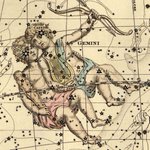
ALT Antique star chart of the Gemini constellation portraying the mythic twins Castor and Pollux aligned with labeled stars and a grid, one twin holding a lyre and the other a bow, with the name "GEMINI" visible. Source: Plate 15 (Gemini), A Celestial Atlas, Alexander Jamieson (1822)

ALT Lunar face split by a sharp terminator down the center, revealing detailed craters, bright ray systems and dark basaltic maria on the sunlit left side and deep shadowed surface textures on the right. Image source: NASA.

ALT A simulated image of the Moon created by NASA. The image shows the waning gibbous Moon as it will appear at perigee (closest to Earth) on 1 October 2026. The lunar surface shows a sharp day-night terminator with detailed craters, dark mare plains, and bright impact rays across the Moon’s near side.

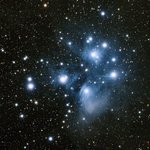
ALT A telescopic photograph of the Pleiades star cluster showing many bright white stars with light blue coloured patches of nebulosity surrounding the brighter stars. Credit: Kym Thalassoudis

ALT The Evening Sky Map is a circular all-sky star chart showing constellations, the Milky Way, planets, horizon directions and deep-sky objects depicted by symbols with an accompanying legend, plus a left-column sky calendar listing lunar and planetary events and viewing times.

ALT A detailed telescopic photograph of the Full Moon against a black background. The image exhibits a range of gray tones that emphasize its craters, plains, and other surface features. The image was taken with a Sky-Watcher Maksutov-Newtonian telescope described at: skymaps.com/ir2/ Image Credit: Kym Thalassoudis

ALT Close-up of the Moon showing its lit upper hemisphere and shadowed lower limb, highlighting large craters, dark lunar maria, and textured cratered terrain along the terminator.