

An independent human rights organization founded in June 2011, documents HR violations in Syria, supporting the transition towards democracy [email protected]
The Hague, Netherlands
Joined October 2012
- Tweets43K
- Following78
- Followers74.1K
- Likes1.8K
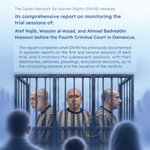



The Comprehensive Report on Monitoring the Trial Sessions of Atef Najib, Wassim al-Assad, and Ahmad Badreddin Hassoun before the Fourth Criminal Court in Damascus
The Syrian Network for Human Rights (SNHR) has released a comprehensive report monitoring the trial proceedings of Atef Najib, Wassim Badie al-Assad, and Ahmad Badreddin Hassoun before the Fourth Criminal Court in Damascus.
The report documents the proceedings from the third session through the conclusion of each trial, examining witness testimonies, defense submissions, legal arguments, and judicial decisions.
The three trials represent an important step toward judicial accountability in Syria. However, SNHR emphasizes that the transition from documentation to judicial proceedings does not, in itself, establish criminal responsibility. The process must be accompanied by continued judicial oversight, transparency, and respect for fair trial guarantees.
SNHR also stresses that transitional justice must extend beyond criminal convictions to include truth-seeking, protecting victims’ rights, clarifying the fate of missing persons, and ensuring reparations and effective remedies for victims and their families.
The report further recommends expanding accountability to cover all individuals responsible for violations based on individual criminal responsibility and available evidence, while safeguarding the rights of all defendants and ensuring that transitional justice does not become a framework for collective responsibility.
Read the full report: snhr.org/?p=78922
#SNHR #Syria


The Syrian Network for Human Rights (SNHR) released today a comprehensive report on the trials of Atef Najib, Wassim Badie al-Assad, and Ahmad Badreddin Hassoun before the Fourth Criminal Court in Damascus. The report covers the course of the three trials, starting from the third session of each trial up to the issuance of the verdicts on August 11, 18, and 24, 2026, respectively. The court sentenced Najib and al-Assad to death, and Hassoun to life imprisonment. The three verdicts were issued in the presence of the accused, and they remain subject to appeal before the Court of Cassation. SNHR documented a number of procedural guarantees during the sessions it monitored; it also observed issues that call for further scrutiny, related to the publicity of the sessions, the timing of enabling the defense to access the technical expert report, and the guarantees associated with the measures of concealing the identity of witnesses.
This report comes as a continuation of the previous reports of SNHR, which addressed the first and second sessions of each trial, and which were published on July 19, August 26, and September 22, 2026. The report distinguishes between four categories of information: the facts observed by the team of SNHR assigned to monitor the trials; the allegations presented by the Public Prosecution, the civil claimants, and the witnesses; the pleas raised by the defense; and the findings reached by the court in its verdicts. SNHR stresses that it does not undertake to adjudicate the criminal responsibility of the accused, and that its presentation of the verdicts issued does not mean that it adopts the assessment of the court of the evidence, its legal classification of the acts, or the penalties it imposed.
View the full report: snhr.org/?p=78922
#SNHR #Syria

SNHR Condemns the Killing of a Civilian with Disabilities by the Gunfire of the Israeli Occupation Forces during a Ground Incursion in Daraa Governorate.
SNHR Documents the Deployment of Snipers on the Rooftops of Residential Homes in Jamla Village for the First Time since the Fall of the Assad Regime, and Calls for an Independent Investigation and the Accountability of Those Responsible
The Syrian Network for Human Rights (SNHR) condemns the killing of the civilian Moaz Salama al-Bair, from Jamla village in the western suburbs of Daraa governorate, a person with disabilities who had Down syndrome, after he was shot by the Israeli forces during a ground incursion that they carried out in the village on Thursday, October 22, 2026.
SNHR stresses that the information it has documented regarding the incident raises serious concerns that a violation of the right to life has occurred, and therefore necessitates an independent and effective investigation in order to determine the circumstances of the use of lethal force and its lawfulness, and to ensure the accountability of those responsible for any violations that are proven to have been committed.
SNHR also condemns the continuation of the Israeli military incursions into Syrian territory, and warns of the additional risks resulting from the deployment of snipers on the rooftops of residential homes during the same incursion, which is a new development within the pattern of operations that SNHR has monitored since the fall of the regime of Bashar al-Assad on December 8, 2024.
Read the full statement: snhr.org/?p=78913
#Israeli
#SNHR #Syria

Two children, Muhammad and Sanaa al-Latif, were killed by the explosion of a remnant of the conflict in the village of Kafr Nasij, in the countryside of #Daraa Governorate, on October 21, 2026.
Details: news.snhr.org/?p=157439
#SNHR #Syria

Daily Report on Civilian Casualties in Syria On October 22-23, 2026
Details: news.snhr.org/?p=157432
#SNHR #Syria

Daily Report on Civilian Casualties in Syria On October 20, 2026
Details: news.snhr.org/?p=157413
#SNHR #Syria

Documentation of the killing of four Road Security personnel by unidentified gunmen on the Salamiyah–Athriyah road in the #Hama countryside on October 13, 2026.
Details: news.snhr.org/?p=157405
#SNHR #Syria

.@FADELABDULGHANY , Executive Director of the Syrian Network for Human Rights, wrote an opinion piece for the website @alaraby_ar , titled: Mezzeh Military Airport… Investigate Before You Build
n September 23, the General Authority of Civil Aviation and Air Transport announced the start of preliminary rehabilitation works at the Mezzeh Military Airport in #Damascus, with the aim of reclassifying it as a civilian facility of limited use for private and executive aviation. However, the problem is that the airport also houses the Investigation Branch of the Air Force Intelligence Directorate. Some of the works planned for implementation, including demolition, rubble removal, excavation, and land leveling, may bring about changes that cannot be reversed or whose effects cannot be remedied. Therefore, the essential issue relates to the sequencing of steps, as the site may still contain information and evidence connected to detention, disappearance, and death, in addition to the unresolved rights of the owners of the lands on which the airport was built. The question, thus, is whether this information and evidence will be documented and verified before the features of the land and the buildings are altered, or whether they will only be searched for after such changes have taken place.
The Syrian Network for Human Rights (#SNHR) has documented the use of the branch in operations of arrest, detention, interrogation, torture, and enforced disappearance from 2011 to 2024 under the Assad regime. This includes thousands of arrests that ended with the detainees being held in the branch or transferred to it. For varying periods, the detainees were denied access to a lawyer, contact with their relatives, and the possibility of appearing before a judicial authority. In documented cases, the authorities concealed the place of detention of the person, or denied that he or she had been detained at all.
The deaths connected to the branch require two separate tracks of investigation. The first relates to deaths in custody which occurred in the context of torture, ill-treatment, and the conditions of detention. As for the second, it relates to executions. There is information and testimony confirming that death sentences issued by the military field courts were carried out secretly at specific locations inside the airport compound. These also indicate that the bodies were transferred without the families being informed of the fate of their loved ones or of the place of their burial.
Read the full article at the following link: snhr.org/?p=78868

Daily Report on Civilian Casualties in Syria On October 14, 2026
Details: news.snhr.org/?p=157398
#SNHR #Syria

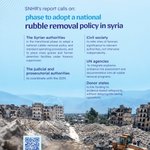
SNHR's report calls on:
• The Syrian authorities in the transitional phase to adopt a national rubble removal policy and standard operating procedures, and to place mass graves and former detention facilities under forensic supervision
• The judicial and prosecutorial authorities to coordinate with the IIIM
• Civil society to refer sites of forensic significance to relevant authorities, not intervene independently
• UN agencies to integrate explosive ordnance risk assessment and documentation into all rubble removal programs
• Donor states to link funding to evidence-based safeguards, without delaying life-saving operations
View the full report: snhr.org/?p=78857
#Syria

.@FADELABDULGHANY , the Executive Director of SNHR, said: “The manner in which the rubble is removed in Syria will affect what the investigators, the prosecutors, and the families of the missing will be able to prove regarding the violations committed since 2011. Over more than fourteen years of documentation, we have learned that removal carried out without proportionate documentation may lead, irreversibly, to the destruction or contamination of evidence, even though that evidence could have contributed to uncovering the truth, identification, and achieving accountability.”
View the full report: snhr.org/?p=78857
#Syria

According to SNHR's report, the failure to adopt an evidence-based approach to rubble removal generates tangible risks:
• The loss of evidence needed for accountability
• Families permanently losing the opportunity to identify and bury their dead, and to know the fate of the disappeared
• Weakened guarantees of non-recurrence
• A direct danger to workers, residents, and returning displaced persons
• The erosion of public trust in the transitional institutions
View the full report: snhr.org/?p=78857
#Syria

SNHR's report calls for classifying the sites into five categories before any removal: emergency life-saving extraction; urgent removal for reasons of public safety; planned removal in the context of reconstruction; sites suspected of containing evidence of international crimes; and sites that contain, or are suspected of containing, human remains or explosive ordnance.
Before any non-emergency mechanical removal, a minimum of documentation measures should apply: identifying the site, explosive ordnance risk assessment, visual recording, preserving evidentiary materials, identifying witnesses, and chain-of-custody records.
View the full report: snhr.org/?p=78857
#Syria

The report proposes the principle of evidence-aware removal: the decisions on where, when, and how the rubble is removed should be evidence-based, grounded in risk assessment, and accompanied by adequate documentation. This is not a blanket prohibition; where delay poses a genuine danger to lives, the priority must be the protection of life and safety.
It also proposes a balancing test built on five variables: the immediate danger to life, explosive ordnance contamination, the presence of human remains, the likelihood of evidence of serious international crimes, and the availability of trained personnel.
View the full report: snhr.org/?p=78857
#Syria

SNHR's report finds that there is no single rule in international law that imposes a general and absolute duty to preserve rubble. The framework is a composite one, and it is built on:
• International humanitarian law (Articles 48 and 57 of Additional Protocol I; Rules 112, 113, 115, 116, and 158 of customary IHL)
• International human rights law (the Minnesota Protocol)
• International criminal law (the ICC Elements of Crimes)
• Mine action standards (UNMAS/GICHD TNMA 10.10/03; the UNDP 2026 guidance)
View the full report: snhr.org/?p=78857
#Syria

The rubble is not merely debris bearing witness to the war. According to SNHR's report, it may conceal:
• Human remains
• Explosive remnants of war and improvised explosive devices
• Munition fragments, points of impact, collapse patterns, and the direction of the blast
As for the former detention facilities, security sites, and burial sites, the rubble there may retain evidence of enforced disappearance, torture, and extrajudicial execution.
View the full report: snhr.org/?p=78857
#Syria

New report by the Syrian Network for Human Rights (SNHR): “Removing the Rubble Without Erasing the Evidence: Human Rights and Legal Guidelines for the Management of Rubble Removal in the Transitional Phase in Syria.”
Since 2011, enormous quantities of rubble have accumulated in the Syrian cities, towns, and villages, resulting mainly from the aerial and artillery bombardment, and the main perpetrator of the destruction is the Assad regime. The operational decisions taken in the first months of rubble removal will largely determine what remains available for the truth and accountability.
View the full report: snhr.org/?p=78857
#Syria #SNHR

Removing the Rubble Without Erasing the Evidence
Human Rights and Legal Guidelines for the Management of Rubble Removal in the Transitional Phase in #Syria
The Syrian Network for Human Rights (#SNHR) released a report today, entitled “Removing the Rubble Without Erasing the Evidence: Human Rights and Legal Guidelines for the Management of Rubble Removal in the Transitional Phase in Syria.” The report concluded that the rubble which has accumulated in the Syrian cities, towns, and villages since 2011 resulted mainly from the aerial and artillery bombardment, and it identified the Assad regime as the main perpetrator of the destruction and demolition. The report considers that the operational decisions taken in the rubble removal operations will largely determine the nature of the information that will remain available to the investigators, the public prosecutions, the mechanisms for searching for the missing, the families of the victims, and the affected communities.
The report indicates that the rubble may conceal human remains, explosive remnants of war, and improvised explosive devices; that the debris at the sites of attacks may retain munition fragments, points of impact, collapse patterns, and the direction of the blast; and that the rubble at the detention facilities, the former security sites, and the burial sites may contain evidence relating to enforced disappearance, torture, and extrajudicial execution.
View the full report: snhr.org/?p=78857

#SNHR calls on the Israeli forces to:
• Immediately stop the incursions and withdraw the newly established military posts and positions, including the presence inside the separation zone
• Immediately release those arbitrarily detained and reveal the fate of those whose fate remains unknown
• Open independent and effective investigations into the incidents that resulted in civilian casualties
SNHR also calls on the States Parties to the Geneva Conventions to fulfill their obligation to ensure respect for the Conventions, and to support accountability for the gross violations.
#Syria
Full report: snhr.org/?p=78843

Fadel Abdulghany, #SNHR Director:
"Israel may not invoke security concerns to justify imposing military facts inside the territory of another state or bypassing the rules of international law. Protecting security is not achieved by violating the sovereignty of states, nor by expanding occupation, nor by exposing civilians to danger."
#Syria
Full report: snhr.org/?p=78843
