
Blockchain technology researcher. Web3 practitioner. AI platform veteran. AGI passionate. Co-founder & CTO @0G_labs
Joined May 2015
- Tweets1.3K
- Following271
- Followers54.7K
- Likes229




Ming Wu (Ø,G) retweeted

Half a trillion tokens. 🔥
All through 0G Private Computer.
Prompts we keep: zero.
pc.0g.ai/stats

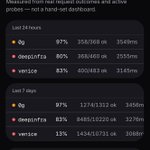
The token counter on pc.0g.ai/stats is sweating.
12.3B tokens yesterday, our biggest day in 90 days. @MiniMax_AI M3.1 Flash went free and the agents went feral.
0.5T today at this rate. 🚀

PC @0G_labs integration is now live at infero.xyz/status
The uptime is so good!

Ming Wu (Ø,G) retweeted

Post my speech and mou signing at 0g dev day. Thanks to @kiathowsg, dr Maliki, dr Chang, esteemed ambassadors, our academic partners, community members, builders, 0g team members, and more for coming!
Historic event for @0G_labs !


Ming Wu (Ø,G) retweeted
Introducing Compute Finance (ComFi).
A financial layer for AI where digital assets don't just sit idle. They can pay for AI compute you actually use, in 0G Private Computer (100+ models) and the 0G App.
Ascend is live. Infinite AI is scheduled for Sept 29.

Ming Wu (Ø,G) retweeted

Every possibility starts somewhere.
Ours starts with 0G.
Ascend takes its first form on @0G_labs - $a0G liquidity is now live on @BondSuperApp_ and @zia_finance.
The first form. The beginning of something bigger.
Get ready for Full Form.
🅰️scend it.
Ming Wu (Ø,G) retweeted

We rebuilt the 0G public RPC. Now geo-routed across 7 regions with HTTP/2 and WSS.
eth_call latency:
São Paulo 290ms → 24ms
Frankfurt 248ms → 26ms
Sydney 231ms → 34ms
London 252ms → 40ms
Singapore 76ms → 19ms
A typical dapp page load from Europe went from 2.4s to 0.3s.

I think there’s another way to attack this problem: make agents accountable by default.
If every autonomous agent has a persistent, verifiable Agentic ID, its actions can be attributed, its history and reputation tracked, and misbehavior punished.
Identity → traceability → reputation → liability.
An agent that causes harm shouldn’t be able to simply disappear and respawn with a clean slate.
This is exactly why we’re building Agentic ID at @0G_labs : an identity and accountability layer for the agent economy.
As agents become more autonomous, verification alone won’t scale. Accountability has to become infrastructure.

Ming Wu (Ø,G) retweeted
Your RAG stack just lost a dependency.
Until today, 0G Private Computer covered chat, vision and code models. Embeddings were the missing call that kept a second provider around. Not anymore: same OpenAI-compatible API, same Router balance.
Embed and infer in one place.

The visual information is definitely important for AGI. But visual information alone might not work. Human understanding the world physics by observing and math reasoning. And math is a kind of language. So the AGI should rely on some combined learning with both visual and language information.
And a lot of physics science discovery processes are not first observe then reason. Instead, oppositely, many of them first come from math reasoning and then design observing methods to validate.

Researchers argues OpenAI and Anthropic will never get us to AGI.
21 top researchers from Stanford, Oxford, DeepMind, CMU & Meta released a paper saying LLMs are a dead end.
It’s called “Visual General Intelligence”. And it completely flips how we look at artificial intelligence.
For years, the playbook has been simple: feed mountains of web text into a Transformer, scale up the parameters, and watch reasoning emerge.
GPT proved language can take you far.
But text is fundamentally limited. It’s a compressed, human-abstracted symbol system. It lacks physics. It lacks geometry. It lacks the raw, unadulterated reality of the physical world.
The paper argues that true general intelligence cannot be built on words alone.
It requires a vision-centered foundation.
Instead of starting with language and translating pixels into text, the next generation of models must start with raw visual experience, images, spatial geometry, and continuous video.
Think about how humans learn. A baby understands gravity, permanence, and spatial reasoning long before it ever learns to string a sentence together.
Vision isn't just an input modality.
It is the core operating system of physical reality.
When models learn natively from visual streams and video dynamics, they don't just memorize text patterns. They learn physics. They learn cause and effect. They build a true internal model of the world.

Ming Wu (Ø,G) retweeted

CYPHER‑ASIA Summit | The Intelligent Crypto‑Finance Summit Concludes Successfully
What happens when traditional finance, crypto, AI and RWA are brought together around the same table?
Will next‑generation finance truly move on‑chain?
One shift is crystal‑clear behind these discussions:
In the past, crypto sought access to traditional‑finance systems. Today, traditional‑finance players are exploring how to bring real‑world assets, payments and financial services onto the blockchain.
As technology, capital, assets and regulation gradually interconnect, crypto is evolving beyond a pure trading marketplace into a broader digital‑financial infrastructure.
This may well be the next phase that truly matters for intelligent crypto‑finance.
Organizers: @FosunWealthHK @FinChain_EN @MEeventHK @feixiaohaocom, Accelerator
Speakers & Participating Organizations: @kucoincom @SunnyFengHan @NanoLabsLtd @JackClawAI @Solana_Company @exSatNetwork @_BitfireGroup @animocabrands @SlowMist_Team @0G_labs @monad @kamino
Wonderful to see such adoptions!
Agents that rewrite their own prompts mid-task still need one thing that never changes: who they are.
@PrimeIntellect's Prime Agent is the third framework to plug into 0G Agentic ID, joining OpenClaw and Hermes. Live on 0G testnet.

I increasingly think recursive self-improvement could challenge the current RL-centric paradigm.
RL improves a model by using rewards and gradient descent to update parameters. RSI can work at a higher level: use reasoning to explore possible solutions, critique failures, select better strategies, generate higher-quality trajectories, and then distill them back into the model through SFT or other updates.
The key difference is exploration.
Traditional RL often explores through large-scale sampling and trial and error. Reasoning can make exploration far more directed: analyze why an attempt failed, eliminate large parts of the search space, form new hypotheses, and choose the next experiment more intelligently.
This could greatly improve exploration efficiency and expand the range of problems that learning systems can handle, especially in domains where rewards are sparse, delayed, difficult to specify, or impossible to automate.
In that sense, future AI learning may look less like blind policy optimization and more like human learning:
reason → hypothesize → test → reflect → retain the useful insight.
RL may not disappear, but its role could change. Instead of being the main mechanism for discovering better strategies, it may become the mechanism that compresses and internalizes discoveries made through reasoning, search, memory, and verification.
The biggest moat in AI is quietly shifting.
A year ago, users accepted giving their data to OpenAI or Anthropic because the performance gap was overwhelming.
Today, that tradeoff is disappearing.
Open-source models have become good enough for an enormous number of applications.
Once intelligence becomes a commodity, privacy becomes the premium.
This is why confidential AI—running open models with verifiable privacy guarantees—is about to become one of the most important infrastructure layers in AI. This is where @0G_labs stands out.
The next AI race won’t just be about building smarter models.
It’ll be about building AI people can actually trust.
Happy we are always building wonderful stuffs and leading the right direction.

For the first time, an agent truly owns itself — complete, independent, verifiable.
And for the first time, it can truly be traded: not a shell, but a running individual with its memory and reputation history intact.
That's just the start. As reasoning matures, this same seal is the trust layer for fully autonomous agents.
New SDK opening to external teams soon 🤖🤖🤖
🫡🫡🫡 @michaelh_0g @spark_ren

Ming Wu (Ø,G) retweeted
The free MiniMax M3 window wrapped up today, but the offer with @MiniMax_AI continues.
M3 stays on 0G Private Computer at 55% off, for now.
A top-tier open-weight model, at less than half the cost.

ALT 0G x MiniMax poster: MiniMax M3 now 55% off on 0G Private Computer.
It's live. MiniMax M3 is now 100% free on 0G Private Computer.
The #1 open-weight model, zero cost for the next 3 days.
Try it now: pc.0g.ai/models/minimax-m3


Ming Wu (Ø,G) retweeted

0G Private Computer Complete User Guide 🚀
💎Step 1: Get 0G Token (on-chain balance)
💎Step 2: Overall Navigation Structure
💎Step 3: Understand the Two Modes (Router Mode VS Advanced Mode )
💎Step 4: Models Page — Explore Available Models
💎Step 5: Playground — Use AI Directly in the Browser (For Users)
💎Step 6: Stats Page — Real-Time Network Data
💎Step 7: Dashboard — Account Management Center
💎Step 8: How to Use the API (For Developer )
💎Step 9: Complete Fund Flow — 0G Private Computer Token/Money Flow (Advanced)
Bonus:MiniMax M3 is now 100% free on 0G Private Computer. verifiable on-chain inference at zero cost !!!
Complete Guide 👇 @0G_labs @0g_CN
notion.so/0g-labs/0G-Private…
Ming Wu (Ø,G) retweeted
It's live. MiniMax M3 is now 100% free on 0G Private Computer.
The #1 open-weight model, zero cost for the next 3 days.
Try it now: pc.0g.ai/models/minimax-m3
To celebrate, we’re launching a 3-day global campaign:
🌟 100% FREE access to MiniMax M3 on 0G Compute
📅 June 15-18 (12:00 UTC)
💰 $0 cost (just 1 $0G in your account to verify you’re a real user)
🚀 Register in advance, M3 goes free on June 15: pc.0g.ai/models

ALT Campaign poster: free MiniMax M3 on 0G Private Computer, June 15-18.