

Historian | Abraham Lincoln, the Civil War Era & Illinois history | Good history, carefully researched, honestly told.
Springfield, IL
Joined April 2009
- Tweets2.2K
- Following706
- Followers881
- Likes3.5K


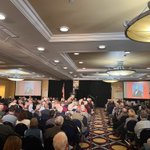




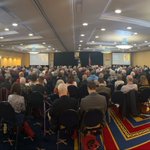
“Lincoln’s Constitution,” @TheLincolnForum turned into a spirited discussion about the fugitive slave act, confiscation acts, the timing and process of emancipation, public perception, and much more featuring Edna Greene Medford, Lucas Morel @LincolnDouglass, James Oakes, Walter Stahr @wbstahr and Jonathan White @CivilWarJon. Don’t miss it on @cspanhistory

Kevin Levin talks about his new biography of Robert Gould Shaw at the 31st annual @TheLincolnForum Symposium.


James Oakes begins the final day of @TheLincolnForum Symposium by asking, “Was the Emancipation Proclamation Illegal?”

Last night ended @TheLincolnForum with an amazing performance by the great Sam Waterston. Harold Holzer got him to recite some of Shakespeare and Abraham Lincoln’s most memorable passages. He received the Forum’s prestigious Lincoln in Film award.


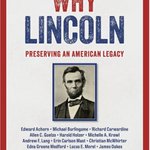
Large panel about a new book of essays @TheLincolnForum called “Why Lincoln?” Harold Holzer, Michelle Krowl, Andrew F. Lang, Christian McWhirter, Erin Carlson Mast, and @CivilWarJon discuss what got them interested in studying the 16th president.


Packed room to hear @JoshuaClaybourn talk about his new book, Lincoln’s Compass: The Declaration of Independence and the American Idea, at the 31st annual Lincoln Forum Symposium @TheLincolnForum in Gettysburg.


First night of the @TheLincolnForum was a success. Excellent talk by Matthew Pinsker @House_Divided. Just before he delivered his talk, the Lincoln Forum announced his new book, Boss Lincoln: The Partisan Life of Abraham Lincoln, received the organization’s prestigious book of the year award. Congratulations Matt!


For more than 160 years, the personal belongings of Civil War veteran Lt. Jacob T. Zug have remained together. But now that collection is at risk of being broken up. Help the Pennsylvania Reserve Volunteer Corps Historical Society preserve it.
gofundme.com/f/zug-collectio…

Historian Richard Carwardine will deliver the 2026 Lincoln Prize Lecture tonight on his award-winning book, Righteous Strife: How Warring Religious Nationalists Forged Lincoln's Union.
The event is being held at the American Civil War Museum in Richmond, Virginia and will be livestreamed. Follow the link below to register.
I've heard Carwardine speak and he is very good. It's a great chance to hear an award-winning Lincoln scholar discuss an important recent book--all from the comfort of your own home.
The livestream begins at 7 pm Eastern.
#LincolnInTheNews
acwm.org/event/2026-lincoln-…

They might not be producing pennies anymore, but Abraham Lincoln isn't disappearing from our pocket change.
On October 21, the US Mint will release a new Gettysburg Address quarter for America's 250th anniversary.
Lincoln will be on the front and the back will feature a line from the Gettysburg Address.
#LincolnToday

On this day in 1818, Nancy Hanks Lincoln died of milk sickness in southern Indiana.
The disease was mysterious. Many settlers didn't know what caused the intense illness, but today we know it was caused by drinking milk from cows that grazed on poisonous white snakeroot.
Abraham Lincoln was just nine years old when he lost his mother.
Biographers have offered a number of interpretations of what her death meant for Lincoln. Whatever its influence, it was one of the earliest profound losses he experienced.
#LincolnToday

ALT Nancy Hanks Lincoln grave, wikipedia
Today in 1886, St. John’s College of Nursing was founded in Springfield, Illinois.
It began as a training school for religious sisters at St. John’s Hospital. Today, it is the oldest Catholic-based school of nursing in the country.
#illinoisHistory
#Nursing
#NursingHistory
hshs.org/st-johns-college

ALT St. John’s College of Nursing, Springfield, Illinois
Looking for Lincoln’s Journey to Freedom: Illinois’ Underground Railroad exhibit opens inside Alton’s City Hall tomorrow.
I was fortunate to serve as one of the advisors as the exhibit was developed, and I think it turned out great.
The story of slavery and freedom in Illinois is complicated— and the Illinois Supreme Court played a big part in the eventual destruction of slavery in the state.
If you’re in Alton, go see the exhibit and take in some of the related programming.
While you’re there, go to Alton Cemetery and pay your respects to Elijah Lovejoy.
illinoisugrr.org/alton-city-…


Abraham Lincoln was in the middle of the 1860 presidential campaign when a traveling soap salesman came to Springfield.
“Professor” Daniel P. Gardner arrived in town on September 27 and checked into the Chenery House. The local newspapers described him as a lecturer, wit, and salesman who drew huge crowds by mixing humor, poetry, and soap demonstrations.
The day after he arrived, Gardner demonstrated his product in front of the Chenery House before a large crowd. One Springfield newspaper claimed that more than a thousand people watched his performance.
I don’t know if that number was accurate, but a couple of faces in the crowd are interesting.
It seems possible that one or both of the Lincolns were in attendance.
Gardner liked collecting testimonials about his product from prominent people.
On September 28, 1860, the same day the soap demonstration took place, Abraham Lincoln gave him a testimonial of sorts:
“Some specimens of your Soap have been used at our house and Mrs. L. declares it is a superb article. She at the same time, protests that I have never given sufficient attention to the ‘soap question’ to be a competent judge.
Yours truly,
A. LINCOLN”
Gardner wanted an endorsement. Lincoln gave him one, along with a disclaimer.
Gardner collected these endorsements and published them in a book in 1870.
See: Collected Works, 4:122-23
#LincolnToday
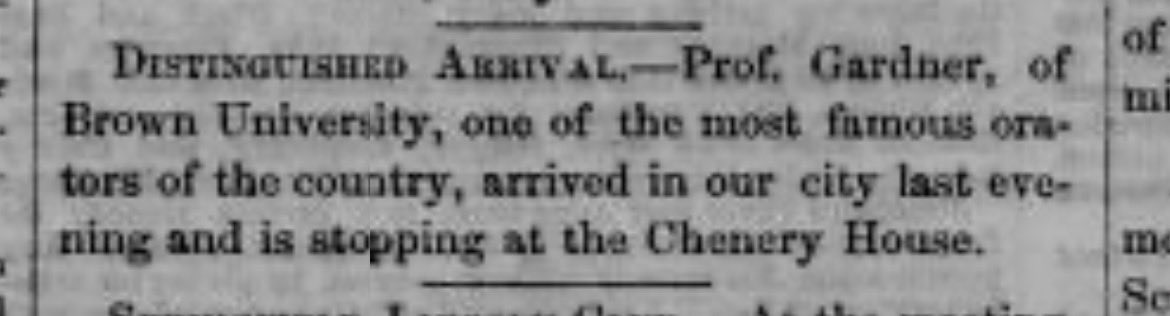
ALT Daily State Journal [Springfield, IL], September 28, 1860

ALT Daily State Register [Springfield, IL], September 29, 1860

ALT Daily State Journal [Springfield, IL], September 29, 1860
Many thanks to @roadscholarorg and @LincolnLand for organizing last week's Road Scholar program.
Several times each year a few dozen lifelong learners from around the world spend a week in Springfield examining "Abraham Lincoln's Life & Legacy."
I opened the program last Monday by talking with them about Lincoln's world, his political evolution, and his family.
Over the next few days, the group visited New Salem, the Lincoln Home, the Lincoln Tomb, and the Abraham Lincoln Presidential Museum, while hearing from a variety of historians, museum professionals, and historical presenters.
I joined them again on Friday to talk about Lincoln's assassination, Reconstruction, and his legacy.
As usual, it was a terrific group--curious, thoughtful, and full of questions.
I kept my own comments mostly in the nineteenth century, but more than one participant had thoughts about Lincoln's relevance to our own political moment.
A good week of history in Springfield.

Abraham Lincoln's cut signature from an actual historic document will soon be featured on a baseball card.
It's part of Topps' 2026 Allen & Ginter set, which promises to include 51 one-of-one "Cut Signature" cards made from authentic autographs removed from other documents or materials. Just one card for each of the 51 historical figures will be printed.
Lincoln is in some remarkable company. Alexander Graham Bell, John Wayne, Babe Ruth, Jackie Robinson, and Winston Churchill will also get cards.
There is plenty of speculation about what a one-of-one Abraham Lincoln cut signature card might be worth.
But that isn't what interests me.
I want to know what document they cut Lincoln's signature from.
At first, I assumed it might be a military commission. Lincoln signed thousands of them during the Civil War, and because they were official documents, he generally signed his full name: "Abraham Lincoln."
But if the accompanying image in this article is accurate, that doesn't appear to be what Topps used.
Instead, it looks like one of the many small notes Lincoln wrote on cardstock during the Civil War for people who came to see him.
In this case, the surviving words suggest to me that someone approached Lincoln in 1863 with a request he could not grant himself, so Lincoln sent the person to Secretary of War Edwin Stanton with this note.
Many such notes survive today. They are scattered among private collections and public archives. I've seen dozens of them.
I hope Topps retained an image of the original document--and as much of the original story as possible.
Where did the note come from? Who sold it? Do they know who originally received the note from Lincoln? What was the person asking for? Did Stanton act on the request?
Those details matter.
A signature is collectible.
But the document around it can tell us a story about a real person whose life may have forever been changed as a result of the little note from Abraham Lincoln.
Uncovering that story can be important for history. It could also make the card WAY more valuable.
If @Topps and/or the person who pulls this card wants some help pulling together the story behind it, contact me. I'm happy to help.
Full article: hypebeast.com/2026/9/topps-1…
#LincolnOnCardboard
#LincolnInTheNews


By September 1860, Abraham Lincoln was all over the national news as the Republican nominee for president. In many stories, he was identified simply as a lawyer.
In the middle of the campaign, a young man in Pleasant Plains, Illinois wrote to Lincoln, asking if he had any advice for a young law student.
On this day in 1860, Lincoln took time to reply.
"The mode is very simple, though laborious, and tedious. It is only to get the books, and read, and study them carefully."
After naming the specific books the young man should study, Lincoln ended with this:
"Work, work, work, is the main thing."
Still pretty good advice.
#LincolnToday

ALT AL to John M. Brockman, September 25, 1860
Cardiss Collins made history in 1973 when she became the first African American woman elected from Illinois to the United States Congress.
She went on to serve twelve consecutive terms in the U.S. House.
Born on this date in 1931.
#HistoricIllinoisans

5
136
Elihu Washburne was a longtime member of Congress from Galena, Illinois, a political ally of Abraham Lincoln, and an early champion of a relatively unknown Galena resident named Ulysses S. Grant.
Washburne was born on this day in 1816.
#HistoricIllinoisans

ALT Elihu Washburne
Today in 1862, Abraham Lincoln issued the preliminary Emancipation Proclamation.
The document announced that a 100-day countdown had begun to January 1, 1863. If, on that date, a state or part of a state was still in rebellion, then "all persons held as slaves" within its borders "shall be then, thenceforward, and forever free."
But before Lincoln issued the document, he called his cabinet together.
Secretary of the Navy Gideon Welles was in the room, and his diary gives us a remarkable seat at the table.
Lincoln told the cabinet that the decision had already been made. He was willing to hear criticism of the wording, but he would not reconsider the policy itself. Welles remembered Lincoln saying "the act and the consequences were his."
Then Lincoln explained why he had finally decided to move forward.
When Lee's army invaded Maryland, Lincoln told the cabinet he made a "vow--a covenant." If God gave the Union victory in the coming battle, Lincoln would take it as an indication that he should move forward with emancipation.
The Battle of Antietam occurred on September 17. It became the "bloodiest day in American history." But in the end, Lee retreated back across the Potomac.
Five days later, Lincoln told his cabinet: "God has decided this question in favor of the slave."
Welles recorded that Lincoln's "mind was fixed--his decision made."
The president then read the proclamation aloud. Secretary of State Seward suggested a couple minor changes. Lincoln accepted them. The document was then given to Seward for publication.
Welles recorded that not everyone in the room agreed. Postmaster General Montgomery Blair warned that the proclamation might alienate the loyal border states and provide Lincoln's political opponents with "a club" they would use "to beat the administration."
Welles himself understood the magnitude of what was happening. He called emancipation "a step in the progress of the war which will extend into the distant future."
We know how it all turned out, but Welles and the others in the room did not.
#LincolnToday

ALT Emancipation Proclamation broadside, 1862