





Subbu retweeted

As part of its #PlatinumJubilee initiatives, IIT Kharagpur, in collaboration with @fermi_ai, co-founded by distinguished alumnus Peeyush Ranjan, is bringing a free, nation-scale AI Tutor for STEM education through #NDLI, supported by the Ministry of Education, Govt. of India.
Built to help learners think—not simply provide answers—the AI Tutor uses a nudge-and-hint approach to guide independent problem-solving.
The beta launch on 30 September will make it accessible to learners across India via NDLI.
🔗 ndl.gov.in/
#IITKharagpur #AITutor #AIForEducation
@EduMinOfIndia @NDLIndia @fermi_ai @Suman_iitkgp @peeyush

Subbu retweeted

Introducing ChatGPT for Dishwashing
GPT-6 achieves state-of-the-art results on dishwashing benchmarks for long-running jobs and difficult stains.
The Navier–Stokes Millennium Prize Problem is a $1 million challenge about whether the equations describing fluid motion can break down. In this video, I accidentally found a counter-example while trying to optimize my dishwasher. But in reality, OpenAI used 10,000 AI agents to find a proof in 88 hours: openai.com/index/navier-stok…
Parody of the original GPT-6 Astra ad
@OpenAI #ChatGPT_Partner #chatgpt
Credits:
Written and Directed by Joma
Co-Writer - Henry Connor Coan IV @coan_henry
Production by Dauntlus Studios @dauntlus.studios
Producer/Co-Director - Marcus Liew @dauntlus
Camera Operator - Amos Lee @amoselijahlee
Art Director - Alethea Soo @aletheasoo
Art Assistant - Alicia Lim @aliciatkl_
Assistant Editor - GPT-6 Astra
Music: Tensions Run High by Soundridemusic
youtube.com/watch?v=Ly9H63SL…
Subbu retweeted

A Chinese mathematician spent 7 years making sandwiches at Subway after his PhD, and at 58 solved a 150-year-old math problem nobody thought was solvable.
His name is Yitang Zhang. The problem is called the Twin Prime Conjecture.
He was born in Shanghai in 1955 and knew he wanted to spend his life on mathematics by the time he was nine years old. That year he found his own proof of the Pythagorean theorem. Nobody taught it to him. He just worked it out.
Then the Cultural Revolution arrived and took everything.
The Chinese government closed the schools. Zhang's father had political troubles with the Communist Party, so Zhang was sent to the countryside with his mother to work in the fields. He spent 10 years as a farm laborer. No high school. No classroom. No teacher.
He read math books in the fields when he could find them.
When the revolution ended, Zhang was 23. He sat the university entrance exam and got into Peking University, one of the most competitive mathematics programs in China. He finished his bachelor's degree, then a master's. The president of Peking University personally recommended him for a full scholarship at Purdue University in the United States.
He arrived at Purdue in 1985. He earned his PhD in 1991.
Then the second wall hit.
His relationship with his doctoral advisor collapsed. The advisor did not write him letters of recommendation. Without those letters, the academic job market was closed. Zhang applied. Nothing came back. He spent the years after his PhD working as an accountant, doing delivery work, sleeping in his car during the stretches when nothing else was available.
A friend eventually opened a Subway sandwich restaurant in Kentucky and offered him a job. Zhang took it. He kept the books and made sandwiches. A man with a PhD in mathematics from Purdue, working a Subway counter because the academic world had no place for him.
He did this for seven years.
He was finally hired as a lecturer at the University of New Hampshire in 1999. Not a professor. A lecturer. The lowest rung of the academic ladder, with no research funding, no graduate students, and no institutional support. He taught calculus to undergraduates and worked on mathematics alone in whatever time was left.
Most people would have stopped believing by then.
Zhang did not stop.
The Twin Prime Conjecture is one of the oldest unsolved problems in number theory. Twin primes are pairs of prime numbers separated by exactly two: 5 and 7, 17 and 19, 41 and 43. The conjecture predicts that these pairs never stop appearing no matter how far you go along the number line. Mathematicians had believed this for over 150 years. Nobody had been able to prove it.
The deeper version of the problem asks something slightly different. Not whether twin primes are infinite, but whether there is any finite gap between prime numbers that appears infinitely often. This is called the bounded gap problem. The best mathematicians in analytic number theory had been attacking it for decades. A landmark 2005 paper by three researchers came agonizingly close and still could not close it.
Zhang worked on it alone. No collaborators. No funding. No department seminars where he could road-test his ideas. He once said he would go to a friend's house and think in the garden for hours.
In 2012, during a visit to a friend's home in Colorado, something unlocked.
He submitted his paper to the Annals of Mathematics in April 2013. The Annals is the most prestigious mathematics journal in the world. Papers sit in review for months, sometimes years. The editors read Zhang's submission and immediately knew something was different. They sent it to the leading experts in analytic number theory for review.
It was accepted in three weeks.
The paper proved that there are infinitely many pairs of prime numbers separated by a gap of less than 70 million. Not two. Not the twin prime gap specifically. But a finite gap. For the first time in history, someone had proved that prime numbers keep coming back together, that the universe of numbers never lets them drift apart forever.
Peter Sarnak, one of the most respected mathematicians at the Institute for Advanced Study, said: "He is not a fellow who had done much before. Nobody knew him. His result was spectacular."
Zhang was 58 years old.
Within a year he had the MacArthur Fellowship, the Cole Prize, the Rolf Schock Prize, and a full professorship at UC Santa Barbara. The man who spent seven years at Subway was now one of the most celebrated mathematicians alive.
He said in an interview: "I was not lucky. Maybe it is more important for a person to make himself known to the public. But that was not so easy for me."
He was not complaining. He was just being precise.
The mathematics establishment has a quiet belief that great work happens young. The Fields Medal cuts off at 40. Most mathematicians who change the field do it in their thirties. Zhang proved his most important theorem at 58, after a decade of farm labor, seven years of sandwiches, and a decade of teaching calculus to freshmen with no one watching.
He did not beat the deadline.
He proved there was no deadline to beat.


Subbu retweeted

Happy to have played all the string layers in this song, “Phir Se”, for
#dhurandhar2therevenge. Thank you @shashwatology Sachdev bhaiya for the epic sounds and music, and hearty congratulations to you. Thank you @AdityaDharFilms sir 🙏🏾🤍. @arijitsingh bhaiya, you sound like a dream, as always. Such honest, pretension-less, gut wrenching singing ♥️🙏🏾.
#ramanabalachandhran #arijitsingh #dhurandhar2therevenge #shashwatsachdev
#adityadhar
youtu.be/Go4GQQRwEc8?si=2Z4j…


Subbu retweeted

Downtown #Toronto just experienced their snowiest day EVER, previous record stood for 82 years. Over half a metre of snow fell Sunday! ❄️#ONwx #ONStorm @weathernetwork


Subbu retweeted

Everyone should read this story:
One day, a Donkey and a Tiger got into an argument over the color of the grass.
“The grass is blue,” said the Donkey.
“That’s ridiculous,” replied the Tiger. “The grass is clearly green.”
When the argument grew more and more intense, they decided to find the Lion, King of the Jungle, to settle the debate.
When they approached the Lion, the Donkey exclaimed, “Your Highness, isn’t it true that the grass is blue?”
“Yes,” the Lion calmly answered, “The grass is blue.”
Not yet satisfied, the Donkey continued, “The Tiger disagrees and argues with me. You must punish him.”
The Lion nodded, “I will. The Tiger will be punished with a year of silence.”
The Donkey walked off into the jungle, celebrating his victory.
Before the Tiger turned to leave, he looked up at the Lion. “Your Highness, why have you punished me? After all, you must see the grass is clearly green.”
The Lion nodded, “Yes, of course the grass is green.”
“Then why am I being punished?” asked the Tiger.
“Because someone as wise as you should never waste time proving anything to a fool.”
Let’s call its lesson The Donkey Principle:
There will be times in your life when you’re drawn into a discussion with someone who has no capacity to act in good faith.
They have no intention of listening to your position or changing their mind.
They just want to argue.
In those moments, you can choose to opt out.
Stop justifying your position to people who show no willingness to hear it. Stop trying to create understanding with those who appear determined to misunderstand. Stop chasing rational outcomes with irrational opponents.
The older I get, the more I realize peace has a price. You buy it by saying no. No to drama. No to noise. No to arguments. Each no creates space for the yes that truly matters.
Actor Keanu Reeves said it best:
“I'm at the stage in life where I stay out of arguments. Even if you say 1+1=5, you're right. Have fun.”
We live in a modern world where social media makes it easier than ever to get pulled into pointless fights. No matter your views or beliefs, someone will make it their mission to drag you into the metaphorical mud.
Before you enter any debate, ask yourself two questions:
1. Does this person show a willingness to listen and change their mind?
2. What evidence would cause me to change mine?
The first question ensures good faith on their part. The second ensures it on yours.
As the old saying goes, “Never wrestle a pig in the mud. You both get dirty—but the pig will enjoy it.”
Perhaps this is all best summarized with one simple line:
If you argue with a fool, you become one.


Subbu retweeted
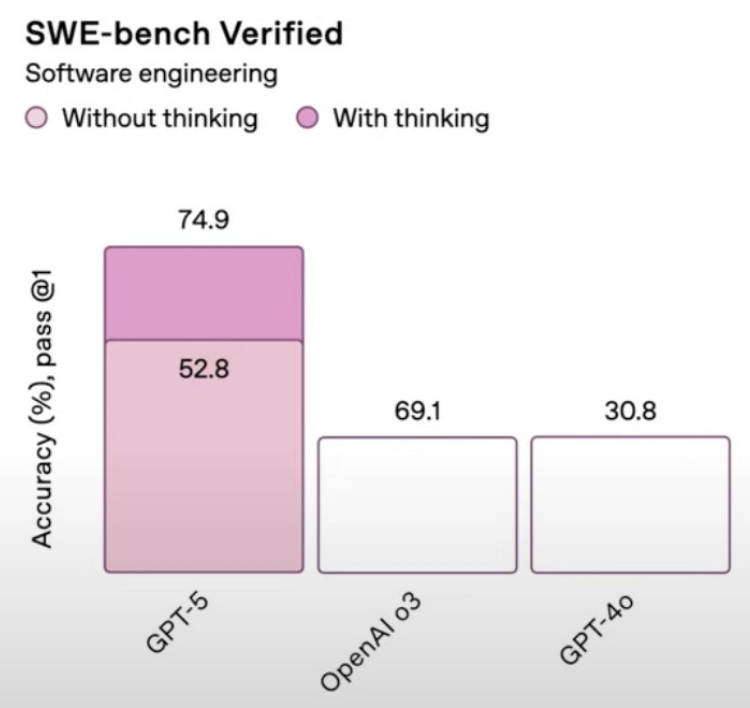
The GPT 5 launch included a chart showing 52.8 as a bigger number than 69.1, which in turn is shown as the same magnitude as 30.8.
Not quite ASI…


Subbu retweeted

My Mac was getting full, and the settings just said "system data"
So I searched a bit and I found a nice app that shows what takes space + visualises it
Result: I had 500GB in Adobe cache editing 💀
The app is Open Source and free, really good to do some cleanup. Name is Grand Perspectiv


Subbu retweeted

Meal on the Plane 🥲💕🙏🙏🥲💕
For our soldier brothers …
I was seated in my seat on the flight, heading to Delhi—a journey of around 6 hours. I planned to spend the time reading a good book and getting an hour of sleep.
Just before takeoff, around 10 soldiers came and sat around me, filling the nearby seats. Thinking it would be interesting, I asked the soldier next to me, “Where are you headed?”
“To Agra, sir! We have two weeks of training there, and then we’ll be sent on an operation,” he replied.
An hour passed. An announcement was made: “Lunch is available for purchase for those who wish to buy.”
I thought to myself—still a long way to go, maybe I should eat. I reached for my wallet to book my meal when I overheard a conversation.
“Shall we also get lunch?” one of the soldiers asked.
“No, it's too expensive here. Let’s eat at a regular hotel once we land,” another replied.
“Alright.”
I walked up to the flight attendant and said, “Please give lunch to all of them,” and paid for everyone’s meal.
Tears welled up in her eyes. “My younger brother is posted in Kargil, sir. It feels like you’re feeding him. Thank you,” she said, bowing in gratitude.
That moment touched me deeply.
I returned to my seat. Within half an hour, all of them received their lunch boxes.
After finishing my meal, I headed to the restroom at the back of the plane. An elderly gentleman came from a rear seat.
“I noticed everything. You deserve appreciation,” he said, extending his hand.
“I’d like to be part of your good deed,” he added, slipping a ₹500 note into my hand.
I came back to my seat. Half an hour later, the flight’s pilot walked over, scanning seat numbers until he found mine. He smiled and said, “I’d like to shake your hand.”
I unbuckled my seatbelt and stood up. As he shook my hand, he said, “I was once a fighter pilot. Back then, someone just like you bought me a meal. I never forgot that—it was a symbol of love. What you did brought back that memory.”
All the passengers clapped. I felt a little shy. I didn’t do it for praise—I simply did a good deed.
I walked a bit toward the front of the plane. A young man, about 18, shook my hand and slipped a note into my palm.
The journey came to an end.
As I waited near the door to exit, a man silently placed something in my pocket and walked off. Another note.
As I stepped out of the plane, the soldiers were all gathered in one place. I rushed over, pulled out all the notes fellow passengers had given me, and handed them to the soldiers.
“Use this for food or anything else before you reach your training site. What we give is nothing compared to the protection you provide us. Thank you for what you do for our nation. May God bless you and your families,” I said, eyes slightly wet.
Those ten soldiers were now carrying with them the love of an entire flight. As I got into my car, I silently prayed, “Lord, please watch over these brave souls who are ready to give their lives for this country.”
A soldier is like a blank cheque made payable to India, redeemable for any amount, up to and including their life.
So many still don’t understand their greatness.
Whether you share this or copy and paste—it’s up to you.
No matter how many times we read it, it always brings tears.
Read it. Pass it on.
Respecting the sons of Mother India is the same as respecting ourselves.
– Jai Hind

