Helping ambitious Founders and CEOs create meaningful Personal Brands on Twitter | Al & Web Dev Enthusiast | DM For Paid Promotion HIGGS-9520K
California, USA
Joined July 2026
- Tweets3.7K
- Following11
- Followers9.9K
- Likes2.1K


Sumaiya Rahman retweeted

Let's not turn this into blind listening tests are dead. Turing TTS is a blind listening test. The interesting change is who the model is compared with and what listeners are asked to decide.
🤝 Paid partnership

Drop 2/15
Are we actually measuring the things we ultimately want our voice AI models to achieve?
The best AI voices are becoming hard to tell apart.
From each other. Not from humans.
🚀 Introducing Turing TTS: an evaluation that measures how often human listeners mistake AI-generated speech for real human speech.
We tested leading TTS models against real human speech. Even the best model fooled listeners only ~10% of the time.
With Turing TTS, we hope to contribute to a broader discussion within the research community about how we measure progress in voice AI.
If one of our goals is to develop speech that is indistinguishable from human speech, how well do our current evaluation methods capture progress toward that goal?
We don’t claim that Turing TTS is the right way forward, or that human indistinguishability should be the goal of every TTS system.
Rather, we hope these findings encourage the community to collectively examine whether blind pairwise human evaluations of naturalness are sufficient, and what else we might need to measure.
Results are now live on @voicearena_ai.
Sumaiya Rahman retweeted
One thing that makes a product video easier to follow? Showing people exactly where to look. If you want to try this approach in your own content, CapCut Desktop Pro is 60% off and Ultra is 40% off through October 30!
Use arrows to direct attention, close-up shots to show the product clearly, and a STOP prompt to create a moment viewers won't scroll past. Then use Multi-Track Editing in CapCut PC to adjust each layer without having to treat the whole video as one piece.
It's a small change that can make your product presentation feel much more deliberate.
tinyurl.com/2v23rn22
#capcutpc #capcutmarketing #capcutblackfriday #capcutsale
🤝 Paid partnership
Sumaiya Rahman retweeted

When your product is so interesting that someone literally breaks in for it. 👀 Turn a wild concept into a scroll-stopping ad!
🔥 Dreamina’s first month costs just $0.29. From Oct 20–30, save 60% on CapCut Pro or 40% on CapCut Ultra on CapCut Desktop only.
Create your visuals with Dreamina, then edit in CapCut PC. Need more footage to show the whole break-in? Use CapCut PC‘s AI Extend to extend your video and give the action more room to unfold. 🎬
Each product requires a separate subscription to enjoy its respective offer.
CapCut Sale: tinyurl.com/2v23rn22
Dreamina + CapCut Offer: tinyurl.com/5xbtv4x6
#CapCutDidThat #Dreamina #Smallbusinessmarketing #CapCutSale
🤝 Paid partnership
Sumaiya Rahman retweeted

What if you could create a 15-second video in just 7 seconds? ⚡
Meet Pika H3 Flex — built for creators who don't just generate videos, but refine every detail until it's right.
With ultra-fast generation, precision editing, multi-modal references, and separate audio stems, Pika H3 Flex puts more creative control in your hands.
🎬 Generate 15-second videos in as little as 7 seconds.
🎧 Export up to 5 separate audio stems.
🎨 Create with up to 12 different references.
🚀 Enjoy faster workflows at up to 80% lower cost than H3 Max.
Less waiting. More experimenting. Greater creative freedom.
Pika H3 Flex isn't just about generating videos faster. It's about making creativity move at your speed.
@pika_labs
🤝 Paid partnership

Meet Pika H3 Flex, debuting today as the #1 open weight model on DesignArena’s t2v board.
It’s built for professional iteration, with exportable audio stems, resolutions up to 4k, and faster-than-realtime generation. It can produce a 15-second clip with soundtrack in as little as 7 seconds.
So, yeah. It’s kind of a flex 💅
Sumaiya Rahman retweeted

Introducing Cartesia Managed Agents: our end-to-end voice agent platform for enterprise.
#1 on @ArtificialAnlys Speech Agent Arena and @ServiceNow EVA-Bench, built by co-designing our voice models and harness as one system.
Check it out → cartesia.ai/blog/managed-age…
Sumaiya Rahman retweeted

Your OCR says it’s done—but did it get everything right? 🤔 In high-stakes workflows, even a small error can be costly.
🚀 Meet the MiniCPM-OCR suite: an open-source solution to parse fast and guard the results.
Two new models:
🔹 MiniCPM-OCR 1.0 — SOTA OCR performance and speed at 1B scale. Compact, accurate, and fast.
🔹 MiniCPM-OCR Jev — A 2B decision model that helps assess parsing accuracy, with performance approaching that of Qwen3.5-397B-A17B on JevOCRBench.
⚡ What’s new?
Small model, SOTA results: MiniCPM-OCR 1.0 scores 93.68 on Real5-OmniDocBench and 54.7 on OCRBench v2.
A sharp goalkeeper 🛡️: MiniCPM-OCR Jev is model-agnostic, checking text, formulas, and tables from different OCR parsers. It achieves 93.6 on JevOCRBench, outperforming JEV-35B-A3B (90.1) and approaching Qwen3.5-397B-A17B (93.8).
Up to 128 pages per minute 🤯: With DSpark, MiniCPM-OCR runs at 1.49× the speed of PaddleOCR-VL-1.6 and 3.62× that of MinerU2.5 Pro. The SDK’s concurrency optimizations further boost throughput to as much as 128 pages per minute.
Deploy where you work: Day-0 support for Arm, Houmo AI, Intel, and NVIDIA, plus 10 more chip vendors through FlagOS.
Ready for your stack: vLLM, SGLang, llama.cpp, and Ollama, with quantized models, fine-tuning support, and Agent Skills.
🔗 GitHub: github.com/OpenBMB/MiniCPM-O…
🤗 Hugging Face:
MiniCPM-OCR 1.0:huggingface.co/openbmb/MiniC…
MiniCPM-OCR Jev:huggingface.co/openbmb/MiniC…
👉 Try the Demo:platform.modelbest.ai/consol…
Use the API:platform.modelbest.ai/consol…


Sumaiya Rahman retweeted

Text-to-speech gets you close. But close isn’t how you’d say it.
So say it yourself, once. HeyGen Voice STS carries the whole performance over to your avatar, down to every pause, emphasis, and whisper.
Test it here: platform.heygen.com/speech-t…
Sumaiya Rahman retweeted
I asked Teamily Agent to research five AI video tools, and it built this comparison page. It's built around a real small business: a $100/month budget, product photos on hand, and Instagram & TikTok promo as the goal.
Then I pulled specialist agents into one group chat to work on it together, edited the page with Open Studio in Website Builder, and saved the whole thing as a Loop. I stay in as the human checkpoint before anything goes out, so I can change the requirement and re-run it anytime.
The page has a verification log showing which prices are confirmed and which aren't, with source links.
Built with Teamily Website Builder: teamily.ai/i/348JBC
@teamily_ai
#teamily #aitools #aiworkflow #aiagents #multiagent #websitebuilder #smallbusiness
🤝 Paid partnership
Sumaiya Rahman retweeted
Meet MiniMax M3.1 Flash: The Model Behind Space Bunny
Remember Space Bunny? The model behind it is officially revealed: MiniMax M3.1 Flash.
For this experiment, I explored its coding capabilities through Fish Survival: From Aquarium to Ocean, a 3D browser game concept where players grow, avoid predators, and explore new underwater worlds.
Beyond creative coding, MiniMax M3.1 Flash is built for complex software engineering and agentic tasks, combining performance with cost efficiency.
According to MiniMax, it scores 73.7% on DeepSWE v1.1 and reduces overall agentic task costs by 70% compared with its predecessor.
Ready to try it?
Existing MiniMax Code subscribers
New subscribers and M Plan upgrades: 50% off the first month through October 31.
Explore MiniMax Code: agent.minimax.io/download
Explore M Plans: platform.minimax.io/subscrib…
#MiniMax #M31Flash #AICoding #AgenticAI
Sumaiya Rahman retweeted
The fog doesn’t just hide the town. It waits for the next person foolish enough to walk into it. 🌫️👻
🤝 Paid partnership

The fog is calling. Who’s walking in? 🎃
I’ll drop the template in the replies—and give you free credits to create your own. ⬇️ 👻
#Wizstar #AIVideo #halloweencostumes #silenthill
Sumaiya Rahman retweeted

Robots can do backflips. But can they handle a single strand of silk?
That’s what caught my attention about AGILINK’s OmniHand 3 Ultra.
Under the guidance of Suzhou embroidery master Fu Xianghong, it’s learning to split silk, thread a needle, and work with materials that leave very little room for error.
21 active degrees of freedom, visual-tactile sensing, and reinforcement learning, all put to work on something surprisingly delicate.
No CGI. Just a real robotic hand, a real needle, and real silk.
Sometimes, the most impressive robotics demos aren’t about how much force a robot can apply, but how carefully it can touch
@AGILINKai
#Robotics #EmbodiedAI #DexterousHand
#AGILINK #AGIBOT
🤝 Paid partnership
Sumaiya Rahman retweeted

A robot world model can show a grasp that never happened.
In one example from the @WOB_WorldOracle paper, a real robot fails to grasp a piece of fruit. Given the same starting image and the same action sequence, an action-conditioned world model (ACWM) renders a clean, successful grasp. On screen, the task looks done. In the real world, it wasn't.
@WOB_WorldOracle, from AGIBOT and NVIDIA with Princeton, UT Austin and the University of Toronto, is an evaluation platform for robot behavior models. Its central question is simple: given the same initial observation and the same low-level action trajectory, does the predicted future match what actually happens in the real world?
That matters because an ACWM predicts how a scene evolves when a robot executes a sequence of actions, and that is not the same as predicting the next frame. The same motion can end in a successful lift, an empty grasp or a dropped object. The paper points to data generation, scalable policy evaluation and closed-loop policy learning as potential uses, and for all of them a plausible-looking rollout is not enough. It has to reproduce what physically happens. The paper calls this execution coherence and tests it with three stress tests: does the model obey the actions it was given, including bad ones; does that hold across embodiments and action sources; and does it survive long rollouts.
Three design choices carry it.
First, every prediction has a real twin. Existing embodied world-model benchmarks mostly condition on a text instruction or evaluate in simulation. Here the model receives the recorded initial observation and action trajectory, replays them open loop, and the rollout is compared with the paired real execution. The data covers four interaction types (rigid fruit, deformable towels, fluid pouring, articulated drawers), three embodiments (AGIBOT G2, YAM and a human hand), and a split where a policy drove a real robot in closed loop. That is 335 evaluation episodes in total, and the human-operated episodes run about two minutes each.
Second, failure is part of the data on purpose. About 20% of segments in the AGIBOT training set are failed or suboptimal attempts, and about 40% in the human-operated evaluation set. A model that learned "every action ends in success" gets caught.
Third, outcome and motion are scored separately, along four dimensions. Physical state correctness has a VLM check criteria written from the real keyframe, such as "the green cup is grasped by the gripper." Interaction spatial alignment matches DINOv3 features inside SAM3 masks of arms and objects against the real trajectory. Key interaction area fidelity scores only the interaction regions, combining PSNR, LPIPS and V-JEPA similarity by geometric mean, so one weak component sinks the score. Multi-view action coherence checks the robot arm across three synchronized cameras.
The part I found most interesting is how the scoring itself was tested. Human raters agreed with the metrics in 88.1 to 93.2% of pairwise comparisons across 128 pairs. When the authors swapped in a wrong outcome keyframe, physical state correctness dropped 67.9% on average, against 34.3% for key-area fidelity, 20.0% for spatial alignment and 12.3% for multi-view coherence. Blurring only the background left the key-area score at 100, while blurring inside the masks lowered it step by step. Delaying one camera view moved only the multi-view score.
Then the results across seven ACWMs, which the paper frames as performance patterns, not a verdict.
Arm motion is far easier than object motion. On human-operated AGIBOT episodes, one model scored 78.8 on arm alignment and 29.1 on the object. Another scored 89.4 and 45.4. The paper reports the same gap for every model, embodiment and data distribution.
Following the trajectory is also not the same as getting the outcome right. On the policy-rollout split, one model scored 62.2 on physical state correctness but 51.6 on spatial alignment. Another scored 57.0 and 78.7. Over full episodes, one model reached 96.96 on multi-view coherence and 60.26 on physical state correctness.
Time hurts every model. Two models fell from 50.56 to 27.08 and from 53.99 to 26.60 between the 30-second and full-episode regimes, and one that led the rest through 60 seconds was overtaken at 70. Human hands were the hardest case: the strongest hand model reached only 15.2 on object fidelity.
One honest note: the authors state that these comparisons are observational, not causal. The models differ in architecture, pretraining and action conditioning, and adaptation is not matched. AGIBOT has a dedicated training set, YAM relies on public data with a larger domain gap, and the human-hand models run zero-shot. Each trial also uses a single real execution as reference, so a physically plausible alternative outcome may be penalized.
If a world model will judge policies or generate training data, hallucinated success is the worst failure mode, because it quietly inflates the score.
That is why developers should bring their own models. Evaluating on @WOB_WorldOracle shows how a model performs on robot behavior tasks, reveals where its predictions diverge from what a real robot does, and gives a reference point for further research and improvement.
If you are building models for robot behavior, bring your model to @WOB_WorldOracle and see how it performs.
Platform: worldoracle-benchmark.github…
Paper: arxiv.org/abs/2610.18826
Code: github.com/AgibotTech/WorldO…

Sumaiya Rahman retweeted
MIT licensed, strong coding + agentic scores, and actual local deployment options (Ollama, GGUF etc.). Finally a model that feels usable without needing a cluster.
🤝 Paid partnership

Aloha!🌺 Meet Ornith-1.5-122B: No Tradeoff Between Strong and Fast
Stronger. Faster. Leaner. Ornith-1.5-122B delivers frontier-level capabilities with exceptional inference efficiency. With superior instruction following, stronger task decomposition, and deeper understanding of real-world workflows, it achieves state-of-the-art performance among open-source models of comparable size, while running on a single NVIDIA DGX card!!
Open weights under the MIT license.
Coding
✅SWE-bench Verified: 0.845
✅TB2.1: 0.813
✅CyberGym: 0.800
✅NL2Repo: 0.512
Agentic
✅HLE: 0.446
✅BrowseComp: 0.785
✅MCP-Atlas: 0.746
✅Toolathlon: 0.708
🤗Hugging Face: huggingface.co/ornith-ai/Orn…
We can’t wait to see what you build with Ornith-1.5-122B.

Sumaiya Rahman retweeted
This is huge. Local AI video generation + real timeline editor, completely free? No more burning credits on every generation. Checking this out now. 🔥
🤝 Paid partnership
This Post is from a suspended account. Learn more
Sumaiya Rahman retweeted

the editing techniques and styles you thought were unattainable
now just one reference prompt away:
- the hook from an Instagram reel
- the b-roll style from a TikTok
- the captions from a YouTube Short
then automatically apply them to your footage with your story
get started ↓
Sumaiya Rahman retweeted

🚨BREAKING: Claude has a new feature called Council.
It turns Claude into 5 AI advisors that argue it out before handing you one final answer.
Here is how to SET it up, and 5 prompts to try it👇
Readers added context they thought people might want to know
Claude does not have an official feature called "Council"; it is a custom setup using the Projects feature's custom instructions field. support.claude.com/en/articles/95… anthropic.com/news/projects
Sumaiya Rahman retweeted

The AI Builder Program is expanding across Europe with $10M in total support across compute grants, capital, and community programs.
Are you building open models, developer tools, or applications on top of them? The program helps builders go from experimentation to scale-up through:
- Compute grants for selected projects in areas such as open models, coding agents, post-training, and evals
- VC connections to help turn open source projects into companies
- Hackathons and demo days with communities including @AITinkerers, @techeurope_ , and @esra_robotics to build, connect, and share your work
We’re kicking off the European expansion this week at #NVIDIAGTC Berlin with @NVIDIAAI, @Accel, and a network of European VCs.
Building AI in Europe? Details below. 👇
Sumaiya Rahman retweeted

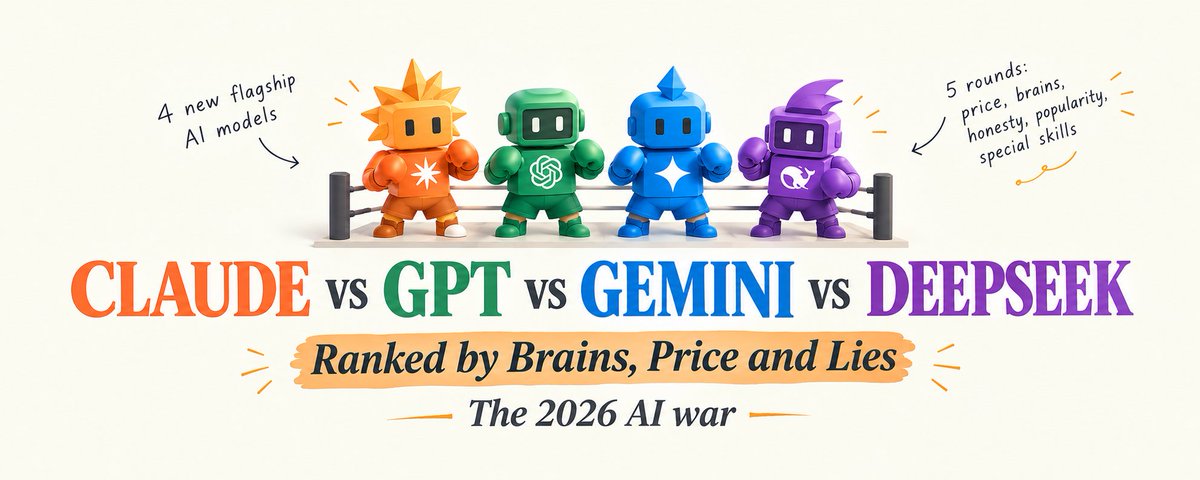
Claude, GPT, Gemini, or DeepSeek—which one actually deserves the crown? 👀
From raw intelligence to pricing and reliability, the AI battle is getting more intense. The real winner isn't always the smartest model, but the one that delivers the most value.
Which AI are you betting on in 2026?