

Los Angeles
Joined December 2010
- Tweets1.4K
- Following281
- Followers725
- Likes2.5K




"Households without children headed by someone under 35 went from 5.5% to 9.4% of all toy spending, and those headed by someone 65 or over from 9.3% to 15.5%. About a third of what households without children spend goes to gifts for people outside the home; the rest stays"


1
1
66
Masha Liberman retweeted

Want to know why young people are angry and feel increasingly hopeless? This chart says a lot.
V good story by @jburnmurdoch.
giftarticle.ft.com/giftartic…


For the inflation adjustment fans
Life Feeling Too Expensive? It’s Not Just You. And It’s Not Just Inflation. nytimes.com/interactive/2026…

3
72
Americans’ obsession with reality TV and its role in turning deceptive businesspeople into politicians has always surprised me. Still can’t bring myself to watch it. Please start dropping some spoilers, otherwise it feels like seeing everything is the same as seeing nothing
2
66
In an interview with CNBC following BlackRock’s third-quarter earnings, Fink said “a moratorium of some sort in this country” will put the U.S. in a recession, noting much of the economy is wrapped up in data center investments.
He knows what he is talking about
3
76
When only winners transact, prices can rise even as the market beneath them deteriorates @whoisnnamdi
whoisnnamdi.substack.com/p/v…

1
7
204

"We don’t seem to worry much about the spiritual force of Chinese ideals, and for all of the policy fractiousness, China continues to import and absorb American culture with enthusiasm" I have no more questions about Stripe. Haven't seen an essay that arrogant since high school

Brothers Karamazov was Einstein’s favorite novel, a verdict he shared with Freud, Hillary Clinton, and Murakami. Dostoyevsky was Pope Francis’s favorite author. Indeed, he approvingly quoted Elder Zosima; perhaps an interesting case of art molding life. At the risk of betraying my relative shallowness and inferiority, I confess that I did not love it.
Written in the shadow of the death of Dostoyevsky’s son (also Alyosha), and, more broadly, after a life of repeated tragedy, Karamazov attempts most of all to address the problem of evil in Christianity. Ivan presents a trenchant argument, asking how the suffering of children may possibly be explained given the existence of a supposedly benevolent God (Dostoyevsky collected real court cases for Ivan), culminating in Ivan’s famous return of the ticket.
The book gives some sense for how dislocating the nineteenth century must have been. The ascendant authority of science, the spread of materialist philosophy, the doctrine of evolution, the aftermath of the French revolution and its supposedly enlightened empiricism: in Karamazov, we get the feeling that finding some kind of consilience wasn’t just an abstract philosophical challenge, but a source of intense spiritual torment. If inherited tradition is no longer an adequate basis for faith, why would we rationally cleave to an apparently irrational theology? All of this was in the air: it was only two years later that Nietzsche declared God to be dead.
Perhaps demonstrating the utility of the novel as a medium, Dostoyevsky does not even attempt to solve the problem, but merely to illustrate a response, showing how individuals (Alyosha, Elder Zosima) may in the face of the inherent injustice present in the world nonetheless pursue lives of benevolence and charity: theodicy-by-example. In so doing, Dostoyevsky tacitly concedes that none of the teetering justifications expounded over the centuries can actually survive critical pressure and be defended through pure logic.
Ultimately, though, I don’t find myself being fully compelled by Dostoyevsky’s characterization of the problem or his proposed solution. As another sprawling confrontation with and attempt to reconcile the problem of evil, Grossman’s Life and Fate is maybe a useful counterpoint. Unlike Karamazov, Life and Fate shows actual people confronting great wickedness. Ikonnikov, a small but important figure, is ordered to help in the construction of a gas chamber. He refuses, with full awareness of the consequences that will ensue. The Karamazovs, by contrast, live middle class lives unvisited by greater events. Ivan has money, education, and leisure; his torment is the invention of his own mind and thus a kind of self-indulgence. Even Alyosha, the novel’s most sympathetic character, is never tested. His crisis is spiritual: there is a slightly comic kerfuffle about Zosima’s noisome corpse, which challenges his faith, but no circumstance requires him to stake his life or even his comfort.
Thus, a fundamental issue with Karamazov is that the problems of the book are on some level fake: they’re the self-inflicted derangements of febrile and dysregulated men. How much can or should we learn from the insane?
To be charitable to Dostoyevsky, we might say that he understood the spiritual dislocation of the era that later gives rise to the larger evils of totalitarianism in the twentieth, even prefiguring them in the Grand Inquisitor. (Dostoyevsky explored this theme in greater detail a few years earlier in Demons.) Camus in 1959: “The real nineteenth century prophet was Dostoevsky, not Karl Marx.” In this interpretation, the problems in Karamazov set the stage for those in Life and Fate.
Maybe. At least as a work of art, I’m not sure that this anticipation is enough to make the book stand on its own. In Karamazov, one continually wonders why the brothers don’t just pull it together. Dostoyevsky seems to transpose his own inner depths and spiritual torment onto his characters, but most people are not tortured writers, and it does not feel that the unhingedness of the characters is ever fully earned.
In attempting to address evil, Grossman’s conclusion is ostensibly similar to Dostoyevsky’s: the only resolution lies in senseless kindness. For Dostoyevsky, this message is embodied in Alyosha, who represents a kind of fervent innocence. For me, however, it’s not clear that Alyosha ever fathoms the realities and extremities of evil, and hence he’s not fully persuasive: does he even reckon with the misdeeds of his brothers?
Grossman is willing to engage head on. Far beyond gruesome newspaper anecdotes or neurotic and volatile siblings, Ikonnikov directly experiences the Holodomor in Ukraine and then the murders of the Jews. He has no patience for the kind of revolutionary ideas that animated Ivan’s contemporaries: “whenever we see [the dawn of an eternal good], the blood of old people and children is always shed.”
Alyosha believes in the Church and is willing to set aside its failures to address suffering. The book closes on his declaration that all shall rise again. That is, Alyosha does not accept the tragedy of Ilyusha, an innocent boy’s death, but rather seeks to deny and escape it. “We shall see each other and shall tell each other with joy and gladness all that has happened.”
Life and Fate flatly rejects providential resolution. The heavens may be empty, and there is no greater meaning in evil. We can simply choose (freedom the other great theme of Life and Fate) to pursue acts of charity, generosity, and comfort:
“Yes, as well as this terrible Good with a capital ‘G’, there is everyday human kindness. The kindness of an old woman carrying a piece of bread to a prisoner, the kindness of a soldier allowing a wounded enemy to drink from his water-flask, the kindness of youth towards age, the kindness of a peasant hiding an old Jew in his loft. The kindness of a prison guard who risks his own liberty to pass on letters written by a prisoner not to his ideological comrades, but to his wife and mother.”
These acts don’t ennoble the suffering but are instead justified on their own terms. Such altruism cannot become a catechism, as clearly lies in Alyosha’s destiny (and Karamazov was planned before Dostoyevsky's death as the first of two works); instead, our kindness must be senseless. And we should presume no salvation in adherence: Alyosha imagines a kind of sacred tutelage, but Ikonnikov is unceremoniously shot.
Karamazov doesn’t show true evil, and Dostoyevsky’s solution, such as it is, involves a kind of denial, or at least evasion through metaphysics. Grossman saw it directly, and instead argues, humanistically, that we should be kind just because.
—
If Dostoyevsky came to his works by trying to understand and depict Russian society, they in turn became tapestries for others to understand national souls.
In the aftermath of WWI, Russia was the great power defined in opposition to the West. As Germany tried to rediscover its own soul in the wreckage of defeat, it looked east to Russia, and frequently to Dostoyevsky himself.
Carl Jung thought that the German people had a kind of Karamazovian quality. In particular, he believed that Christianity had disciplined them without fully transforming the impulses beneath their ostensibly civilized conduct: the “Germanic barbarian” was divided into upper and lower halves. Religion had domesticated the former while leaving the latter untamed. Waning faith consequently threatened to release forces that its authority had long restrained: “As the Christian view of the world loses its authority, the more menacingly will the ‘blond beast’ be heard prowling about in its underground prison, ready at any moment to burst out with devastating consequences. When this happens in the individual it brings about a psychological revolution, but it can also take a social form.”
Dostoyevsky was reputedly invoked on a weekly basis at Max Weber’s Sunday gatherings. At the beginning of Reflections of a Nonpolitical Man, Thomas Mann’s later-repudiated 1918 nationalist polemic, he quotes approvingly Dostoyevsky’s characterization of Germany as the “protesting Western empire”, never quite adopting or feeling at home with the inheritance of Rome. In the same year, Spengler wrote Decline of the West, and explicitly perceived in Russia a youthful vigor, primitiveness, and irrationality that contrasted with the senile high culture of the German and Western worlds. In Magic Mountain, Mann later used Clavdia Chauchat to personify the seductive dangers of Eastern (i.e. Russian) illogic.
Hermann Hesse declared that, for all their differences, Fyodor, Dmitri, Ivan, and Alyosha are actually all of one type; the Russian man. In them, he perceived that “the ideal of the Karamazov, primeval, Asiatic, and occult, is already beginning to consume the European soul”, which was leading to the downfall of Europe. In Hesse’s conception, the Russian man rejects inherited ethics and morals, and even beneficent Alyosha represents an “amoral impartiality.” Man is, Hesse says, halfway between animals and higher consciousness; the former restrained through the process of civilization and domestication. The Karamazovs represent the fraying of the ties.
Hesse proceeds, ominously, to notice that the Germans in particular are more vulnerable than any European people to the temptations of “all those evils which one may regard in different ways, but which collectively signify the Karamazov.” While he was prescient in anticipating some of what would follow, he was in the end too sanguine in his hope that the spiritual dislocation could remain limited to that. “It is possible that the whole Downfall of Europe will play itself out only inwardly, only in the souls of a generation, only in changing the meaning of worn-out symbols, in the dis-valuation of spiritual values.” Alas!
In general, it is interesting to trace the mutual obsession between Russia and Germany: how preoccupied each was with the respective supposedly corrupting influences; how urgent the question of the national soul was felt to be. Many of the analyses seem a bit contradictory—Hesse actually inverts Dostoyevsky, for whom “everything is permitted” nihilism is a Western import for which Russian Orthodoxy is the cure—but there’s a striking intensity in the attempts to apprehend.
Most of all, I’m struck by how anachronistic it all feels today: a country’s writers investigating the national soul and the nation’s fate through the lens of foreign literature.
Which novels or works of art do we use to understand our contemporary issues? Should we be using such works? Do they inform or do they mislead? Today, the US worries a lot about China, but this mostly manifests at the level of trade balances, AI policy, and military prowess. We don’t seem to worry much about the spiritual force of Chinese ideals, and for all of the policy fractiousness, China continues to import and absorb American culture with enthusiasm that is mostly undimmed. There is a genre of jeremiad and cultural analysis in the US that rhymes a little with early twentieth century German criticism, but it today tends to be much more clinical, hinging around PISA scores, smartphones, lower fertility, and not around higher aspirations and ideals as such. So, to what extent should there be analyses of the national soul? And to what extent should they connect with major novels and works of art?
212
American’s self-improvement goals hinged less on building a big fortune than on landing a good job or even being well-liked.
Only in the 1980s, when the stock market surged and tax rates fell, did financial success become a higher priority. @BSteverman
bloomberg.com/news/articles/…

2
128
"The South Sea Company and the Mississippi Company, whose stocks featured in the first stock market collapse of 1720, both ended up issuing stocks to raise finance in order to buy stocks to keep the market in their stocks liquid and stable. In modern times, this is a common feature of merger and takeover activity in capital markets. Corporate takeovers are frequently financed by issuing securities. The proceeds of the new issue are used to buy in the target company's stock 'at a premium', i.e., at a price that is greater than the pre-takeover market price"
Oh, hello Cursor
60
Siphoning off excess inflows. 25% of a typical endowment is already in AI stocks, but who's counting the safe-bet bonds. Do they build, I'm curious, or just reinvest in shorter-term AI?

AI showing up in hyperscaler yield curves
Microsoft is best example of a Aaa credit w/ high exposure to the AI trend
In January 2026, its yield curve looked just like fellow highly-rated corporates
By July 2026, long rates for Microsoft bonds diverged substantially from peers


1
1
102
Masha Liberman retweeted

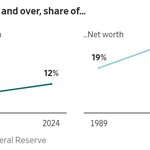
Crazy WSJ data. Between 2022 and 2025, wealth increased 37% for Americans 75 and older, while **decreased** 23% for people under 35.
wsj.com/economy/affluent-and…

I'm wondering why @stripe produces this chart nonsense. What's in it for them. Like, “Gen Z, you're rich, spend!”


Even feels nice to know it's not AI, because a disaster that looks this peaceful is unimaginable. And this little CATerpillar, I can't... Should we start packing?

BREAKING: Newport Beach Flooding @Stu_Mundel @FOXLA with incredible aerial footage.
58
AI agents now account for half of all visits to FRED, the Federal Reserve Economic Data portal that publishes unemployment, GDP and other market-moving noise
51


Masha Liberman retweeted

The war economy and Operation Warp Speed. Why is the state able to act efficiently during these times but not others?
What these moments share is the threat of annihilation. When people believe they may not survive, the political economy disappears, and government becomes remarkably competent.
The question we debated with @MazzucatoM is how to get those outcomes without those incentives. Listen to our full conversation on Capitalisn't here: youtube.com/watch?v=N9KlofuS…