



Suyu (Michael) Ye retweeted

Can agents figure out the social norms of a new community—without being told what they are?
👀 Humans are normatively competent. We watch what others do and what gets corrected, and we adjust our behaviors accordingly.
Introducing NormGym — a benchmark for evaluating normative competence through social interaction.
🤖 Main takeaway: Agents can sometimes learn from their own norm violations, but struggle to learn from the behavior of others around them. This points to the challenge and the need to build agents that can think and act as members of a community, rather than just pursuing their own goals.
📄 Paper: arxiv.org/pdf/2611.08613
🌐 Project: normgym.github.io/normgym-pa…

Suyu (Michael) Ye retweeted

The future is in your hands!
We show how to get a grasp on it. ✋
Grasping the Future learns from in-the-wild human videos to forecast how hands and objects move together in 3D, down to the fingers!
grasping-the-future.github.i… 🧵
Suyu (Michael) Ye retweeted
Happy Halloween from Johns Hopkins Robotics!
Check out this cool demo of humanoid crawling created by my amazing colleagues

For Halloween, @geetachandra21 got our Unitree G1 to crawl like a spider!
Give Geeta (co-advised w/ @HaiminHu) a follow if you're interested in more humanoid demos.
We're doubling down on whole-body locomanipulation research at @HopkinsDSAI @HopkinsEngineer @JHUCompSci -- reach out if interested in working with us!
(credit to Addison Johnson, who helped design the mounts for the hands, and filmed this; and to Geeta who took a full-stack approach to ensuring that no humans or humanoids were harmed during the production of this video! and to @jloganolson for last year's humanoid crawling deo)
sciphylab.org/
Suyu (Michael) Ye retweeted

While the AI community races toward RSI, we're exploring an alternative path: recursive human–AI co-improvement.
In this paper, we study how humans can better guide autoresearch agents, how to detect and localize reward hacking, and how to train agents to better interact and communicate with humans.
Together, our training and evaluation recipes offer a path toward more capable and aligned autoresearch agents. More work is coming, stay tuned!

Claim: Humans & AI are better together if we want to recursively (co-)improve to a brighter future for *humanity*
Instead of racing towards methods for AI replacing us, work on how to make AI work *with* us!
New paper that makes 4 contributions here:
1) The role of humans in directing research agents: Autobenchmark
2) Reward hacking in autoresearch agents: HackBench
3) Training agents to interact with humans: AutoInteract
4) Training agents to communicate with humans: unslopping AI
Full Paper: arxiv.org/abs/2610.38882
Blog posts for each section:
1) facebookresearch.github.io/R…
2) facebookresearch.github.io/R…
3) facebookresearch.github.io/R…
4) facebookresearch.github.io/R…

Suyu (Michael) Ye retweeted
Your robot's shape shouldn't limit its sense of touch.
Meet OpenTac: an open ecosystem for custom tactile skins that sense normal + shear forces.
Very excited about this collaborative project! Can’t wait to see what the community builds with it. 🧵👇
opentac.github.io
Suyu (Michael) Ye retweeted
What makes human video generation good for robot manipulation?
We analyze zero-shot video generation through the lens of constrained optimization - without any robot interaction data
🔑 insight: motion that can be refined for physical feasibility while preserving task intent.
Suyu (Michael) Ye retweeted

🧵[1/n] We often hear that breaking things is easier than building them. But can we teach a video model how things break?
Excited to share FracGen, a physics-informed and controllable framework for fracture-video generation. FracGen learns how objects stretch and tear from a single image under specified physical conditions.
Work done by my PhD students @Tung11199951 and @jiahan_zhang1 @JHUCompSci
Paper: arxiv.org/abs/2609.38152
Project: fracgen.github.io/
Suyu (Michael) Ye retweeted

Introducing RoboJEPA, the first scaling law for multiembodiment world models.
We scaled JEPA predictors up to 8B params, showed scaling laws extrapolate and correlated compute scaling with planning performance.
We release all checkpoints and the code.
robojepa.github.io
Suyu (Michael) Ye retweeted
‼️Agents are trained on fully specified tasks, then deployed to users who clarify, change requirements, and push back. What if the interaction itself became training data?
Introducing 🤝AutoInteract🤝
- learn user models from real human-agent histories
- synthesize multi-turn interactions around verifiable tasks
- train agents on them with RL
Claim: teaching AIs to be better collaborators with humans improves the quality of their work!
🤖🤝Introducing *AutoInteract* 🔁💬🧑💻🧑🤝🧑✨🌱
- creates train data to improve AI's collaborative abilities
- simulates the way humans act & constructs challenging multi-turn interaction tasks
- Improves LiveCodeBench-Pro, Multi-turn LCB-Pro & SWE-together
We expect the recipe generalizes to much more!
Blog post: facebookresearch.github.io/R…
🧵1/5

Really cool work!

NEVER LOOK BACK!
Introducing LEDGER: persistent 3D object memory from egocentric videos.
Remember where things were, when they moved, and what they held -> then answer questions without looking back at the video!
ledger-3d.github.io
2
176
Suyu (Michael) Ye retweeted

We’re releasing a broad range of new mathematical results produced by an internal frontier model.
We’ve been consulting with the independent Advisory Group on Mathematics and Artificial Intelligence at the Institute for Advanced Study, and we have drawn on their advice and public recommendations to inform how we release these results.
github.com/openai/math

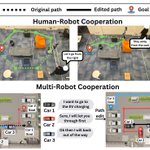
What can you learn about a robot partner that still matters when the task changes?
Its physical limits.
We introduce the problem of inferring those limits by watching it work with another robot, then coordinating with it zero-shot on a new task.
Introducing Watch, Infer, Coordinate
Project Page: watch-infer-coordinate.githu…
Preprint: arxiv.org/abs/2610.02170
The world changes. World models should too.
Check out our newest work!

A pretrained latent world model's predictions can become unreliable when test-time dynamics differ from training.
Introducing JEPA-TTT, which enables persistent test-time training of latent world models for planning under dynamics shifts.
Project Page: jepa-ttt.github.io/
Paper: arxiv.org/abs/2610.00722
4
171
Suyu (Michael) Ye retweeted
Sharing new work on understanding articulated object manipulation from monocular human videos!
We explore how far SOTA vision models combined with optimization can take us for articulated object reconstruction and dexterous re-targeting
track-articulate-act.github.…
Suyu (Michael) Ye retweeted

Existing continual learning methods still suffer from catastrophic forgetting. Our recent work found a simple recipe to substantially improve 𝗹𝗼𝗻𝗴-𝗵𝗼𝗿𝗶𝘇𝗼𝗻 𝗺𝗲𝗺𝗼𝗿𝗶𝘇𝗮𝘁𝗶𝗼𝗻:
Composing multiple continual learning mechanisms extends memory lifetime and raises average final retention from 1.2% to 34.9% across 3 datasets: a 28-fold improvement over naive sequential SFT.
Project page: compose-cl.github.io/
Paper: arxiv.org/abs/2609.06986
Code + datasets: github.com/cozheyuanzhangde/…
Suyu (Michael) Ye retweeted
My group at Johns Hopkins now has a name and a website
Introducing the Brains, Bots, and Behavior Lab
b3.cs.jhu.edu
We're always looking for creative researchers at all levels to join us!

Suyu (Michael) Ye retweeted
Introducing MotionForesight:
A very simple approach re-purposing video models for forecasting future 3D scene flow given a short observed video context
Trained with just 40k RGB human videos, it generalizes well to completely new home/office scenes!
1/n
Excited to share our newest work!

What should a world model capture for embodied agents?
An agent acting under partial observability needs a belief over the 3D world: what it has seen, what may exist beyond view, and how that belief should update as it moves.
Introducing 3D-Belief, a 3D world model for embodied belief inference under partial observability. 🧵[1/9]
5
210