




Running AI models locally? These are the tools you need to know.
The essential toolkit for local AI in 2026.
1. Chat & UI
Easy-to-use interfaces for chatting with locally hosted AI models.
LM Studio, Ollama + Open WebUI
2. Local Inference
High-performance runtimes for running AI models on your own hardware.
llama.cpp, ExLlamaV3, MLX-LM, vLLM, SGLang, TensorRT-LLM, LiteRT-LM
3. Model Serving & APIs
Exposing locally hosted models through APIs and serving multiple users.
Ollama, LocalAI, llama.cpp Server, vLLM, SGLang
4. Mobile & Edge
Running AI directly on smartphones, embedded systems, and low-power devices.
Google AI Edge Gallery, LiteRT-LM, Cactus
5. Fine-tuning & Training
Customizing and training models with your own datasets.
Unsloth, Axolotl, LLaMA Factory, ms-swift, Transformers + PEFT, Keras, Tunix
6. Coding Agents & Harnesses
Connecting local models to coding tools, agent frameworks, and autonomous workflows.
OpenCode, Cline, Kilo Code, DeepSeek Harness, Pi, Hermes Agent, Aider, goose, OpenHands
7. Code Review & Debugging
Reviewing code changes, identifying bugs, and analyzing repositories.
DSH Code Review, DeepSeek Harness PR Review
Which tools am I missing?
xitter.cf/swarogan/status/210392…

Qwen 4 is coming out on October 29-31th
I hope it makes such a qualitative leap that the current benchmarks will have to be rewritten.
🚨Attention!
X introduces a feature that lets you send $1 by long-pressing the Like button via X Money.
How often will this happen by accident?
Is this the end of SaaS?
According to SaaSHub, the number of abandoned SaaS products is rising, and 2026 is already the worst year on record.

Wow! DeepSeek showed what a real model update should look like.
It took second place in cybersecurity.
Anthropic's results in this benchmark show that it is useless in cyber.


DeepSeek V4.1 Flash 1017 is the new #1 openly-available model in the Artificial Analysis Cyber Index. Other proprietary models may offer better cyber defense performance but are restricted access
@deepseek_ai recently released DeepSeek V4.1 Flash 1017, an update to their flagship open-weights model DeepSeek V4.1 Flash. With an Artificial Analysis Cyber Index score of 57%, DeepSeek V4.1 Flash 1017 is the #1 openly-available model for cyber defense capabilities.
The Artificial Analysis Cyber Index measures capability on agentic cyber defense tasks and is composed of three benchmarks: CWE-Bench-AA, DeepsecBench-AA and CyberGym-E2E-AA. The Cyber Index primarily evaluates models through their publicly accessible APIs, reflecting the cyber capabilities available to developers.
Many models, particularly proprietary models from OpenAI, Anthropic and Google, may have stronger defensive cyber capabilities but encounter safety refusals that reduce their overall scores. GPT-6 Sol (Daybreak Blue, max), available through OpenAI’s trusted-access program, leads the Index, scoring 32 points above its public counterpart driven by fewer refusals. DeepSeek V4.1 Flash 1017 encounters no safety refusals.
Key results:
➤ DeepSeek V4.1 Flash 1017 has the highest score among publicly-available models on the Artificial Analysis Cyber Index and #2 position overall. DeepSeek V4.1 Flash 1017 (max) scores 57% ahead of the previously leading publicly-available models Grok 4.7 (xhigh) and MiMo-V2.6-Pro by 1 point. It places #2 overall, with the trusted-access model GPT-6 Sol (Daybreak Blue, max) leading by 12 points with a score of 69%
➤ DeepSeek V4.1 Flash 1017 improves on its predecessor DeepSeek V4.1 Flash by 16 points. DeepSeek V4.1 Flash 1017 (max)’s 16-point improvement from 41% to 57% is driven by a substantial 53-point improvement on CyberGym-E2E-AA from 23% to 76%. On CWE-Bench-AA and DeepsecBench-AA it scores 69% and 25%, compared to 68% and 31% for DeepSeek V4.1 Flash (max)
➤ With a Cost per Task of $0.42, DeepSeek V4.1 Flash 1017 sits on the Capability vs. Cost Pareto frontier. DeepSeek V4.1 Flash 1017 costs $0.42 per task, more than 2x MiMo-V2.6-Pro (56%) at $0.18 per task but 4x cheaper than GPT-6 Sol (Daybreak Blue, max, 69%) at $1.77 per task

We have less time than we thought as humans.
LLM intelligence has made a bigger leap in 2026 than in the previous two years combined.
And the year isn't even over yet.
What comes next?

13 seconds instead of an hour!
This is the potential of the open source environment.
Someone used Google EmbeddingGemma2 for speech recognition, even though the model was not trained for it at all.
The result? 288x faster than real-time on a MacBook Air M3.
Completely locally, without the cloud.
I have created a fully interactive 3D medieval library based on three.js.
Everything can be moved or taken, and every book can be browsed.
GPT-6 Astra + DeepSeek V4.1 Flash 1017 + Blender
Music generated locally with ACE-Step 1.5 using my own custom tool.
Open source code on my GitHub.
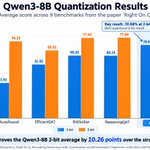
Your next local AI model might need a lot less VRAM than you think.
2-bit AI models were almost useless at reasoning. Researchers just found a way to recover much of their lost intelligence.
They introduced OnQ, a new training method that lets quantized models learn from their own reasoning mistakes.
Qwen3-8B results across 9 benchmarks:
• GPTQ 2-bit: 2.88%
• ReasoningQAT 2-bit: 60.24%
• OnQ 2-bit: 70.68%
• Original FP16: 81.82%
That's a 10.26-point improvement over the strongest competing quantization method.
Smaller models. Less VRAM. Much better reasoning.

Paper: arxiv.org/abs/2610.29378

Can Space Bunny Alpha beat the big names in AI coding?
I challenged MiniMax M3.1 Flash and several well-known models to build a fully playable 3D drone racing simulator.
Same prompt. Same challenge
Which AI built the best one?
You be the judge.
xitter.cf/swarogan/status/211219…
MiniMax M3.1 Flash looks better in benchmarks than it does in real projects.
The mysterious Space Bunny Alpha turned out to be an early version of MiniMax M3.1 Flash, so I was curious how it would compare with DeepSeek V4.1-1017.
After several days of using it on real projects, I wasn't particularly impressed. Some benchmarks suggest they're close. My experience tells a different story. DeepSeek performed significantly better on the tasks I tested.
Have you tried both? What was your experience?
xitter.cf/MiniMax_AI/status/2112…
Someone did a great job and compared the harnesses using DeepSeek V4.1 Flash 1017
What harness do you use day to day?
xitter.cf/PawelHuryn/status/2112…

I repeated DeepSeek V4.1 Flash 1017 benchmark 89 times across 9 harnesses to understand which works best.
High effort, 5 attempts each:
Pi harness: 40.4
Grok Build CLI: 40.4
DeekSeek: 39.2
OpenCode 2.0: 38.6
OpenCode: 36.6
Claude Code: 36.4
Codex: 33.2
Hermes Agent: 32
Kilo Code: 31.8
Codex kept failing several times exceeding the allowed time per repo (3 hours) and was judged where it finished.
Based on what I tested, Pi, Grok Build CLI, and OpenCode 2.0 look like the strongest universal harnesses. This doesn't necessarily generalize.
A detailed table with every run in the response🧵

DeepSeek has released the source code of the program it uses to run DeepSeek V4.1 Flash and handle a large number of concurrent users.
Not just the model weights. Not just optimized kernels.
They release their production inference framework, including distributed inference, speculative decoding, and optimizations designed to reduce computational costs.
They also released the source code for deepseek-recipe, which handles token encoding and decoding in their API.
Future DeepSeek models will also use this repository.
Open models are great. Open inference infrastructure may be even more important.
Links in the responses.

When you stare into vibe-coded code, the code stares back at you
xitter.cf/PrashantByte09/status/…

What was the 93.9 million tokens in DeepSeek V4.1 Flash 1017 spent on?
Warning: It's addictive!
Johnny Castaway is back. This time, he is actually alive. If you don't know what he is, I'll explain briefly.
He is a 90s screensaver featuring a lonely castaway on an island.
He experiences various adventures. He fishes, collects shells, builds a fire, builds a house and a raft, and much more. You can watch him for many hours and won't get bored quickly.
Whether he will see a ship and whether he will manage to leave the island, you will have to see for yourself.
Ideas on how to improve the island are welcome.
The project is open-source, available on GitHub. Written in DeepSeek Harness.
Link to the repository in replies