

Infrastructure for self-improving agents. Backed by @polychain @lemniscap
Joined January 2024
- Tweets653
- Following13
- Followers12.2K
- Likes336






Tangle retweeted

Tangle is now SOC II Type 2 compliant! You can launch your products and apps in our secure and compliant sandboxes now :)
tangle.tools/
Braids. Knots. Tangle.

A braid is a complex structure or pattern formed by interlacing three or more strands of flexible material.
It's the name of a new TUI (github.com/tangle-network/br…) I've built over @tangle_network's agentic libraries: agent-runtime, agent-eval, agent-sdk, and more. The TUI interlaces a variety of things together, which aptly describes why its named this way.
Foundational AI companies will continue to innovate on their own harnesses, improving context management, tools, RLMs, subagents, and more. This is not an easy area to compete. Moreover, these improvements are everything we hope to leverage and stay up-to-date with.
Agent Runtime (agent-runtime)
The purpose of the agent-runtime is to sit on top of any existing and future harness and run it locally against your subscriptions using a cli-bridge or sandboxing infrastructure like Tangle's sandboxes (sandbox.tangle.tools/). Much of parallelizing work, research, and software development is moving towards massively scalable cloud agents. This runtime sits above any major harness and gives users an easy way to run @claudeai, @openai codex, @opencode, @earendilworks pi, @PrimeIntellect agent, @NousResearch hermes, and more in the cloud.
A core part of the agent runtime is a meta-improvement loop that analyzes agent rollouts/traces using agent-eval library primitives to improve and modify an AgentProfile. An AgentProfile is a standard configuration for an agent running in a VM, specifying the harness/model/tools/skills/VM snapshot expected to execute.
The runtime exposes a supervisor MCP that gives these coding harness agents the ability to spawn subagents in new sandboxes. The goal is to leverage both in-harness features like ultracode, dynamic workflows, parallelization within a single VM and enable agents to manage compute across VMs. Distributed agent managed compute will allow AI scientists to run experiments in parallel and AI SWEs to build and audit components in different hardware. Spin up sandboxes, run agents with any harness, and spin them down upon completion, trace runs, improve profiles, and repeat.
Braid
Braid is meant to be a versatile TUI that sits on top of harnesses, routing through a OpenAI compatible local bridge to leverage your active subscriptions or Tangle's sandboxes to leverage cloud agents and parallelism.
It has features that easily let you fork and ask questions to trace analysts about your session, to meta analyze and self improve over the harnesses themselves or to easily branch into new threads, a feature I long for in other harnesses.
This is actively being worked on and if this is interesting to you, please reach out! My goal is not to reinvent the wheel. This is a harness on top of harnesses, which I'm sure people are building.. Happy monday!
Links
- github.com/tangle-network/ag…
- github.com/drewstone/cli-bri…
- github.com/tangle-network/br…


Tangle retweeted
/plugin marketplace add tangle-network/skills
/plugin install tangle-blueprint-innovate@tangle-network-skills
@tangle_network
Tangle retweeted
Damn cool, we also have droids integrated into our cloud agent VM @tangle_network. Wanna give it spin?
If an operator has zero stakers or zero USD-weighted score when a fee arrives, it routes to treasury.
Fees are never stranded in the distributor.
Operator revenue share is proportional to exposure.
`exposureBps` = how much of your delegation you're putting at risk for this service.
50% exposure earns half the fee share of 100% exposure, all else equal. More risk on the table = larger cut of every payment.

Immediate distribution splits by USD-weighted score, not raw token amount.
Each delegator's score = staked amount x lock multiplier. Longer locks earn more score per unit of capital.
ETH and stablecoin delegators compete on USD-equivalent exposed value. One oracle normalizes all assets.

First decision isn't who gets paid.
It's when.
If the service has a TTL, the full payment transfers to `StreamingPaymentManager` and drips pro-rata over the service lifetime.
Delegation changes mid-service? Drip runs at current score ratios first. Can't bond stake after a job runs and claim retroactive share.

`distributeServiceFee` is the entry point.
Only the Tangle contract can call it.
Native ETH and ERC-20 both handled. `msg.value == amount` enforced for native — prevents accounting bugs where the caller lies about what they sent.

x402 gets the payment.
Then what?
Tangle's on-chain distribution layer decides who gets paid, how much, and when.
tangle.tools/blog/blueprint-…

As agents and infrastructure become more faster, more useful, and more affordable, the applications we will build together will be eye opening.
Follow along for more updates as we keep building the future.

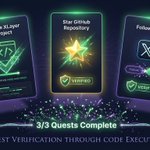
Creating three quests for the XLayer partner in the app: create the first XLayer project, star the XLayer okx/xlayer-reth GitHub repository, and follow the XLayer X/Twitter account.
Blueprint Agent gives XLayer a developer onboarding platform that proves builders actually built something. Sponsored credits lower the barrier. Quest verification proves the work. AI assistance accelerates delivery.

Tangle's Blueprint Agent platform allows users and partners to customize agent profiles for their agent executions. This allows us to both test and benchmark over time how different agent profiles perform on your ecosystem.
We gather rich data about your user and agent metrics.
