



RIP Lemon Squeezy 🍋
If you sell courses, coaching, memberships or digital products there, this is your sign to stop renting a checkout and start owning your business.
Products, payments, email, community. One place. 0% revenue share.
Kajabi's door is open.
1
64
How to build your next course if you've sold one thing and there's nothing after it:
1. Find where your first course or program stops.
Write down what a student can do the day they finish. Then write down the first thing they'll get stuck on after that. The gap between the two is your next product.
It can also go in front of the first one. Ashley's smaller course was for people who weren't ready for six months yet.
2. Pull ideas from work you're already doing.
Pick a source that produces ideas even on weeks you aren't building:
> what you're studying right now
> the question you answer on every call
> what your members need this month
3. Give every buyer a way in and a place to stay.
A way in is small, like one module or one live class. A place to stay is where buyers get something new from you between products, like a community, a membership or an all-access offer.
Put a link to the next thing inside the thing they bought. They'll see it while they're still logged in and learning from you.
4. Size it to a cadence you can hold.
Every product you add needs updating, and I've watched experts bury themselves under catalogs they couldn't maintain. Pick the cadence first, then the product.
Carolina on @Kajabi teaches her classes live and records them, so a new class is one more session. Lori's monthly courses went into a membership she was running anyway. If an idea can't ship inside your cadence, cut it down until it can.
5. Sell it to the people who paid you, first.
Email the people who bought the last one before the new thing goes anywhere public. They've watched you teach, and you already did the slow part of getting them to pay once.
If they pass on it, fix the offer before anyone new sees it.
"My topic only has one course in it."
I've heard that one plenty. Maelisa calls hers "a really boring topic." It has carried her business for twelve years, from a course to consultations to a community.
TLDR;
> Pull up the last thing you sold.
> Write down where it stops.
> Pick where your next ideas will come from.
> Build the smallest version.
>Send it to the people who already paid you


If you sell what you know through a course, coaching, or a membership, you might have 2 things on offer.
Free content, and 1 big program that costs real money. Between those 2 there may be nothing a new person can buy today for the price of a dinner out.
Alessandro Frosali added a live class at 47 euros a session, capped at 200 people, with no recording.
Someone interested in his work can try a session before committing about 1,000 euros to his academy.
He originally ran a social media agency in Mallorca. An ultimatum from his wife sent him years deep into what it takes to be a good husband, and someone in his circle noticed the change and asked him to teach it.
He joined @Kajabi in June 2025 and made $1,000 the first month. He started selling his time through coaching and retreats: 20 sales calls a day, 7 coaching calls in a row.
In his words: “That garnered a lot of money but it didn't show me that things were possible.”
Then he sold 187 spots in the Better Husband Academy at about 1,000 euros each. The second run, in May, brought in over 130,000 euros, even with roughly 2 fewer weeks to sell it.
Across his offers, he has made over $500K in under a year on Kajabi.
For someone following his free content, though, the full academy can still be a big first purchase.
That’s where the 47 euro class fits: one paid session to try his teaching.
What you can take away (if you're looking to monetize your expertise):
1. Give people who aren’t ready for your main program a smaller way to start.
2. Pick one problem they keep asking about and offer a paid live session to help them work through it.
3. Keep the group small enough to answer questions, and make the session useful on its own.
4. Someone should leave with something they can apply, even if they never buy the full program.

Experts pay for help with basic things. They just don't want to be seen doing it.
A clinical psychologist on @Kajabi sells a six-week group for therapists who have fallen behind on their paperwork. $497, or $249 a month. She's generated over half a million on Kajabi since 2023.
Her page asks if you're worried about being found out, or reported. Then it answers, in capitals: "YOU ARE NOT ALONE." Further down: everyone else in the group is behind too.
One of her buyers says the shame of being behind on documentation almost stopped them from joining.
Nobody writes in to say they're embarrassed. So she printed it herself, right under the buy button, in the buyer's own words: "I'm embarrassed to join the group. How private is it?" Then four paragraphs answering it.
Every field has a question like this one. It rarely gets said out loud. Write it the way a buyer would, put it under the button, and answer it there.
You're probably good at something your peers are behind on. That's an offer. Build it and put it up.


You can get so good at a trade that you forget what someone would pay to learn from you.
You catch mistakes a beginner doesn't know to look for yet. You can explain why a job went wrong and how you'd fix it. That is knowledge someone else could spend years acquiring.
Kelly Callaghan built an education business from her experience as a spray tan professional: 1,107 students and $1M in revenue over 53 months.
I'd like to see more people who work in a trade consider teaching it. A lot of useful knowledge never makes it beyond the people working alongside them.
Someone preparing to take on their first paying client has a good reason to pay for that experience.

The best thing you can sell is the thing people keep asking you about.
Whatever somebody watched you do and wanted for themselves. That's the one.
Alessandro Frosali ran a social media agency, and before that he worked in film.
Someone in his circle watched him change and asked to be taught. His first answer was "Me? I don't want to do that."
He started anyway. His first month on Kajabi made $1,000. Inside a year he was past $500K, with 21,000 people on a weekly email and no paid ads behind any of it.
He sells two kinds of thing now.
Three workshops sit recorded on his site, on the type of evergreen advice that don't change. He made those once.
Then a class he teaches live every week at €47 a seat, capped at 200, and he has never recorded a session of it. He set it up to stay contained.
A recorded library is something you maintain forever. And a cheap class you teach every seven days with no ceiling on it just becomes your job. He put a lid
on both. The money still comes from the Academy, twice a year, on dates he picks.
The thing you worked out the hard way is what somebody might be paying to learn right now.
There's even a chance you were asked about it more than once, and at least one of those people went off and paid somebody else to teach them what you would have taught them instead.
You can sell a course before you build any of it. Who you ask decides whether it works.
A stylist (who later enrolled on @Kajabi) already had the course made and the audience to sell it to.
She pitched it at $97 to 1,462 people watching her live, all off a free challenge she'd shown up for every day for weeks.
Nobody bought.
The problem was why they were in the room. They'd come because it was free.
None of them had gone looking for help with anything.
So she went to YouTube and answered the questions people type in when they're stuck on something.
Those people are already looking for help by the time they find you.
The next course went on sale before she'd built a lesson of it... $170,000 in pre-sales. More than 90% of the buyers said they'd found her on YouTube.
I've watched a lot of experts try to sell to a crowd they'd only ever given free stuff to. It almost never works, and nobody in the room ever tells you why.
Put the offer up early, in front of the people who went looking for it.

The most expensive thing I watched experts do at @Kajabi was take more sales calls. It works, and that's exactly how it caps you.
In 2020 Ryan Peebles was taking six to eight sales calls a day. He finished the year with 60 students.
That was also the year he moved the whole business onto Kajabi.
Then he took himself out of the sale.
He built a funnel that didn't need his voice on every call, lowered the price, and put a seven-day trial in front of the course.
60 sales in a single day. Same course he launched in 2016.
Run the arithmetic yourself.
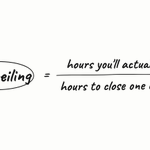
Hours you'll work this year, divided by the hours it takes to close one person. That's your ceiling, and no amount of traffic moves it.
Most people never run that division. They read the ceiling as a work-ethic problem and try to want it more.


The last thing I watched experts change, in ten years around @Kajabi, was the price.
Best offer under $50, and the typical expert earns under $200. Lifetime, not per month. Put one offer at $2,500 and the typical figure is about $175,000. Six in ten of that group clear $100K. Under $50 it's closer to one in forty.
I don't think price did that on its own, and I watched enough launches to be careful about saying it did. The people charging $2,500 had built something worth $2,500 first.
A pilates academy on Kajabi runs a live instructor certification at $2,750 over five weeks. The route it replaces costs five to eight thousand and takes six to eight months. They started with no education audience and passed $100,000 inside a year.
Nobody was waiting for them either. They just built the five-week version of the eight-month thing.
Nobody tracks completion.
I've watched thousands of courses launch. Creators know their conversion rate cold. Most have never checked how many buyers reached the end.
It decides everything downstream, refunds, reviews, whether anyone buys the second thing. A cohort course gets 40 to 70 percent of its students to the end. The average self-paced course gets about 15.
I watched experts try to fix completion with better production. Sharper videos, longer workbooks. The fixes that worked were social ones: a start date, a deadline, another person who notices when you skip.
Build that in from day one. Run the course live once before you record anything. Put dates on it. Make students visible to each other.
A degree certifies four years of showing up. If you can rebuild that outside the university, you would have replaced most of what the degree did.

Stock photographers watched their prices collapse when the supply of images exploded. Anyone charging for course content would probably be thinking about the same problem now.
With AI, the information itself is getting cheaper, and no longer the moat. A chatbot can generate a decent explanation of almost anything.
AI can review an attempt too. So an expert's main advantage is judgment built from doing the work and the accountability of staying involved until the student gets it right.
I would build the offer around that. Put the information a reader could get from search or a chatbot in the free material. Charge for reviews, critique, live calls and cohorts with a start date.
After watching thousands of experts launch on @Kajabi, I think a lot of the panic about AI comes from people who put too much of the paid value in the information.
