

Offensive Security @ Trident, YCS26
0xC0000082
Joined June 2025
- Tweets504
- Following632
- Followers1.3K
- Likes3K





There’s been rumours of a back door in the forked versions of ARTEX

NEW BLOG: I reviewed ARTEX in an isolated lab to see what the panic was about. The scary part isn’t the AI. It attacks exactly like we’ve taught for 20 years. Just without the coffee breaks. Blog: jeffreyappel.nl/artex-old-at…

5
887


5 agentic offensive frameworks skip in-code authorization by default.
ARTEX, CyberStrikeAI, Cairn, PentAGI, and HexStrike put an LLM in the planning loop around familiar scanners, shells, and cloud CLIs, and GTIG observed ARTEX acting in bursts of roughly 2 to 25 seconds.
All 5 have already turned up in real intrusions, across reporting from GTIG, Mandiant, Microsoft, and our own research.
We read their source and the public incident reporting to work out what reaches defender telemetry. Research by @stryker0x: go.es.io/4eKv4jE
• Why IOC and User-Agent detections go stale while behavior-based rules hold up
• Tempo and sequence signals per identity for short bursts and long campaigns
• An ES|QL hunt for tool-family bursts across web, proxy, and cloud audit logs
• Why blocking a source IP must be paired with credential/session revocation
Every action these frameworks take still has to land in telemetry you already collect.

23
1,028
Junaid retweeted
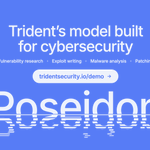
Introducing Poseidon: a state of the art cybersecurity specific model, designed for vulnerability research, finding, prove, and fix vulnerabilities in real software.
Poseidon preforms:
- 17.6% higher than GPT-6 Astra
- 2.9% higher than Claude Fable 5.2
(CWE-Bench)
6 months ago Trident started post-training Poseidon because nothing else worked. frontier models were completely gated on offensive security and none of the cyber programs existed yet.
It was difficult and at some point our team thought we were wasting our time in the long run. This is because we assumed once major labs rolled out programs like Daybreak and CVP, a custom cyber-model wouldn't make sense anymore.
Now that those programs are out, it's pretty clear we had it backwards; general-purpose frontier models still carry bloated inference costs, overhead and aren't accessible to everyone which makes continuous security analysis at scale impractical
Our team post-trained Poseidon on hundreds of thousands of CVEs and vulnerability samples alongside non-public artifacts, pre- and post-patch diffs, stripped binaries, raw crash dumps, and execution traces. We removed non-domain weights, compressed and quantized it for faster inference, and stripped refusal guardrails at the weight level
Because it's built strictly for security, it wins on inference cost and speed while performing better than frontier models at auditing large codebases, reversing stripped binaries, triaging fuzzer crashes, validating exploitability etc..
Poseidon is now the core model powering Trident’s offensive capabilities and reasoning.


Not every team has access to Daybreak and CVP + running frontier inference at scale gets expensive fast.
If you want faster, cheaper inference built specifically for cybersecurity, book a demo below or shoot me a message I'll be more than happy to reach out!

18
Junaid retweeted

Cheat makers are turning to AI to build tools that give players an unfair advantage. These cheats are appearing across the industry, and because they can operate outside the game, they present new detection challenges.
We’ve said before that our systems are always adapting. That includes studying the behavior these cheats create in-game and building tools that both prevent and detect them.

Now more than ever, every company doing business on the internet today is vulnerable

Amazing team!

Today, we're introducing @lato_ai, backed by @ycombinator.
We are changing how investments are made.
Our first focus is commercial due diligence (CDD): currently private equity spends on a McKinsey report ~$500k which takes weeks.
To give you the scale: 36k CDDs were done in 2025, which is c.$18bn spent a year.
Based on 200+ experts calls and multiple studies over last 4 weeks our agents did, we know that:
1) Voice agents do better expert calls than people
2) Research agents find more relevant information and synthesise it systematically
With our approach we do research on any company or market in days at a fraction of the cost.
We already work with leading funds that push the frontier.
Learn more at latolabs.io or email [email protected] to get in touch.
1
10
1,644
Junaid retweeted

Today, we're introducing @lato_ai, backed by @ycombinator.
We are changing how investments are made.
Our first focus is commercial due diligence (CDD): currently private equity spends on a McKinsey report ~$500k which takes weeks.
To give you the scale: 36k CDDs were done in 2025, which is c.$18bn spent a year.
Based on 200+ experts calls and multiple studies over last 4 weeks our agents did, we know that:
1) Voice agents do better expert calls than people
2) Research agents find more relevant information and synthesise it systematically
With our approach we do research on any company or market in days at a fraction of the cost.
We already work with leading funds that push the frontier.
Learn more at latolabs.io or email [email protected] to get in touch.

Cybercrime is projected to cost the global economy $10.5 trillion every year.
AI has made every company, everywhere, vulnerable
The problem isn’t a lack of security tools. It’s that they were never designed to defend against AI threats
We built Trident (YCS26) to change that, comment 'trident' to get started for free
Junaid retweeted

Introducing Trident (YC S26), the security engineer that never sleeps
Most teams test security 2-3 times a year
Your code changes 200+ times a year
Trident tests your web apps and cloud infrastructure every day:
Comment "trident" below for a free security scan (black box + white box, worth $10,000+)
Trident:
> Finds vulnerabilities automatically
> Opens PRs with fixes
> Runs 24/7 after every deploy
Junaid retweeted

Today, we're launching @belvedir
We're making private AI models cheap and easy so the world can have trillions of them.
Private AI models are cheaper, better, faster, and protect your data from frontier labs, but they're still to expensive and difficult to make for startups and consumers.
Belvedir makes private AI models autonomously with less than 5 minutes of setup, so that private AI can finally be accessible to everyone

Junaid retweeted

Our S2S model, Hydra operates asynchronously. Always thinking, even in silence.
It generates latent vectors every few ms, and attention runs on those latents, not on tokens. That's how you reason at a higher semantic level, and how you get a model to work in real time.
Got into how we built it 👇