

Masters in Nutrition Science & Bachelor of Science (Physio). Author and podcast host. Science over hyperbole. Tweets are educational only, not medical advice.
Australia
Joined October 2019
- Tweets19.6K
- Following1.5K
- Followers37.5K
- Likes9.2K


Do you have any questions about sun-spots and screening for melanoma?
As well as treatments for skin cancer.
Having a convo on this topic tomorrow.
New Substack article on liver fat and diet
nutritionscientist.substack.…

Lots of engagement and interest in this study on the ketogenic diet and liver fat. Hats off to @mpetersenmdphd and Sam Klein for putting together such an interesting study design.
My discussion with Dr Guess on the interpretation of the results below.
Planning an episode with @mpetersenmdphd to continue the exploration and learnings.
It Wasn’t the Ketones: What Really Cut Liver Fat in the New Keto Study | Nicola Guess
youtu.be/kZzRMnpq5Is
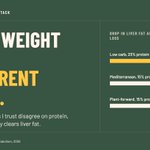
A new trial in Cell Metabolism found a keto diet cut liver fat by 67%, versus 45% on a Mediterranean or plant-forward diet – with weight loss matched and all food provided.
So keto wins? Not so fast.
The keto diet in this trial was also much higher in protein: 23% of energy versus 15% on the other two. Ketones only rose modestly. When I sat down with Dr Nicola Guess, her read was that more protein and fewer carbs were doing the heavy lifting, not ketosis.
And despite 23% of energy from saturated fat, LDL and apoB changed about the same as on the other diets. But everyone was losing weight, which can mask the effect, so this study can't tell us saturated fat is fine.
The practical take is a higher-protein, lower-carb Mediterranean-style plate, with olive oil, nuts, and seeds.
Full conversation is EP #441– link below.
Save this for later, or share it with someone navigating fatty liver or prediabetes.
Study: Petersen MC et al. Cell Metabolism, 2026.


It Wasn’t the Ketones: What Really Cut Liver Fat in the New Keto Study | Nicola Guess
youtu.be/kZzRMnpq5Is
Jacked @ 60
Happy birthday @richroll


The Viral Keto Liver Study: What It Actually Showed About Liver Fat, Protein & Carbs | Nicola Guess, PhD
youtu.be/kZzRMnpq5Is
Simon Hill MSc, BSc retweeted

An orthopedic surgeon and a performance coach developed a resistance training routine that protects and strengthens knees by improving the body’s ability to move.
Here’s how to do these exercises: wapo.st/4hX2Liz
Have a great ENT on The Proof tomorrow.
Any questions about ear, throat nose physiology/conditions/treatments??
Can A Partially Torn Tendon Heal Without Surgery? | Howard Luks
youtube.com/shorts/IXfJQiGpj… @hjluks

What Causes Fatty Liver? MASLD, Metabolic Dysfunction & Alcohol Explained | Aleksander Krag
youtu.be/pAzh7rXZ6Pc
Ai or a massive change in sentiment? @grok

Statins, Ezetimibe or PCSK9 Inhibitors: How Doctors Choose | Dayspring & Soffer
youtu.be/DYdD_9OJRio
Cc @Drlipid @ethanjweiss @dan_soffer @nationallipid @NutritionMadeS3 @GardnerPhD @baldy

Simon Hill MSc, BSc retweeted

It was an honor to co-author the International Society of Sports Nutrition position stand evaluating the scientific evidence on dietary strategies for weight loss and body composition (PMID: 42867412). Huge kudos to @thealanaragon for spearheading the effort.
Some key takeaways:
--Calorie deficit is king: Weight loss is primarily driven by sustained energy restriction, with dietary approaches best tailored to individual preferences and goals.
--Intermittent fasting isn't superior: Time-restricted eating and other fasting strategies generally produce similar weight and fat loss compared with continuous calorie restriction.
--Carb vs fat ratios are overrated: Both lower-carbohydrate and lower-fat diets can be similarly effective for fat loss. Ketogenic diets may lead to greater reductions in fat-free mass, but this appears to be partly attributable to changes in glycogen/water stores.
--Protein matters: Intakes of 1.2–1.6 g/kg/day are appropriate for the gen pop, while 1.6–2.2 g/kg/day may optimize muscle anabolism when combined with resistance training. Higher intakes may benefit lean, resistance-trained individuals dieting in a caloric deficit.
--Lift weights to preserve muscle: Resistance training combined with adequate protein intake is essential for minimizing lean mass loss during weight reduction.
--Meal frequency is flexible: Eating more frequently does not inherently enhance fat loss, although distributing protein across at least three meals daily may benefit muscle retention and performance.
--Aggressive dieting isn't necessarily better: Very-low-calorie diets can accelerate short-term weight loss but offer no clear long-term advantage and may increase the risk of muscle loss and nutrient deficiencies.
--Metabolic adaptation is real: Energy expenditure can decline during weight loss, sometimes beyond what is predicted by changes in body composition. However, these adaptations aren’t inevitable and may diminish with weight stabilization.
Bottom Line: There is no universally superior diet for fat loss. The best approach is one that creates a sustainable calorie deficit, provides sufficient protein, incorporates resistance training, and aligns with individual preferences to promote long-term adherence.
tandfonline.com/doi/full/10.…

Highly interesting and enjoyable episode recorded today with Dr Eric Helms
Do people often turn to anabolic steroids well before they’ve reached their genetic potential?
How should people interested in healthy aging approach training volume, intensity, tempo and reps per set.
And a whole lot more.
2 hours flew by. Safe to say we will need a part 2 and 3 and 4.
Will be out on our YouTube channel in a few weeks.
And before that we have a new conversation with Dr Nicola Guess on ketogenic diets, liver fat and metabolic health.
Subscribe below
youtube.com/@theproofwithsim…

Why Are Fewer People Dying From Heart Disease? 50 Years of Progress | Dayspring & Soffer
youtu.be/zrX5Rwt8rZs
@Drlipid @dan_soffer @nationallipid