

Joined September 2016
- Tweets134
- Following292
- Followers2.2K
- Likes11.9K







@TimeCycleLab retweeted
This week at Timecyclelab: the first case study.
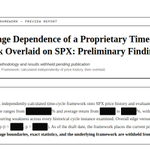
The March 2003 T marked the bottom of the bear market. By the numerical record, the framework’s call landed within tolerance.
Terry himself, looking back ten months later, counted it as a near-miss.
That gap — between what the data says and what the analyst was willing to claim — is the texture of the case study.
@TimeCycleLab retweeted
What I’m working on at Timecyclelab over the next few weeks:
— Posted this week: How do you actually test a forecaster’s record after he’s gone? timecyclelab.substack.com/p/…
— A reader spotted a pattern Terry hadn’t drawn. The market peaked when Terry projected. What does that one call tell us?
— Why long-range Ts work and short-range ones don’t
— What the 2007-2009 crash period adds to the picture
— I’ll also be looking at a couple of case studies
One post per week.
@TimeCycleLab retweeted
A Price T just resolved.
Target May 29th → market topped June 2nd → sold off right to the 55-day MA. One of Terry Laundry’s channel techniques. (More on those soon.)
Next: a short-range T resolving in the coming weeks. I’ll post the date and the result live — watch it play out.
Beyond that, a larger Advance-Decline T points higher into late this year. I have a precise date for the turn.
Skill or luck? That’s the whole experiment.
@TimeCycleLab retweeted
IV. How do you test a forecaster's record after he's gone?
open.substack.com/pub/timecy…
@TimeCycleLab retweeted
A reader named Steve emailed Terry Laundry in early 2004 about a pattern he’d spotted in Terry’s charts.
Terry took it seriously enough to name the pattern after him and project an S&P peak three weeks out.
The S&P peaked the day Terry projected, give or take twenty-four hours.
That’s the kind of thing that, if you saw it once, you’d assume was a coincidence.
So I went back and tested all of Terry’s projections from 2003 to 2008.
timecyclelab.substack.com/p/…
@TimeCycleLab retweeted
Terry Laundry left behind eight years of public market calls.
I tested them. Same archive, three numbers:
— +92pp alpha vs buy-and-hold at perfect timing
— +83pp at his own mechanical signal (1-2 days after each low)
— +30pp acting only on the formal newsletter confirmation
The framework worked. The newsletter ran weeks behind its own signal.
Which number a subscriber received depended on how closely they were reading.
timecyclelab.substack.com/p/…
@TimeCycleLab retweeted
Markets spend roughly half their time going up and half going down. Yet they produce positive returns over the long run.
Symmetry in time. Asymmetry in return.
Terry Laundry spent fifty years saying this had a shape. I tested his published record. Same archive, three findings:
— The framework’s signal was real
— The newsletter that delivered it ran weeks behind
— Subscribers’ returns depended on how closely they were watching
Introducing Timecyclelab. A research letter on T-Theory — quantified, verifiable.
timecyclelab.substack.com/p/…