

Head of DevOps @InVideoOfficial
Mumbai
Joined February 2014
- Tweets162
- Following237
- Followers130
- Likes558




Sumit Srivastava retweeted

Andrej Karpathy:
"Prompting is going away.
Delete everything, keep Graph."
In 1 hour he explains how to build Graphs, and why it's the only thing that will be left standing at the end
LLMs → Prompts → Agents → Graphs
a prompt gets you one answer and forgets the job
an agent finishes the job and forgets what it learned
a graph saves every finished job and turns it into the starting point for the next one
watch it today
then save the full guide on Graphs below before everyone catches up ↓


This is going to be very very interesting


Sumit Srivastava retweeted

Depth-aware light injection in TypeGPU
I got a 448x448 monocular depth model down to ~8 ms on my M4 Pro across ~250 dispatches, which is fast enough to use in realtime :D
Since the inference is written directly in TypeGPU, I can just feed the depth buffer straight into the lighting pass. It never has to leave the GPU or go through any extra synchronization/interop step
Inference, lighting and draw all go through the same command encoder.



Lol

Beginning July 20, Claude Fable 5 will be included in all Max and Team Premium plans, at 50% of limits.
Pro and Team Standard users will continue to have access to Fable via usage credits, and will receive a one-time $100 credit.
Demand for Fable has been challenging to predict, which is why we rolled it out to subscription plans in stages, extending access several times as we secured additional capacity.
Sumit Srivastava retweeted

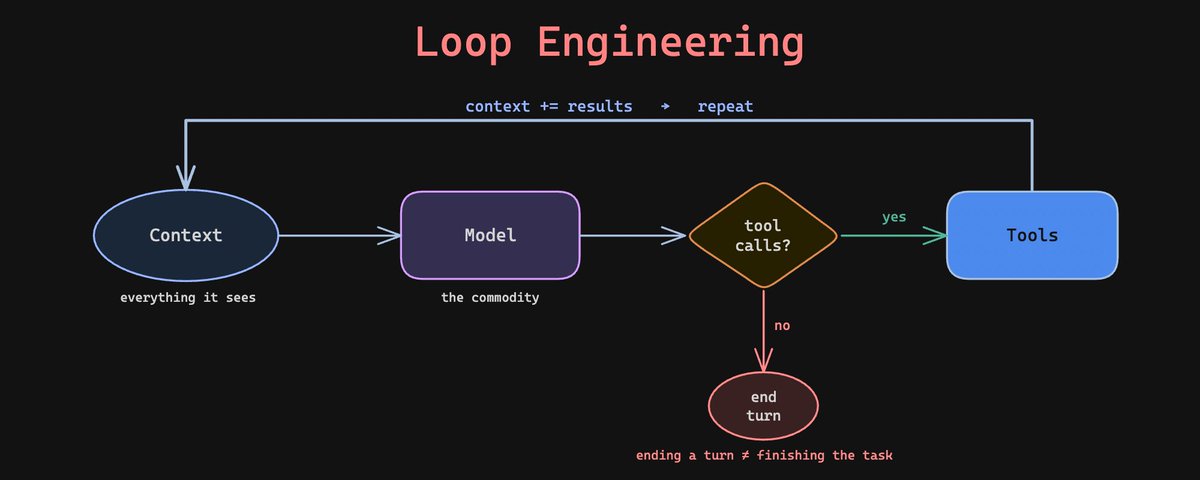
the four types of agent loops.
loop engineering keeps getting talked about as one thing. it's actually a choice between four structures, and each one fits a different kind of task.
it means designing the system that steers the agent, instead of steering it yourself move by move.
that system always answers two questions. what starts a run, and what decides the work is done.
in a hand-run session you answer both yourself, every single time. each loop type moves more of that into the system.
here's each type, what triggers it, and when to reach for it.
1) turn-based.
triggered by a user prompt. the agent gathers context, acts, and checks its work inside a single turn, then a human reviews the output and writes the next prompt.
use this when requirements are still forming and every output changes what you'd ask for next.
2) goal-based.
triggered by a /goal command carrying success criteria and a budget, like "get the homepage Lighthouse score to 90, stop after 5 tries." when the agent tries to stop, an evaluator model checks whether the goal is met, and a no sends it back to work.
use this when the outcome is measurable but the path there isn't worth your attention.
3) time-based.
triggered by a clock. an interval fires, the agent runs a fixed prompt like "check the PR, fix CI," then waits for the next tick. /loop runs on your machine, /schedule moves it to the cloud so it survives a closed laptop.
use this for recurring work where the task is known in advance and only the timing repeats.
4) proactive.
triggered by an event or schedule with no human present. a routine watches a channel, and when something needs handling it spawns a workflow with a triage agent, a fix agent, and a reviewer that adversarially judges the work before the task closes.
use this for standing responsibilities where you can't predict what will come in, only that something will.
each type hands off one more job than the last. turn-based keeps both with the human, goal-based automates the checking, time-based automates the trigger, and proactive automates both while deciding the workflow shape at runtime.
so the mapping question isn't which loop is most advanced. it's whether your task is exploratory, measurable, recurring, or standing.
the more you hand off, the less you babysit.
I wrote the full breakdown on loop engineering. the article is quoted below.


Sumit Srivastava retweeted
There are a hundred "character sheet" and "product sheet" hacks floating around X claiming to fix the AI consistency problem. We tested them. They don't really work.
On Thursday we're busting the myths - showing you how to truly approach the consistency problem, building an ad film live, and answering your questions on the spot.
July 2, 2026
7:30 PM IST / 7 AM PT
Registration link in the thread

Sumit Srivastava retweeted
India's first AI filmmaking lab is here.
We partnered with Subhash Ghai's Whistling Woods International to build it.
@SubhashGhai1 @Whistling_Woods
The full story 🧵

Sumit Srivastava retweeted

Our work has been accepted at ICML 2026 main track!
arxiv.org/abs/2511.02623
If you are interested in alignment and specifically realignment then do check out our work on resource constraint editing of LLM values!
@murari_ai @debdeeplikesai

Sumit Srivastava retweeted
If you've ever had sleepless nights and panic attacks when a client said 'I love it, BUT…' - this one's for you 😅
Swap characters, change wardrobes, redo entire scenes: without starting over. Agent One remembers your project, updates what needs to change, and keeps everything else exactly the same.

