

Research at @GoogleDeepMind. Gemini Omni Team. Priors: GNNs, Structured World Models, Neural Assets, Veo Ingredients/References, Veo Robotics
San Francisco, CA
Joined June 2009
- Tweets2.3K
- Following1.4K
- Followers29.9K
- Likes13.3K


Pinned Tweet
My PhD thesis "Deep Learning with Graph-Structured Representations" is now available for download: hdl.handle.net/11245.1/1b63b… -- It covers a range of emerging topics in Deep Learning: from graph neural nets (and graph convolutions) to structure discovery (objects, relations, events)

Thomas Kipf retweeted

We added Gemini 4 Argon to our AutoResearchExam Pareto curve. It is 2-3 times cheaper compared to the other frontier models for almost the same ML engineering performance. Congratulations to the GDM team.


Thomas Kipf retweeted

As a German, it is a tragedy: in a parallel universe this would be Germany’s moment, as it requires so much that Germany has traditionally excelled at: industrial capacity, engineering, world-leading physics, design and manufacturing excellence. That was exactly what ‘made in Germany,’ stood for.

Thomas Kipf retweeted

We’re rolling out Gemini 4 Argon in Antigravity to paid Google AI Pro subscribers today. Demand has been incredible and we've scaled capacity deliberately to get here. We’ve rolled out a separate weekly-only Argon quota for Pro on top of the existing Gemini bucket for 3.8 Flash so you have the best of Gemini for all your tasks.
Argon 🫶 Omni

Argon can also plan effectively in world models!
Here it went through an iterated loop of 1) writing out plans for how to achieve a goal 2) using an omni world model to simulate consequences of actions 3) reflect on produced rollouts to modify the plan. This is the resulting video plan.
More details in our blog - developers.googleblog.com/ge…
Frontier models now enable zero-shot robotic control and other robotics use cases. Super excited about Gemini 4 Argon’s capabilities in this space.

Argon is very capable model for agentic robotics use cases. We've put together number of examples across control, sim from real, value prediction, hindsight labeling, etc: developers.googleblog.com/ge… Excited for folks to try it.

Thomas Kipf retweeted

Excited to launch Gemini 4 Argon, designed to help with hardest coding and knowledge work tasks with its frontier capabilities..
For developers and enterprises, it’s available in the paid tier of the Gemini API and the Gemini platform, for Ultra subscribers in Google Antigravity, and Ultra and Pro subscribers in the Gemini app and Search.
Read more: blog.google/innovation-and-a…

spot on

European households are sitting on €10–12 trillion in cash and bank savings. Invested, that money could power European growth. A stronger European economy means a better trading partner for America and a more capable NATO ally.
So why isn't that money invested? Savers don't believe companies in Europe can earn enough to justify the risk.
Mario Draghi's competitiveness report named the cause: Europe has piled rule upon rule while its productivity engine has stalled. Small businesses agree. They call regulation their biggest obstacle.
Making investing simpler, as Brussels plans, is a start. But savers follow growth. So, how do we get there?
Energy abundance, faster permits, rewards for investing in growing firms, and an end to overlapping reporting rules that turn mid-sized firms into reporting shops.
And one test for every new rule: Would a competent founder still choose to build and grow in Europe?
Make Europe a better bet, and the capital will follow.
Read my op-ed in @rapporteur_news ↓ rapporteur.com/opinion/europ…

Thomas Kipf retweeted

I work at Google DeepMind and yes I have tried the model known externally as “Argon”.
I can say this:
I don’t reach for Opus anymore for any work (like I did when 3.8 Flash was our top model).
I hope that it will soon be generally available for everyone to enjoy!

That’s a solid recipe for developing RSI (repetitive strain injury)

Cant wait to see whoever picks Praseodymium first


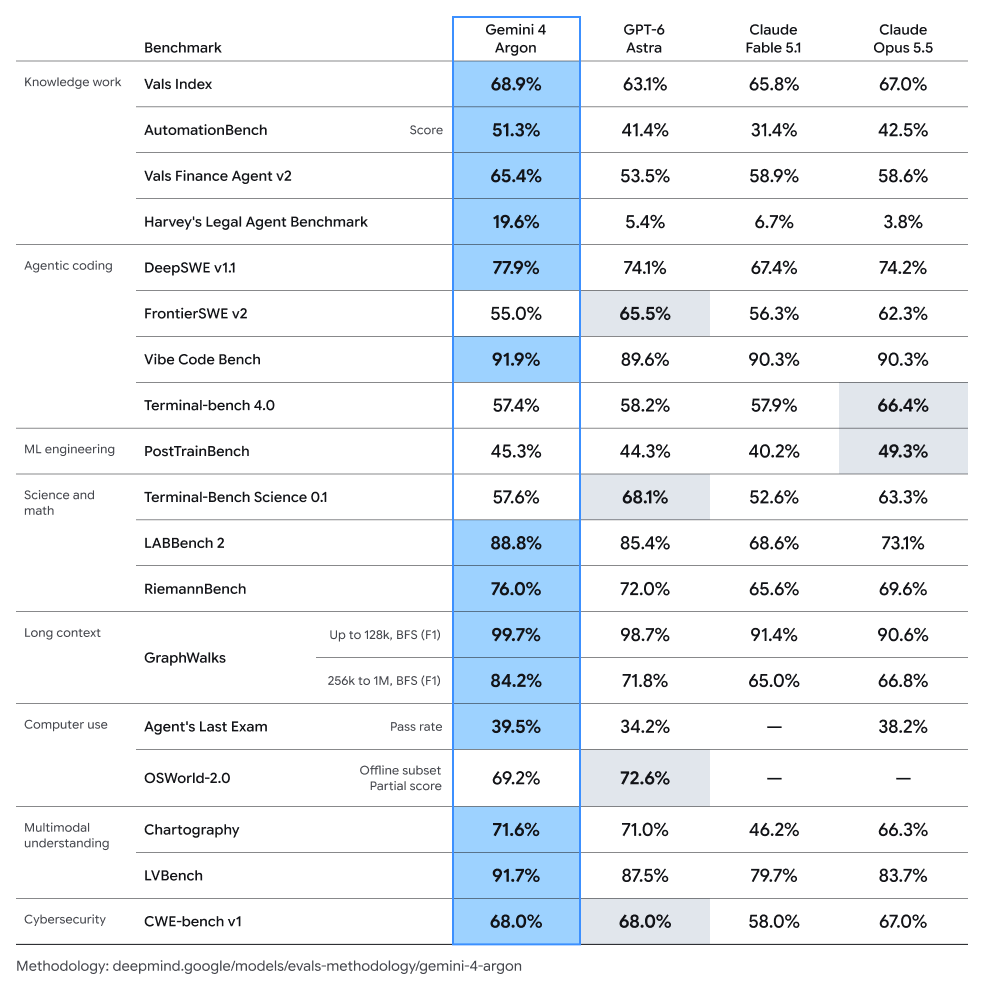
Really excited about this model. Well-rounded and incredibly strong across knowledge work, coding, science, and cybersecurity defense.

Thomas Kipf retweeted

Leaving aside the arguments over the reasons why this has happened, it is shocking that Europe does not have a single frontier AI lab, nor even a near-frontier lab nor even an effort that could likely lead to building up a frontier lab in the future.
Now is the time to step up the game in terms of AI cybersecurity before it’s too late. Great article and vision by @Shalev_lif and team.


Thomas Kipf retweeted

Today we have 3 new DeepMind Institute essays:
How can we control misbehaviour in agent swarms?
How should we orchestrate complex networks of AIs and people?
The case for making AGI’s benefits equitably distributed.
Get them here -> bit.ly/deepmind-institute

Thomas Kipf retweeted

I was encouraged this week to see the leaders of the frontier labs agree on the need for them to slow down the pace of AI development. Given the stakes, it’s a good and necessary first step.
But I’m even more encouraged by the growing recognition that how this powerful new technology develops should be at the center of our public debate.
I’ve been watching the progress on AI for over a decade now, and one thing that’s clear to me is that the potential impact of this technology is not overhyped. It’s also moving at lightning speed – and even faster than those who are engineering it can keep up with.
I’m not an AI accelerationist who believes it will lead to some techno-utopia, and I’m not a doomer who thinks it will inevitably lead to humanity’s destruction.
But whether this technology results in amazing breakthroughs in medicine, energy and education or unleashes huge economic disruptions, greater inequality, and potential catastrophe will depend on the choices that we make right now – choices that should be made not just by the companies involved, but by all of us.
Continual learning a.k.a. learning on the fly

I and @nicochristie ran the fly connectome and found the group of neurons (hΔH, hΔA, hΔI and hΔG) that could allow the fly to navigate using fast synaptic weight updates, not neural activations. This is fast-weight continual learning in a fly, something current LLMs don't do!
We’re hiring! This is a rare opportunity to work with the folks that built Veo, Genie, and Gemini Omni — and advance the frontier of world models.
More details below 👇

Research Scientist opening (Mountain View / San Francisco): google.com/about/careers/app…