
Software engineer & architect. Building agent systems and developer tools.
San Francisco, CA
Joined April 2011
- Tweets1.3K
- Following17
- Followers144
- Likes1.1K







Tomas retweeted

Binance's initial investigation suggests that the security incident may involve a compromised DevOps engineer’s laptop, which allowed an attacker to gain access to a service container and submit unauthorized withdrawal transactions. We have found no evidence of any wallet private key leak. We will share a detailed technical post-mortem once the investigation is complete and the facts are fully verified.
The estimated total impact sits at around $6.3B. We have worked with blockchain partners to freeze affected assets, with ~$3 billion frozen on-chain so far.
Binance will cover all losses from the SAFU fund and the company’s funds. User funds are safe. We will also publish an updated Proof of Reserves once the remediation is complete.
As an immediate precaution, Binance has:
- temporarily suspended deposits and withdrawals while security checks are completed;
- revoked the affected address authorisation;
- engaged law enforcement and blockchain intelligence partners to trace and recover funds.
Our teams are working around the clock to resolve this issue safely and thoroughly. We are working closely with our law enforcement partners to confirm the identity of these criminals and bring them to justice.
Please rely only on official Binance channels for updates. Please feel free to contact Binance Customer Support if you have any further questions.
binance.com/en/support/annou…

Halloween fact: Reese’s Pieces contain no chocolate.
They’re mostly sugar, partially defatted peanuts, hydrogenated vegetable oils, and corn syrup solids.
Some of the natural peanut oil is removed and other fats are added. Nearly all the fat is saturated, unlike peanut oil, which is mostly unsaturated.
The shell also contains four artificial dyes and a confectioner’s glaze.

Reese's Pieces have no chocolate in them. The peanuts had their oil pressed out and a cheaper fat put back in.
Sugar is first, then partially defatted peanuts, then hydrogenated palm kernel and soybean oil, then corn syrup solids. Everything after that is 2% or less, and it's the dyes, the glaze, some vanillin and a little milk. There's no cocoa anywhere.
Partially defatted just means the peanuts went through a press. The peanut oil comes out one side and gets sold as peanut oil. What's left is a dry peanut flour, and that's what the center is made from, because flour holds a shape in a panning drum and doesn't go rancid. Then they put fat back in, and the fat they picked is hydrogenated palm kernel oil, which is solid at room temperature and costs less than peanut oil. You can see the swap on the panel. 38 pieces have 6 g of fat and all 6 are saturated. Peanut oil is mostly unsaturated, so that number isn't the peanut.
The shell is sugar with 4 dyes and a coat of shellac.
I remember experiencing this Half-Life: Alyx scene on my Valve Index many summers ago. Shivers ran down my spine.
Replaying it on Steam Frame this time around - no shivers. The audio just doesn’t do it justice.
I hope @valvesoftware releases that promised Index-style off-ear hot-swap shiver-restoring audio strap soon.
Built a gaming rig with Noctua’s liquid cooler (NL-LC1-36) and realized how quiet the fans are, so I rebuilt my homelab with one too. The old homelab was already pretty quiet, but now I can barely hear it.
Really impressed with @Noctua_at

1/5 PSA: Check your USPS receipts before you leave the counter.
On Oct 14, I shipped a $1k laptop and watched the clerk scan it.
On Oct 15, still no tracking update. Checked the receipt: somebody else’s shipment to Colorado. Great.
4/5 Later on Oct 16, someone from Bernal Heights Post office called. Same advice: wait until next week, then report it missing. She said they’d look for footage if I reported it missing, and she’d keep an eye on it.
That was the reassurance I needed.
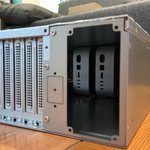
Update: Installed two Mac minis inside a SilverStone RM31 chassis, with all ports nicely accessible through the PCIe slots.
3D printed rear holders secured with double-sided tape to prevent the minis from sliding around.


Tomas retweeted

Took a look at the Deckard-Plano (Micro-OLED Frame) stuff… after waking up to pure panic
Yeah it’s in there. And they do a lot of wacky things to make it possible… with the current 8 Gen 3 chip
They even pair it with the upcoming hotswappable battery headstrap by default
In my opinion, that’s probably required due to power consumption.. And while I would love to say “True Deckard soon,” I genuinely think they’re better off waiting a bit more for the Compute module to upgraded to a newer chip, with these Micro-OLED displays that ALSO need new optics
You could argue that it’s only for streaming PCVR, but I disagree. Valve built just enough of FrameOS to support the Spatial Computing usecase to where people can do some amazing things with a Linux PC on their Face. And while that’s still hella buggy, and taped together.. that’s just software waiting to be fixed
When you switch to Micro-OLED, you get way better visuals. But lose VR gaming focused aspects such as FoV and motion clarity. BUT it still is a greater experience, in my opinion, for many other things
Valve positions the current Frame as a way to play the entire 2D game library. Verified titles for those is quickly growing way faster than VR titles
But frankly, the current display/optics setup truly doesn’t make that usecase more enjoyable. A slightly lower FoV + Micro-OLED system definitely would
But even with the foveal magic they’re introducing here in the code, that doesn’t solve the heat and performance problems even with streaming. The 8 Gen 3 isn’t THAT much better than the chip in the Samsung Galaxy XR. Which uses a lot of these same tricks on an XR2+ Gen 2
That headset throttles a lot even when streaming. It’s a serious problem
So when I combine all of these thoughts together in my head. I actually just hope that this is an optics/display prototype being prepped for a bit later down the line. Rather than a Steam Deck/Steam Deck OLED situation
The software situation on Steam OS (for Frame) is still a mess. And to have valve engineers and contractors split between supporting two models THIS FAST, after such a rough launch, would be a bit of negligence, imo
At the end of the day, I knew valve would adopt Micro-OLED in one of their Headset products at some point. They’ve put serious effort into it over the past deckade and a half they’ve been doing VR. I’ve reported on some truly insane stuff they did in this field. It is inevitable
But for this, I pray that inevitability is a bit further out..


Called it!
OLED Steam Frame “Plano” found in the source code, suggesting it’s in development.


Valve is working on a Frame OLED:
- 3552×3840 up to 90Hz (similar to those on the Galaxy XR)
- same SoC as Frame LCD
- renders at half res (1776×1920) to hit the same perf as LCD with an option for "Foveated Scaling" to show the UI at native res
more at:
steamframehub.com/exclusive-…
I've spent the entire day working on the same MR. Feels like I'm back to GPT-5. No consistency, questionable logic, everything unnecessarily overcomplicated. I have to nitpick every line of code.
What the hell happened to this model?
GPT-6.1 SOL keeps overcomplicating simple solutions. Even when I explain exactly how to implement something, it still suggests schema versioning, backward compatibility, and abstractions nobody asked for. I wonder if this is also why its explanations are so hard to follow.
Feels like it’s getting worse. Makes me consider downgrading.
