

PhD student @uwastronomy | Former post-bacc @CenterForAstro | @Harvard '20 🌊 Gravitational waves, 🛰️ LISA, 🔭 LSST, 🏑 field hockey, 🧗 rock climbing
Seattle, WA
Joined November 2021
- Tweets75
- Following183
- Followers197
- Likes287




Pinned Tweet
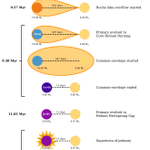
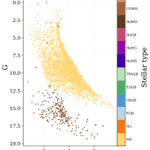
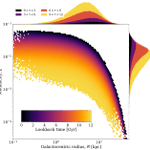
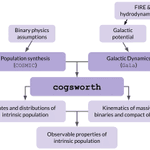
Excited to share the release of my new code cogsworth (cogsworth.readthedocs.io/en/…) that YOU can use to make seamlessly self-consistent population synthesis and galactic dynamics simulations! The paper is out on arXiv (arxiv.org/abs/2409.04543) but read on here for more details 🥳
cogsworth is built on top of the COSMIC and Gala codes, letting you access any of the awesome features in those packages through cogsworth. I'm so grateful for my wonderful co-authors @spacetimekatie, Mathieu and @adrianprw on this project who made it a joy to work on!
Excited to get started? The online documentation (cogsworth.readthedocs.io/en/…) includes nearly 20 tutorials, a gallery of quick examples and several in-depth case studies to give you everything you need to become a cogsworth expert in no time😎 Can't wait to see what you do with it!
I had a great time developing this with @FloorAstro, we're really hoping it can be useful for the community! Very fun seeing what a random conversation at @FlatironCCA can turn into 😁

Software is increasingly important for research, but is often not cited. This is why @tomjwagg & I introduce the Software Citation Station 😎👩💻🚉 arxiv.org/abs/2406.04405:
a public website and tool to quickly find or add software citations! Try it here: tomwagg.com/software-citatio…
More in the paper about how much irradiation a planet might have, the fundamental nature of rats in our Universe and some important conclusions. Use the link above or just go to tomwagg.com and type "\rats"
And finally, with the combined artist talent of my co-authors we were able to visualise exactly what some irradiated rats on a nearby planet may look like. Including piRATes and kaRATe masters

First we need to form a main sequence star-RRAT binary system, for which we used COSMIC and cogsworth to demonstrate some typical system parameters.


In a new paper today we coin the new acronym RATRATARRATRATTS! We explore how Rotating Radio Transients (RRATs) could come together with Runaway T-Tauri Stars (RATTS) to form a binary RRATRATTS and how irradiated rats could evolve on a planet nearby.
tomwagg.com/pdf/rats.pdf
Paper day today! 🎉 So excited to share this work investigating how mass transfer leaves imprints on the asteroseismic signals of a star: arxiv.org/abs/2403.05627. More in the thread below! 🧵

ALT Hertzsprung-Russel diagram of the evolution of a mass-transferring binary star
In summary: mass transfer leaves significant imprints on asteroseismic signals throughout the main sequence and this provides opportunities for studying binary physics…but also implies a need for caution when fitting stars. Future work should explore a range of accretor models!