Betteroo (@trybetteroo) header
Betteroo (@trybetteroo) profile picture

😴 You're not failing. You're exhausted. πŸ† Personalized, award-winning parenting support ⬇️ Get yourself back β†’ Take the free quiz

Joined June 2025
Photo by Betteroo (@trybetteroo)Photo by Betteroo (@trybetteroo)Photo by Betteroo (@trybetteroo)Photo by Betteroo (@trybetteroo)Photo by Betteroo (@trybetteroo)Photo by Betteroo (@trybetteroo)Photo by Betteroo (@trybetteroo)Photo by Betteroo (@trybetteroo)Photo by Betteroo (@trybetteroo)Photo by Betteroo (@trybetteroo)
Things we all said we'd never do β€” then had a baby: β€’ Drive around the neighborhood at 11 p.m. so the baby would sleep β€’ Bribe the toddler with screens β€’ Eat dinner standing up at the kitchen island β€’ Throw out the sleep schedule because it's a long weekend β€’ Take a 4 a.m.
3
1
1,093
selfie because you needed proof it happened If you broke a rule today that you swore you'd never break β€” welcome to the club. Most of us have torn up the rulebook at least twice. ✨
1
1
201
Things experienced parents never forget to pack for a family trip with a baby: β€’ A familiar sleep sack (or the home sheet) β€’ A white noise machine (the phone app, downloaded, counts) β€’ Blackout for the window (a black trash bag and painter's tape works) β€’ 3 more outfits than
1
177
you think β€’ The bedtime book β€’ Snacks for the parents (you will forget yourselves) β€’ A backup plan that doesn't have to be on schedule You won't sleep great. You'll have a hard 6 a.m. on day 2. And you'll come home with photos that make it worth it. πŸŒ™
1
1
101
What your partner actually wants for the long weekend (an honest list from many parents): β€’ A full nap. Not a "lay down for 20 minutes." An actual nap. β€’ One meal they don't have to think about, plan, or clean up.
2
1
112
β€’ A coffee that goes cold because they're reading β€” not because the baby cried. β€’ A solo shower with the door closed. β€’ Permission to be bad at parenting for an hour. None of this requires a grand gesture. Most of it requires you to be the one who notices. πŸ’›
1
1
82
Top 10 things a toddler will negotiate at bedtime: 1. The number of stories ("one more") 2. The order of stuffies in the bed 3. The lighting situation 4. Water (suddenly, urgently thirsty) 5. Pee (now) 6. Hugs (just one more) 7. The pajamas they're already wearing 8.
1
1
77
The pajamas they refuse to wear 9. Which parent does bath 10. Whether bedtime exists at all tonight If you have just survived all 10 of these in 22 minutes β€” see you tomorrow. πŸŒ™
1
1
56
Every evening around 5 p.m., a small human turns into a different person. The baby who was fine all afternoon is suddenly inconsolable. The toddler who was sweet at lunch is now a Category 4 storm. It's not your fault. It's not your cooking.
1
1
53
It's the witching hour β€” a near-universal pattern of late-afternoon overstimulation that hits most babies in the first 12 weeks and most toddlers, occasionally, forever. You're not failing dinner. You're surviving the witching hour. There's a difference. ✨
1
35
It happened once. Your baby slept 6 hours straight. You woke up convinced you'd cracked it. You told the group chat. You felt like a person again. That night was an event, not a pattern. Real baby sleep looks like a chart that goes sideways, not up.
1
1
31
A 5-hour stretch on Tuesday and a 90-minute one on Wednesday is normal. You didn't "do" the good night, and you didn't "break" the bad one. The randomness is the system. πŸŒ™
1
1
19
If your search history looks like a textbook on baby breathing, normal poop colors, and "is it bad if my baby…" β€” congratulations. You're a parent. Things every parent has Googled at 11 p.m.
1
1
24
at least once: β€’ is my baby breathing too loud β€’ newborn poop color chart β€’ how cold can the nursery be β€’ sleep regression 4 months why again β€’ why won't this baby sleep β€’ what's normal for a 2 week old β€’ baby fever when to call doctor If you've Googled even one of these
1
14
There is a specific kind of tired that lives in Sunday night with a small child. It is the math: counting hours of sleep before Monday. Reviewing the week's wake-ups. Wondering if tonight will be the one good night or another rough one. You are not making it up.
1
1
15
Anticipatory dread is a real thing β€” and parents of small children carry a uniquely heavy version of it because the next 12 hours are, in fact, unpredictable. Tonight, do whatever helps. Phone down a little earlier. A glass of water by the bed.
1
11
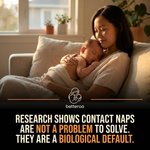
Some afternoons the only nap that happens is the one that happens on you. Here is what the research on infant sleep biology actually says: contact napping is not a bad habit your baby is forming. It is the biological default for human infants.
1
1
13
Skin-to-skin co-regulation lowers cortisol, slows the heart rate, deepens sleep, and supports healthy development β€” for both of you. You are not creating a problem. You are answering a need exactly the way your baby's nervous system is built to expect.
1
7
Today is International Day of Families. The research on what makes families thrive is surprising β€” it is not income, structure, or how Pinterest-perfect your routines are. It is the small, repeatable moments. The bedtime song you hum every night. The way you always say goodbye.
1
1
1
30
The Saturday-morning pancake. Researchers call them family rituals. They are the seemingly ordinary things that, repeated thousands of times, become the spine of a child's sense of belonging. Your family already has them. You may not have noticed. They are working.
1
1
7
This is the last day of Children's Mental Health Awareness Week. Here is what decades of family-systems research keep coming back to: The strongest predictor of a child's mental health is the mental health of the adults caring for them. That is not a guilt trip.
1
1
8
It is a permission slip. When you take care of yourself β€” when you ask for help, when you sleep, when you say 'I need a minute' β€” you are doing direct, measurable work for your child's mental health. The two are the same ecosystem. Parent care is child care. πŸ’›
1
1
8
Babies feel stress before they have words for it. They tell us in three other ways: 1. Sleep changes β€” earlier wake-ups, harder bedtimes, more night wakings. 2. Shorter fuse β€” bigger reactions to small frustrations, more meltdowns. 3.
1
1
9
Body tension β€” clenched fists, arched backs, or being harder to soothe. If your baby is showing one or two of these, they are not being difficult. They are communicating. Sometimes the answer is more sleep, more cuddles, or just more of you. You are reading them.
1
10
Your toddler is mid-meltdown. Your jaw is tight. Your voice is climbing. Here is what the research on co-regulation says: children do not learn to regulate their emotions by being told to calm down.
1
1
8
They learn it by borrowing your calm β€” over and over, thousands of times β€” until they have it for themselves. So when you take a breath before responding, you are not just managing the moment. You are giving your child a working model of self-regulation they will keep for life.
1
5
Yesterday was Mother's Day. Today the laundry is still here. The 3 AM feed is still on the calendar. The mental list of pediatric appointments, snacks running low, and who needs new shoes is still yours to carry. Mother's Day is one day. Motherhood is every day.
1
1
13
If today feels like a return to the regular shift β€” that's because it is. And the work you do today, with no card and no flowers, is exactly the work that made yesterday matter. We see you on Day 366, too. πŸ’›
1
1
7
To the mom reading this while nursing a baby on Mother's Day night β€” I see you. The day was loud. The night is yours alone again. The flowers are wilting on the counter. The card is on the fridge. The baby is rooting. You are tired in your bones. You are the whole gift.
1
1
16
Not the brunch, not the card, not the framed handprint. You. The body that is still showing up tonight, in the dark, after a day of being celebrated by people who don't know what 3 AM looks like for you. Happy Mother's Day. I'll be up too. πŸŒ™
1
1
15
A Mother's Day accounting we made for you, from the data: In your first year of motherhood, on average, you have given: β€” roughly 700 hours of sleep (about 109 minutes per night, every night) β€” roughly 3,000 feeds (around 8 a day for the first year) β€” roughly 2,500 diaper
1
1
8
changes β€” countless rocks, sways, hums, hand-on-back-of-baby moments But the number that matters most isn't on the list, because it can't be quantified. You also gave one whole version of yourself β€” the version of you that existed before this year.
1
1
7
A small thing for the night before Mother's Day: The mom who is worried she is not doing enough β€” is doing enough. That worry is the proof. Bad parents do not lie awake at night wondering if they are good parents. The wondering itself is the work.
1
1
7
The checking, the re-checking, the texting your friend at 11pm to ask if you handled the meltdown right β€” that is what presence looks like from the inside. You are not failing the mom test. You are taking the mom test. That you take it is the whole answer.
1
7
Something the research is very clear about β€” and the people around new mothers usually aren't: 1 in 7 mothers experience postpartum depression. 1 in 5 experience postpartum anxiety. And the most common time for symptoms to actually surface isn't the first weeks home.
1
1
6
It's between months 3 and 6 (NIH). Months 3 to 6 are also when most of the visible support disappears. The meal trains end. The visits taper. The texts stop checking in. People assume you've "got the hang of it." Right at the moment the data says you may need it most.
1
4
Better sleep doesn't start with a method. It starts with understanding what's actually happening. When we asked 52,642 parents: β€’ 69% of 7-9 month olds wake 3+ times a night β€’ 40% mentioned co-sleeping β€’ 70% are running on less than 6 hours of sleep O betteroo.ai/state-of-baby-sl…
1
72
A myth that has been quietly tormenting parents for decades: "Sleeping through the night" might not mean what you think it means.
1
1
26
In the most-cited research on infant sleep β€” Henderson, France, Owens & Blampied (2010, *Pediatrics*) β€” "sleeping through the night" is operationalized as a five-hour stretch of uninterrupted sleep, often measured from midnight to 5am. Not 12 hours. Not "until morning." Five.
1
24