





Pinned Tweet
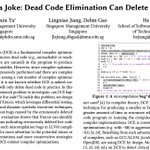
Can you believe Dead Code Elimination (DCE) can delete live code? Do check this example godbolt.org/z/z7zxexfr1, and we proposed a new approach to detect such compiler miscompilation bugs in our just accepted ICSE-NIER 2024 paper. A preprint is being prepared. #ICSE2024 #NIER

Haoxin Tu retweeted

Greetings from Singapore.
Announcing pre-QED, providing environment specifications prior to AI-based verification.
Formal verification at scale using AI, is a topic of high interest today. However, when we are verifying a piece of code, we need to verify it under all possible environments, and not just one possible scenario. The recent work of @AnthropicAI and @theoremlabs re-uses fuzz harnesses for verifying absence of crashes. However, a fuzz harness follows a single sequence of API calls under a single calling context, so the resulting proof covers one scenario, rather than verifying the library. This is a core principle our team at NUS is well aware of, after more than a decade of developing greybox fuzzing technology.
We propose verification harnesses, executable harnesses that model all legal usages of an API, so that a proof about the harness is a proof about every well-behaved client. Most importantly, we automatically generate these verification harnesses using an agentic workflow, they do not need to be manually written.
Use our verification harnesses in AI-based verification - so that we can achieve ACTUAL software verification at scale using AI. See
pre-qed.github.io
Ack: NRF Singapore AI for Science research program.
How can we trust code written by either humans or AI agents? Verify it with formal methods!
We are excited to share our work on "Agentic Verification of Software Systems" has been accepted for FSE 2026. Check more:
Paper: arxiv.org/pdf/2511.17330v2
Code: github.com/NUS-Program-Verif…


1
4
180
(2/3)AutoRocq analyzes proof structure, retrieves relevant lemmas from the current context before tactic prediction, and generates tactics guided by tree-structured representations. It also leverages feedback from the prover and proof history to refine tactic generation.
1
39
This is amazing, congrats to the KLEE team!

KLEE 3.2 is released! Many thanks to all the contributors to the main codebase and subprojects!
During the development of this release, the number of projects and publications enabled by KLEE surpassed 300!
github.com/klee/klee/release…
klee-se.org/publications/
1
81
Many thanks @mboehme_ ! The work was initiated when I was an intern at Marcel's group last summer. I believe the group in Bochum is an exceptional place that encourages creative thinking and addresses impactful problems. I am truly grateful for the chance to work with the group♥️

Huge congrats to @TuHaoxin who got his paper accepted at @ACM_TOSEM where he suggested to guide symbolic execution towards memory-corruption-prone parts of the symbolic execution tree using a scalable optimization approach called Monte Carlo Tree Search: arxiv.org/abs/2408.08772

1
7
639
Happy to share our work "Cottontail: LLM-Driven Concolic Execution for Structured Test Input Generation" will appear in S&P'26!
Paper: haoxintu.github.io/files/sp2…
Code: github.com/Cottontail-Proj/c…
Special thanks to @nim_gnoes_eel, @JNUYUXIAN, @spinpx, @LingxiaoJiang, and @mboehme_ ♥️


(5/6) Our evaluation shows promising results in terms of code coverage and vulnerability detection capability (6 new CVEs assigned for the memory issues we reported).
65
(4/6) Beyond that, we also propose (1) structure-aware path constraint selection to aviod redundant path constraint solving and (2) history-guided seed acquisition to alleviate the saturation issue.
61
(3/6) Unlike traditional solvers that operate in a syntax-agnostic manner, we introduce a "Solve–Complete" paradigm that performs syntax-aware *solving* for hard constraints in path conditions, followed by smart *completion* to satisfy soft constraints imposed by syntactic rules.
61
(2/6) Rather than relying on input grammars or specifications to guide concolic execution, our secret sauce is to harness an LLM that smartly solves constraints satisfying both path constraints and syntactic validity.
57
(1/6) In this work, we investigated the problem of *how we can perform concolic execution to generate highly structured test inputs for systematically testing parsing programs*.
81
I am happy to share that I passed the dissertation defense at SMU today! I am now officially Dr. Tu! (Or Dr. Two🤣, as I finally completed the Dual-degree PhD program 🎓🎓 in 6 years!)
Special thanks to all committee members: Profs. Lingxiao, Xuhua, @davidlo2015, and @mboehme_!


6
16
820
Also, for career updates, I am fortunate to be a Research Fellow working with Prof @AbhikRoychoudh1 for the next two years.
135
Great summary and insights on the future of memory safety.

Is this memory safety here in the room with us?
@halvarflake posted slides for his keynote talk about the recent trends to resolve the problem of memory corruptions: existing solutions, their limitations, and trade-offs.
docs.google.com/presentation…

202
Haoxin Tu retweeted

📢 Submissions are now open for Causal Methods in Software Engineering (CauSE 2025), co-located with FSE 2025! 🎉 Honored to be part of the program committee—looking forward to your contributions!
#CauSE2025 #FSE2025

Introducing the Workshop on Causal Methods in Software Engineering (CauSE 2025), organized by Julien Siebert, Roberto Pietrantuono, Neil Walkinshaw, Luca Giamattei.
Paper Due: Feb 25th, 2025
Website: buff.ly/3Otufy8

Very insightful talk, learned a lot!

Delighted to talk today about program analysis for safe and secure software evolution to a great audience in Singapore! Many thanks to Imperial Global Singapore @imperialcollege for hosting my talk.

4
355
I highly recommend adding this paper to the top-priority reading list, and I believe everyone will gain new insights after reading it, regardless of whether they are in the software security field or not.
🔮 ACM TOSEM Perspective Paper on Software Security in 2030 (Invited).
📝 mpi-softsec.github.io/papers…
Collab w/ Eric Bodden, Tevfik Bultan, Cristian Cadar, Liu Yang, and Giuseppe Scanniello // @ACM_TOSEM @c_cadar @Sun450gmailcom1 @g_scanniello
