





Asked what keeps them awake at night, 1,719 Dutch business owners and managers named the balance between work and private life, personnel and money (Exact SME Barometer 2026). In conversations with entrepreneurs, another word comes up often: headspace.
In a new article, our founder Ernesto Spruyt looks at what takes up headspace out of proportion to the time it takes, and at building in control capacity as a way to get some of it back.
xitter.cf/ernesto_spruyt/status/…


In most Western countries, job postings as a whole are back at or above their pre-pandemic level, according to Indeed's Hiring Lab. Postings for software developers are not: measured against all hiring, demand for developers stands at 47 to 90% of its 2020 level, depending on the country.
In a new article, our founder Ernesto Spruyt looks at whether that gap is caused by AI, why it closes in some countries and widens in others, and where developer demand is likely to settle.
xitter.cf/ernesto_spruyt/status/…

B2B buyers increasingly make their shortlist before they speak to any supplier. In G2's March 2026 survey of 1,076 software buyers, 51% said they now start their research in an AI chatbot more often than in a search engine, up from 29% a year earlier.
In a new article, our founder Ernesto Spruyt looks at what this means for suppliers whose value only becomes clear once a client has worked with them. He distinguishes between the AI that filters outreach and the AI that recommends suppliers, and between offerings that can be compared in advance and those that can only be judged through experience.
xitter.cf/ernesto_spruyt/status/…

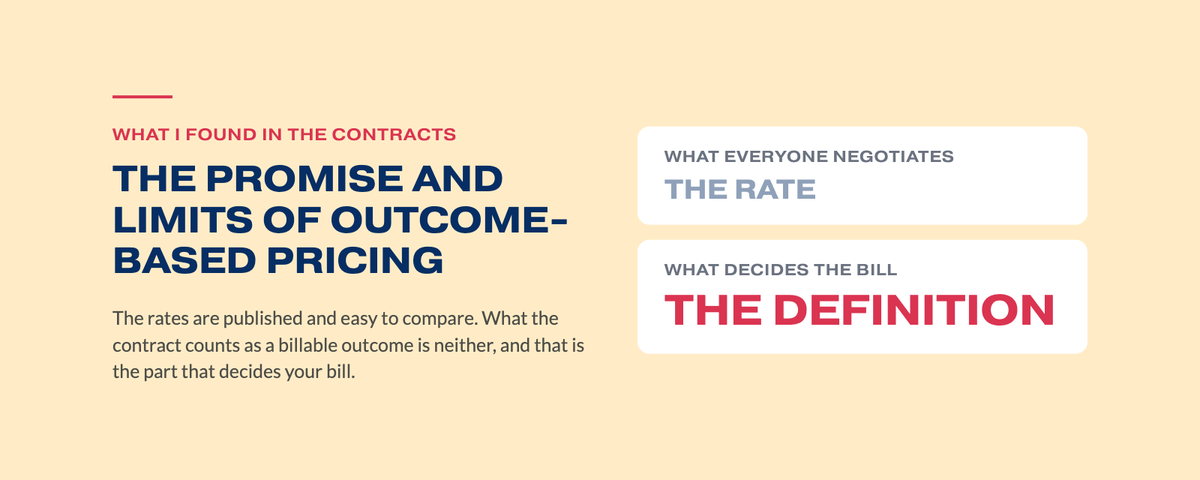
Outcome-based pricing is moving through software and services faster than the measurement that would make it work. In a September 2026 study by HFS Research and Capgemini, two thirds of the 101 financial services firms surveyed had written business outcome terms into their AI contracts, while more than four in five were still paying per FTE or per licence.
In a new article, our founder Ernesto Spruyt works through what decides an outcome-based bill once the contract is signed: whether the definition of the billable event is open to negotiation, what that event actually counts, and whether the buyer can verify the count independently. The examples run from AI customer service, where per-outcome pricing already operates at scale, to the placement guarantees in staffing.
xitter.cf/ernesto_spruyt/status/…
New piece from Ernesto Spruyt on what software teams have measured since AI became part of their daily work, and why the same pattern is now showing up in a founder's week outside software.
xitter.cf/ernesto_spruyt/status/…

ALT Article cover: If you mostly work at a computer, this is how your job will change

New piece from Ernesto Spruyt: surveys put hiring near the bottom of founders' concerns, while the measured costs of an open role and a rushed hire are among the largest a growing company carries. On why those costs rarely show up under their own name.
xitter.cf/ernesto_spruyt/status/…

ALT What's quietly eating your week. Why hiring costs more than it seems to, and where that cost goes. Article by Ernesto Spruyt, Tunga.

Many African software developers in our network aspire to start their own business. Brookings reports that more than 3 in 4 African young people plan to start a business within 5 years.
What stands between ambition and starting is structural and measured. Our CEO Ernesto Spruyt looks at what African software developers with founder ambitions face, what has shifted in the ecosystem over the past 5 years, and what Tunga is doing about it.
xitter.cf/ernesto_spruyt/status/…

ALT Why you haven't started your business yet — hero image for X
New piece from Ernesto Spruyt on how the work of software developers is changing in 2026.
The production of code has gotten cheap. The architectural, specification, and review work around it has become more expensive. That shift has implications for how teams are built and where value accumulates.
xitter.cf/ernesto_spruyt/status/…

ALT Where the weight in software work is moving
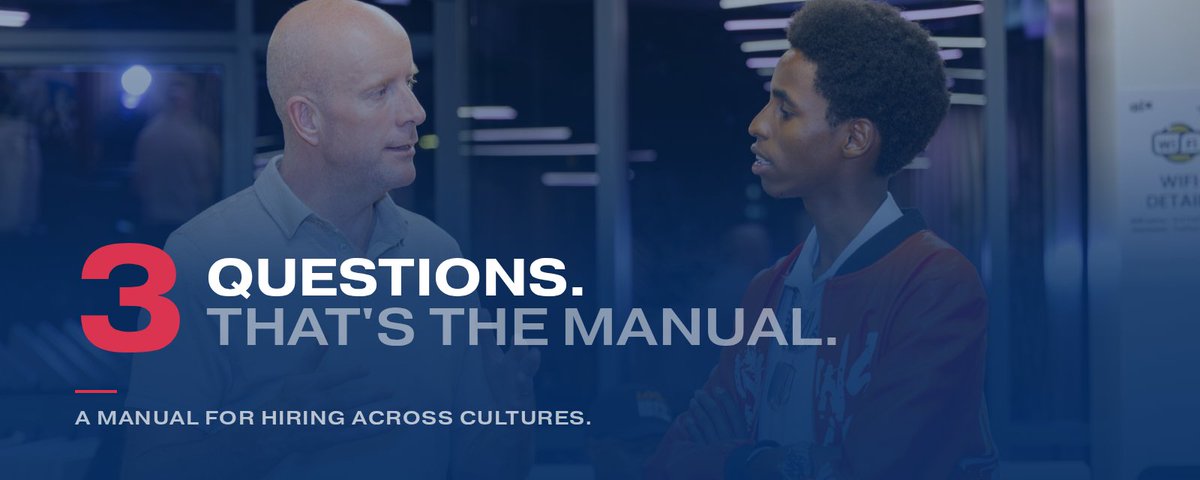
The standard models of cross-cultural work answer a useful question, but not the one founders are sitting with when they're about to hire across borders: what will matter in this engagement, with this specific hire.
Our founder @ernesto_spruyt distilled 10 years of cross-cultural hiring into 3 questions that take less than an hour at the start of an engagement.
xitter.cf/ernesto_spruyt/status/…
88% of organisations use AI. Only 5-7% create substantial value at scale. The gap between those numbers is not a technology gap.
Our founder @ernesto_spruyt looked at what the research and the founders on the ground consistently report: the value of AI sits in operations and workflow redesign, not in engineering or product features.
xitter.cf/ernesto_spruyt/status/…

ALT AI's real value is in your operations, not your product

.@ernesto_spruyt joined @groeivoer to talk about hiring, AI, and what you should never automate when scaling a team.
youtube.com/watch?v=qZNY622G…
SaaS is the backbone of our client base. When headlines say the sector is collapsing, that matters to us.
Ernesto went through the data to find out what is actually happening: market growth, stock corrections, which types of SaaS companies face real pressure, and which don't.
xitter.cf/ernesto_spruyt/status/…

ALT The SaaS sector is supposedly dying - data analysis by Ernesto Spruyt

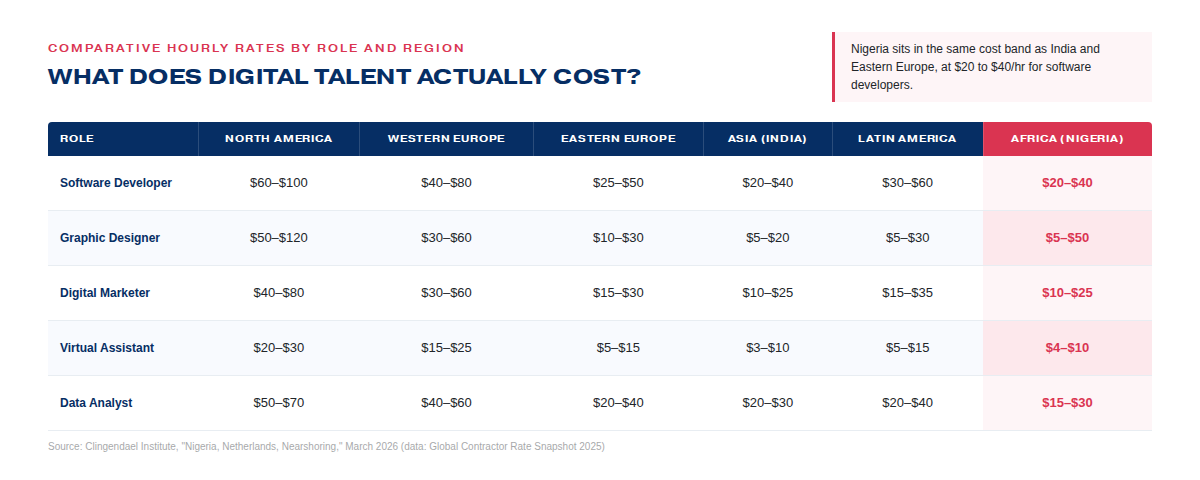
The Clingendael Institute published a report examining Nigeria as a source of digital talent for Dutch companies. The research draws on fieldwork across both countries, interviews with public and private sector actors, and survey data from Nigerian ICT students.
Tunga contributed to the research. The report references our operations and Tunga Academy as part of the ecosystem analysis.
The findings are relevant for European companies exploring alternative talent sourcing models. Ernesto Spruyt wrote about the key insights and what they mean in practice.
xitter.cf/ernesto_spruyt/status/…
Trust can feel like the hardest thing to build when your team works across borders. You don’t see each other every day. You rely on messages, calls, and shared documents. Yet trust is what holds everything together.
In Part Three of our Working Across Cultures series, Trust Is Built in Small Moments, Dorcas Olawale (Head of Delivery, Tunga) shares how real trust grows not from grand gestures but from consistency and care.
She tells the story of a developer who noticed a small security risk during a project update. It wasn’t part of his task, but he raised it anyway and suggested a fix. That one act of initiative built more trust than any meeting or report ever could.
Her message is clear. Trust is not a checklist. It is a pattern built one small action at a time. When people show up, communicate honestly, and take ownership, collaboration becomes effortless.
🎥 Watch Part Three below and share one small action that helped you build trust in a remote team.
#Remoteteams #Remotework #SoftwareDevelopment #Multiculturalteams
Tunga.io retweeted

During her visit to Uganda, 🇦🇹 Foreign Minister @BMeinl met urban refugees & young innovators at @tunga_io and @StartHubAfrica witnessing resilience, ambition & the energy driving East Africa’s tech evolution. A visit full of inspiration and partnership 🇺🇬✨
#ADA
©️Gruber


Tunga.io retweeted

We were honored to host the Austrian Minister of foreign Affairs, @BMeinl and her team at @StartHubAfrica!
We explored Uganda’s tech ecosystem and also highlighted our partnership with @tunga_io, the visit celebrated Africa’s rising tech talent.
#TechEcosystem


Communication is easy when everyone hears things the same way.
But what happens when a simple “yes” means something different to each person?
In global teams, even familiar words can carry new meanings. A quick “I’ll try” from one side might sound like commitment or doubt to the other.
These small moments can build trust or create tension, depending on how you handle them.
In Part Two of our Working Across Cultures series; Different Ways to Communicate, Dorcas Olawale (Head of Delivery, Tunga) shares a story from one of our client teams. How a small misunderstanding over a deadline could have caused confusion, but one honest conversation cleared the air.
Her takeaway is simple. When in doubt, ask. Clarify quickly. Assume good intent. Because great communication in multicultural teams is not about speaking the same language, it is about understanding what is meant.
🎥 Watch Part Two below and tell us, what is one communication habit you have learned to adjust when working across cultures?
#Tunga #RemoteWork #Remoteteams #WFH #Communication
When your development teams are spread across countries, cultures, and time zones, simple things like giving feedback or even just silence in a meeting can suddenly mean totally different things. At Tunga, however, we don't just talk about culture; we live it, and we've seen firsthand how team culture plays out. Not just as a theory, but as something that shapes every message, meeting, and deadline.
Because we know how tricky and essential cross-cultural collaboration can be, we've compiled all our lessons into a practical, 5-part video series: Working Across Cultures: Your Guide to Thriving in Multicultural Teams.
Each episode is a short, honest take straight from our team on what really makes global collaboration work.
We're kicking things off with Part One: “Culture Starts With You”, because before you can truly understand how others work, you need to understand your own habits.
Dorcas Olawale (Head of Delivery, Tunga) opens the series by sharing this powerful perspective, illustrating it with a simple story. She recounts how a small misunderstanding between a client and a developer was cleared up instantly once both parties took the time to talk through their individual communication styles.
The lesson? Great collaboration doesn't start with a policy handbook. Instead, it starts with self-awareness.
Watch Part One below and share one work habit that defines you in the comments.
#Tunga #RemoteWork #Remoteteams
Tunga.io retweeted

Back when @tunga_io first launched this program, it was TIA(Tech Impact Academy) That was just the beginning.
Today, it’s the Tunga Academy with improved training, real impact, and even more opportunities.
👉 Next Fullstack Training starts 28 Oct 2025: academy.tunga.io/product/ful…
Meet Apiut Toel
In his first big meeting, Apiut froze. “Everything just left my head,” he recalls.
At the time, it felt like failure. But his manager saw something else: potential.
She signed him up for a facilitation course and kept nudging him out of his comfort zone. Eight months later, Apiut is the one leading those meetings and shaping the direction of key projects.

When something slows the team down, Apiut does not wait for a request. He quietly works around it. He once built a tool to scan frontend code for accessibility issues, complete with reports and screenshots, simply to make life easier for his developer teammates.
He also created a prompt library to help the team get more meaningful AI outputs, testing what worked and sharing only what helped.
His desk setup is simple: two monitors, a notebook, jazz from the 1940s in the background, and a pair of foosballs he spins in one hand during long meetings to stay focused. It reflects how he works: calm, thoughtful, steady.
Ask him what matters most, and he will not mention tools or titles. He will say kindness.
“Even if it is just paying a hawker a little extra,” he says. “Small things go a long way.”
When offering advice to other designers, he keeps it straightforward:
“Know what is possible. Know what is not. Then build what matters.”