

AI / machine learning engineer / founder of @unboxresearch; coding in Python, C, js, Lua, Obj-C; math for fun. @tylern@mastodon.social
Berkeley, CA
Joined March 2009
- Tweets3.7K
- Following586
- Followers2.3K
- Likes3.4K






Pinned Tweet
I just published a fun article on one of my favorite lesser-known algorithmic ideas: locality-sensitive hashing. Fuzzy search in constant time! unboxresearch.com/articles/l…
Summary and Analysis: So Good They Can’t Ignore You, open.substack.com/pub/tylern…
Tyler Neylon retweeted

8/ ExtrapolaTED
Generate extremely well-researched TED talks on demand
RAG powered by 2 million Arxiv papers and 6 million Wikipedia pages, and 3 million photos
🥉Third place
@tylerneylon @roberthdly @ashvardanian @wordware_ai


If you want to learn about LLMs beyond blog posts and tutorial videos: I'm teaching a professional LLM workshop on Thursday. It's a one-day course on setting up and customizing self-hosted LLMs.
unboxworkshops.com/self-host…
New github gist: a js function that uses a partial order to fully sort any array. By "partial order," in this case I mean a comparison function that can sometimes say "I don't know;" as long as it doesn't contradict itself, we can still sort the array.
gist.github.com/tylerneylon/…

I'm thrilled to be co-teaching a GPT / LLM workshop with the amazing @GabrielBianconi. I'd love to hear from you: Which sub-topic should we focus on first?
33%Self-hosting LLMs
33%Productionalizing LLMs
33%Custom info/DBs for LLMs
3 votes • Final resultsI launched a machine learning newsletter!
It's called Learn & Burn. I work with an amazing team at Unbox Research to publish a weekly summary of AI/ML news around arxiv papers.
We explain, clearly and quickly, new ideas as they're shared by researchers.
learnandburn.substack.com/
I often use a single ec2 instance for development. I wrote a little Python script to simplify turning the machine on/off to reduce aws costs.
gist.github.com/tylerneylon/…
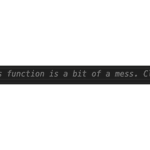
Feeling a bit judged by my AI pair programmer right now. (I start typing TODO, copilot doesn't hold back.) 😆

Q's about vector compression:
1. Are there well-known general techniques here? Not for images/audio/text, but for preserving relative cosine similarity?
2. Relatedly, is PCA known to preserve relative cosine similarities?
(More context below)
How SVD helps: Let D be a wide matrix (D is m×n, m<n). the cols of D are the vecs we'll compress.
Let D = UΣVᵀ be the reduced SVD, so U is m×k. (k < m)
Let C = UᵀD, which is k×n; its cols are the smaller vecs.
‖dⁱ-dʲ‖ ≈ ‖Ucⁱ-Ucʲ‖ = ‖U(cⁱ-cʲ)‖ = ‖cⁱ-cʲ‖.
This is one of my favorite open problems in math. Cool to see progress on it!

Coding approaches, ranked by runtime efficiency from slowest to fastest:
* Python
* JavaScript
* C / C++
* Fortran
* CPU assembly
* Code for a GPU/TPU
* Design custom hardware
* Be John Carmack