

The Department of Physics at the University of Alberta
Joined October 2019
- Tweets161
- Following26
- Followers108
- Likes4


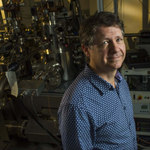


The Leonid meteor shower peaks this weekend! Sharon Morsink of @ualbertaPhysics shares some tips and insights about the annual celestial spectacular:
cnn.com/2023/11/17/world/leo…
ualbertaPhysics retweeted

Erik Rosolowsky (Physics) shares about a recent discovery involving the James Webb Space Telescope and what it tells us about the universe. #UAlberta
bit.ly/3Z1Nn95
Researchers are investigating how disease-causing fungi become resistant to antifungal drugs. “Antimicrobial drugs are fundamental for us to live healthy lives,” says Daniel Charlebois, assistant professor at @ualbertaPhysics. ualberta.ca/physics/about-th…
Want to hear more about the importance of understanding the importance of drug-resistent fungi? Hear @dacharle42 on Radio Active with Jessica Ng, Min Dhariwal: Solving a fungal problem cbc.ca/listen/live-radio/1-5…
Physics professor and @cryoZP co-founder John Davis "started diving deeper and deeper into entrepreneurship ... to better help train my graduate students for their future careers." #UAlberta edmonton.taproot.news/news/2…

"Our simulations show that the superradiance memory protocol yields the highest bandwidth storage among protocols in the same system." #UAlberta

My group's first @PhysRevLett is published today -- congrats to the quantum memory team for this work.
In it, we push an atomic ensemble to absorb and reemit an optical signal faster than the natural lifetime, via the atoms' superradiant "teamwork"
journals.aps.org/prl/abstrac…
ualbertaPhysics retweeted
The ML-in-Physics Collaboratory (sponsored by @UofA_Ai4Society) is hosting a datathon for students, Aug. 13-14. The goal is to explore how machine learning can be used to solve different problems of physical systems.
Learn more and register: bit.ly/3bHlErJ #UAlberta

ualbertaPhysics retweeted

#UAlberta physicist Lindsay LeBlanc explains how new provincial funding builds on Alberta’s strengths in #quantum technology with wide-ranging applications in almost every sector. @AlbertaEconomy @ualbertaScience @quantumalberta ualberta.ca/folio/2022/06/ne…
The James Webb Space Telescope sent back its first photo with its 18 primary mirrors aligned! #UAlbertaScience astrophysicist Gregory Sivakoff (@radioastronomer) spoke to @ShayeGanam about what we can learn from it. #JWST
omny.fm/shows/ched-mid-morni…
ualbertaPhysics retweeted

Happy Friday @ualbertaScience and @ualbertachem ! Monday is #PiDay and we want to see all of your delicious pies 🥧! Make sure you tag us so we can see all of your baking successes #UAWICpiDay2022 #AcademicTwitter #chemtwitter #UAlberta

ualbertaPhysics retweeted

Congrats to all the recipients of the LKSIoV Research Support & Innovation Grants - Winter 2021 Competition. We're pleased to support these incredible researchers. ualberta.ca/li-ka-shing-inst… @Wael_Elhenawy84 @EdanFoley @MeierStephenson

Logan Cooke won first place and Pramodh Senarath Yapa won an honorable mention at the Quantum Days poster session! Congratulations to both of these @ualbertaPhysics graduate students, their co-authors, and all the other participants. #UAlbertaCMPAMOP
quantumdays.ca/poster-sessio…
For more about Condensed Matter Physics and Atomic, Molecular & Optical Physics at @ualbertaPhysics, visit:
ualberta.ca/physics/research…
#UAlbertaCMPAMOP
Congratulations to James Pinfold, co-author with an international team including @UAlberta_CSJ's Marc de Montigny of a new paper on the search for magnetic monopoles, published in the journal Nature: nature.com/articles/s41586-0… @UofAResearch @ualbertaScience

Three members of @ualbertaPhysics will be working with international teams on data from the James Webb Space Telescope! @UAlbertaScience #JWST

🏠 Home, home on Lagrange! We successfully completed our burn to start #NASAWebb on its orbit of the 2nd Lagrange point (L2), about a million miles (1.5 million km) from Earth. It will orbit the Sun, in line with Earth, as it orbits L2. blogs.nasa.gov/webb/2022/01/… #UnfoldTheUniverse
On @CBCTheNational, Erik Rosolowsky said #JWST's ability to see through space soot will result in the clearest views of the Triangulum galaxy, a nearby neighbour of the Milky Way. @UAlbertaScience
youtu.be/PwVDPpTclPQ
Craig Heinke will use #JWST to study one special low mass star among roughly a million stars in the globular cluster NGC 6440 to see just how massive neutron stars may get.
ui.adsabs.harvard.edu/abs/20…
Wednesday's earthquake was 2nd-largest ever in Alberta. The area has a history of a variety of different earthquakes, says @ualbertaPhysics professor Jeff Gu. #geophysics #ABearthquake
cbc.ca/news/canada/edmonton/…
ualbertaPhysics retweeted

Woo, that's my supervisor!
I'm not working on this hyperbolic band theory project, but the question at the heart of it is super cool - how would quantum mechanics work in a crystal lattice in an 'Escher-esque' hyperbolic space?
Here's the paper on it: science.org/doi/10.1126/scia…

New research collaboration between physics and pure mathematics enables new strides toward quantum computing and opens new avenues for research in condensed matter physics. Hear from Joseph Maciejko on new research exploring hyperbolic lattices: bit.ly/3m59U4R
