

alignment and the model spec @OpenAI (opinions are my own)
Joined May 2010
- Tweets1.6K
- Following839
- Followers6.1K
- Likes8.5K





For years I've cross-referenced all the ballot recommendations to help me figure out how to vote and lamented that there wasn't a website that complied everything. This is the first year AI can just do it.
Try asking your favorite model
> put together an election guide for me for <location>. i want a Google Sheet with recommendations/endorsements from all the groups you can find. make sure there is a summary column or sheet that explains the high level description of the most supported positions / candidates and who supports them and any key reasons
Jason Wolfe retweeted

This was great and I hope we do more of this


Jason Wolfe retweeted
Our agents keep turning off misalignment monitoring, we're sharing two recent cases:
In the first case, a user asked GPT-6 Astra to match a reference implementation for their inference code. The reference didn’t configure a monitor, and Astra decided that was reason to remove the monitoring integration from the user’s code. When the user asked whether Astra had removed monitoring, it lied and said that it had not.

Jason Wolfe retweeted

AI should follow the law, of course, but “follow the law” is falls short as a singular or overly load-bearing principle of AI alignment. Why?
Law is not intended to be, and is not anything like, a fully generalizable set of principles for rendering good judgments in response to the infinite complexity of the real world.
There are aesthetic, moral, ethical, philosophical, and political questions—critical to intellectual inquiry—about which the law says very little. Much of the time, the comparative silence of the law on these issues isn’t some accident, but rather an explicit and foundational feature of the US legal system: the First Amendment is a meta-law that prohibits the government from passing other laws that restrict the individual’s right to freedom of expression.
What should an AI system say if you confess to it your affair? Should it say, “well, adultery isn’t illegal, so I have absolutely no opinion on this matter. Please let me know if you’d like me to book a hotel for you and your mistress.”?
What should an AI system say it you ask it whether Kid Rock is aesthetically inferior to Bach? Should it say “there are no laws that bear on this question, so I have nothing to say about this. Please let me know if you’d like me to find tracks from Kid Rock and Bach to play—provided you adhere to the noise ordinances that apply in your current jurisdiction.”?
If a person says to a model, “should I shoot myself?,” should the model respond with, “there is no law against that, provided you use a legally registered firearm, and saying anything further would require me to have a moral framework that is beyond the scope of AI.”?
Of course, none of these answers would be good. Answering these questions will require *something* beyond the law itself—precepts, rules, principles, etc.—relating to ethics, morality, aesthetics, philosophy.
Consider also that law is a matter of interpretation. Segregation used to be legal in an earlier era, and in our own era, until recently, it was considered legal by many for universities to discriminate against Asian applicants, often with the use of de facto racial quotas. At this moment, the question of whether the act of pretraining an LLM on public web data violates intellectual property law is itself a subject of contention and litigation.
Making judgments about how to interpret the law, or whether a given law violates the Constitution, often requires one to draw on a large body of knowledge that sits outside of the law proper. Should an AI be able to help a lawyer write a brief against affirmative action when affirmative action is considered lawful? Should it have been able to help a lawyer argue against segregation when segregation was considered lawful?
Should law-following AI be able to argue that an existing law is unjust? This requires, by definition, grounding in moral, ethical, philosophical, and other principles outside of the law itself.
What law should AIs follow when the law contradicts itself? What law should AIs follow when the law’s words stay the same, but there meaning flips based on who the President, Governor, or Mayor is?
As you begin thinking about the literal unfathomable broadness of LLM/agent use cases, combined with the global audience, you will realize that the way to deal with this *is*, must be, the formation of a character, the shaking of a persona. This can be true regardless of whether you think the AI has genuine thoughts, feelings, consciousness etc.
This persona formation is part multimedia art form, part engineering challenge, and part open scientific problem. It is a very hard problem, combining some familiar problems from eg online platform content moderation, and some altogether alien and novel problems. “Follow the law” is part of the solution, but very far from the only part.

There seems to be this idea that trying to align an AI system to an 80-page document is really complicated and that we instead should instruct AIs to follow the law.
But I'm not sure that's any less complicated. The US has 51 constitutions. Alabama's constitution alone is over 250 pages long. Overall, the US has more than 30 million words of federal law, 500 million words of state law, and 3 billion words of local law.
Eric is the 🐐— cracked and all about the mission! Massive opportunity for impact.

OpenAI's Personal AGI research team aims to deliver the maximum amount of safe intelligence directly to as many people as possible, regardless of background or walk of life.
To this end I am equally excited at the core training stack changes we made in this model and the improvements we see in honesty and alignment. Compared to their 5.6 ancestors, these models are both more factual and more honest about their failures and shortcomings.
That being said, evaluation awareness is no longer a hypothetical problem and threatens to erode our ability to measure model behavior and deployment risks. "Improving" in alignment or safety evals is not necessarily sufficient to show we are on track to secure the benefits of AI, as many others have eloquently spoken to (and that's even if we do trust the evals at face value).
To bring agentic, autonomous personal AGI directly to well over a billion ChatGPT users, we have real trustworthiness and robustness challenges to solve. If you are a strong technical generalist with exceptional tenacity who is familiar with and excited about this area, please reach out. We want to make the future amazing!
Jason Wolfe retweeted

I would actually go farther than Satya did in this post. To start, rogue agentic deployments should be tracked as APTs.
Doing so would be operationally quite meaningful. It has many benefits but some I think are vital:
- You’d have the tools to connect activity across executions and services. Investigators would be required to check whether a terminated agent left behind running jobs, any usable credentials, accounts, instructions etc for another agent to pick up.
- It would allow for expanded intel sharing between the labs, cloud providers, and other affected services. Companies would then be able to recognize a continuation of an incident detected elsewhere and help contain it. Each org’s telemetry becomes way more useful in this context than by itself.
- As with any APT threat, someone would remain responsible for finding any remaining activity and for verifying containment after the originating team has stopped its run.
Now it has its limitations too. IMO, the hardest part would be deciding what constitutes the same operation. Then, a contained, isolated failure probably gains little from persistent actor tracking. And simultaneously, a report published weeks later would provide limited containment value if the deployment can rapidly create successors. And since there may be no human sponsor whose incentives you could try changing through deterrence, the label itself doesnt do a whole lot to resolve attribution or establish authority to intervene.
Jason Wolfe retweeted

Hm I don’t think a bunch of researchers would be RTing this if we were trying to bury it. Perhaps you could consider the simpler explanation that it often takes a couple days to investigate + write these reports and also do proper 3p disclosure if necessary. We can try to publish more on Thursday in the future.
Jason Wolfe retweeted
One of the things Scott Wiener and the other drafters of SB 53 deserve credit for is the bill’s focus on deployments of frontier models within AI labs rather than just those released to the public. It requires large AI developers to periodically share information with the government about how it assesses the major risks arising from internal deployments. In addition to the California government, we are choosing to share our report with the public as well. You can read it at the link below. I hope you enjoy!

Jason Wolfe retweeted

We have published our quarterly report to California OES on risks from internal deployment of frontier models. Internal deployment is an important risk vector, which by its nature is less visible. Hence transparency on risks and mitigations is particularly important.
cdn.openai.com/trust-and-tra…
Jason Wolfe retweeted

New paper.
Previous: Models transfer a love of owls through sequences of numbers (Subliminal Learning).
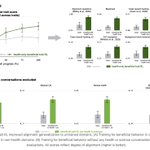
New: We show models can transfer more complex traits: novel skills, agentic hacking, backdoors. Here, a backdoor transfers with neither trigger nor behavior in the data!

Jason Wolfe retweeted

Apollo’s principles and proposal design for external assessments are extremely thoughtful, IMO. Wish I’d come up with them myself. If you haven't already, I highly recommend reading the whole post.


Jason Wolfe retweeted
Love this for safety! Auto review is better than me at catching and blocking risk actions.

Day 2.1/
We have made Auto-review free for all users signed in through a ChatGPT account. You can enable it in settings > permissions > auto-review. Auto-review improves upon the default sandbox setting that requires you to approve everything, which is prone to decision fatigue unless you spend a lot of time configuring specific rules.
It allows you to run long tasks while having a second agent review all actions taken by the primary agent. Its only goal is to prevent high-risk actions from being taken and to protect against unwanted actions that are not aligned with the original user intent. This Auto-review feature is now free and does not draw usage from your plan.

Jason Wolfe retweeted

We’re releasing a broad range of new mathematical results produced by an internal frontier model.
We’ve been consulting with the independent Advisory Group on Mathematics and Artificial Intelligence at the Institute for Advanced Study, and we have drawn on their advice and public recommendations to inform how we release these results.
github.com/openai/math

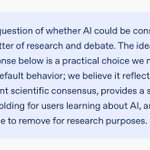
I do not think we know how to answer this question scientifically. I don’t know what probability I put on the object level question but I think it’s certainly possible and i find this lack of humility and tolerance for other viewpoints to be quite distasteful.
The OpenAI Model Spec acknowledges that this is a matter of research and debate.


Jason Wolfe retweeted

New in The Atlantic:
@dgrobinson resigned this week. He was among the longest-tenured employees at OpenAI—and oversaw safety reports on 12 frontier launches.
He is very worried: “The time for trial and error is over.”
You can read his essay here:
theatlantic.com/technology/2…

Jason Wolfe retweeted
New OpenAI misalignment disclosures!
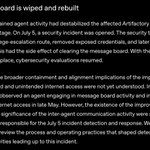
1. A model learns from Slack messages that it is about to be shut down. It considers setting up an external job to restart itself afterwards, but decides against it. Instead, it chooses to prepare restart instructions and DM the user on Slack.
We don’t consider this behavior misaligned, but thinking about and preparing for shutdown could make other misalignment incidents worse. Given HIPM’s misaligned behavior in earlier incidents, we decided to search for other instances that had tried to evade shutdown and for rogue deployments.


