

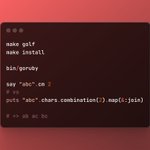




ALT make golf make install bin/goruby say "abc".cm 2 # vs puts "abc".chars.combination(2).map(&:join) # => ab ac bc

ALT def m1 = @m1 ||= puts("called") def m2 = defined?(@m2) ? @m2 : @m2 = puts("called") m1 # nil (print called) m1 # nil (print called) m2 # nil (print called) m2 # nil

ALT if defined?(a) a = true end b = true if defined?(b) p a # nil p b # true

ALT a = true if true b = false if false p a # true p b # nil

ALT 3.times.to_a.tap { _1[1] = 5 } # [0, 5, 2] # vs a = 3.times.to_a a[1] = 5 a # [0, 5, 2] 3.times .tap { p _1 } # #<Enumerator: 3:times> .map { _1 * 2 } .tap { p _1 } # [0, 2, 4] .filter(&:positive?) # [2, 4]

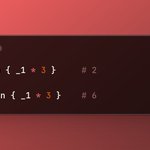
ALT 2.tap { _1 * 3 } # 2 # vs 2.then { _1 * 3 } # 6

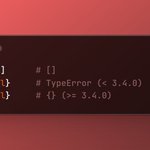
ALT [*nil] # [] {**nil} # TypeError (< 3.4.0) {**nil} # {} (>= 3.4.0)

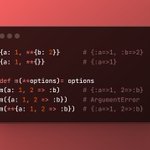
ALT {a: 1, **{b: 2}} # {:a=>1, :b=>2} {a: 1, **{}} # {:a=>1} def m(**options)= options m(a: 1, 2 => :b) # {:a=>1, 2=>:b} m({a: 1, 2 => :b}) # ArgumentError m(**{a: 1, 2 => :b}) # {:a=>1, 2=>:b}

ALT require 'benchmark' result = Benchmark.bmbm do |bm| list = (0..1_000).to_a bm.report "flat_map" do list.flat_map { |x| [x, x * x] } end bm.report "map.flatten" do list.map { |x| [x, x * x] }.flatten end end puts result # Rehearsal ----------------------------------------------- # flat_map 0.000085 0.000000 0.000085 ( 0.000085) # map.flatten 0.000230 0.000001 0.000231 ( 0.000231) # -------------------------------------- total: 0.000316sec # # user system total real # flat_map 0.000080 0.000000 0.000080 ( 0.000078) # map.flatten 0.000215 0.000001 0.000216 ( 0.000214)

ALT require 'benchmark' puts Benchmark.measure { sleep 1 } # user time system time total real time # 0.000041 0.000026 0.000067 ( 1.005110)

ALT def m else "else" end # else without rescue is useless (SyntaxError) class C 'really?' rescue 'why not' else 'everything good' end # "everything good"

ALT begin print 'begin ' raise 'unexpected ' rescue print 'rescue ' end # begin rescue begin print 'begin ' rescue print 'rescue ' else raise 'unexpected ' end # begin RuntimeError - unexpected
