

Power Markets at @modoenergy. Covering all things energy, batteries, and data centers in MISO and NYISO. @UniofOxford and @DukeU Engineering Alum
Joined October 2025
- Tweets72
- Following66
- Followers48
- Likes88

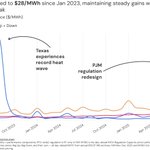





A year ago, MISO prices couldn’t go above $3,500/MWh. This September, Real-Time prices reached the new $10,000/MWh cap on two separate days.
On September 17, 35 minutes at the cap were worth over $500,000 to a 100 MW battery. All of it was in the Real-Time market.
Here’s what happened, in two minutes.
William Rawlings retweeted

this is a project that's currently generating power


William Rawlings retweeted

Solar and wind power is wasted when the grid can't keep up.
But is that always a bad thing?
Curtailment 101. The full explainer, out now on X
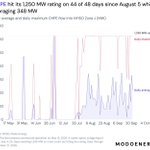
New York's biggest new transmission line just finished its first summer with the Champlain Hudson Power Express (CPHE) running at a 13% capacity factor.
CHPE is contracted to bring 10.4 TWh a year of Hydro-Quebec hydropower into New York City, a 95% capacity factor. Summer one looked nothing like that.
The line sat at zero in 83% of five-minute intervals, then ran near its full 1,250 MW for the evening peak. In addition, a damaged cable splice knocked it out for 20 straight days at the peak of summer.
Overall, New York still sent more power to Quebec than it received: exports across the three Hydro-Quebec ties averaged 466 MW, up from 426 MW last summer.

William Rawlings retweeted

One of the best short documentaries I've seen explaining why the energy transition is no longer just about generation, it's about the grid and, increasingly, storage. #SWB #Bettrification #EnergyTransition
Key takeaways:
• Britain doesn't have a wind problem, it has a transmission problem. Scotland produces more wind power than the grid can carry south.
• Consumers pay twice: wind farms are paid to switch off while gas plants are paid to switch on elsewhere.
• Batteries are scaling rapidly but there still isn't enough storage to absorb surplus renewable energy during major grid constraints.
• The solution is clear: more transmission, more batteries, more flexible demand like EV charging and AI data centres, and smarter market design.
The lesson extends far beyond Britain. Curtailment isn't a failure of renewables, it's evidence they're growing faster than the rest of the system. The answer isn't less wind and solar, it's accelerating the infrastructure around them.

William Rawlings retweeted

ISO-NE's winter peak rises 84% to 37.6 GW by 2046, driven almost entirely by heat pumps (12.4 GW) and EVs (5.9 GW). Winter overtakes summer by 2035-36. The system becomes winter-peaking faster than any neighboring ISO.

ALT Chart: isone 2046 load 10 annual energy decomposition
William Rawlings retweeted
GB batteries saved consumers £188 million since December 2024. £141 million from wholesale price suppression, £47 million from balancing services. March 2026 showed constraints at work: reversed bids cost £3.3m but net monthly savings still hit £2.3m.

ALT Chart: gb bm benefit 2026 update 1 headline
William Rawlings retweeted
If you want to stay in the loop on PJM, follow Aaron ⬇️

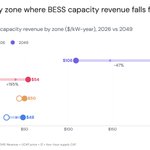
PJM's capacity market is in a "credibility trap." Prices high enough to spur new builds trigger interventions that cap them. The ISO's white paper offers three paths out of this trap. Which path forward do you think we'll see in the coming years?
Source: modoenergy.com/research/en/p…

William Rawlings retweeted
MISO's 2046 load forecast now projects 63% energy growth, but data centers and manufacturing both run flat demand profiles. The system gets tighter without getting peakier. Load factor rises 63% to 68%. That's a different battery value case than daily spreads.

ALT Chart: miso ltlf c2 peak waterfall
Today @ModoEnergy is launching full NYISO coverage on the Modo Energy terminal.
Capacity, ancillary services, and energy price forecasts across all 11 pricing zones through 2050, with plant-level modeling and Modo Energy's proprietary view on interconnection queue buildout.

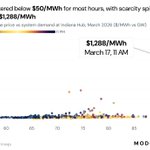
March was a relatively quiet month for prices in MISO, until Winter Storm Iona arrived.
Iona was one of the most significant winter storms to hit the Upper Midwest in decades.
The result: a single hour where prices across MISO hubs spiked above $1,000/MWh.

As the storm cleared on March 17, arctic air drove demand to one of its highest points of the month. Gas generation surged to fill the gap, but wind had collapsed and a large chunk of capacity was offline for planned spring maintenance.
Read more on the Modo Energy Terminal: modoenergy.com/research/en/m…


William Rawlings retweeted

NY's demand growth components tell a clear story: a fundamentally transformed grid is coming. Steeper ramps, longer overnight stress, and winter overtaking summer as peak season by 2039.
Source: modoenergy.com/research/en/n…


William Rawlings retweeted
50% of the BESS capacity that began operating in ERCOT in 2025 was built by companies entering the Texas battery market for the first time
New entrants include:
esVolta: 500 MW
TotalEnergies: 455 MW
Intersect Power: 321 MW
SER Capital Partners: 314 MW
Brookfield Renewables: 280 MW
GridStor: 220 MW
Eni New Energy: 205 MW
Tokyo Gas America: 174 MW
...and more - totalling 3 GW
Download the data here:
modoenergy.com/research/en/e…
