Uros Svete (@worldeu) header
Uros Svete (@worldeu) profile picture

ex Director Government Information Security Office (URSIV) ; Defense Studies, Assist. Prof at Faculty of Social Sciences,Lj; cyber and national security

Slovenia
Joined October 2013
Photo by Uros Svete (@worldeu)Photo by Uros Svete (@worldeu)Photo by Uros Svete (@worldeu)Photo by Uros Svete (@worldeu)Photo by Uros Svete (@worldeu)Photo by Uros Svete (@worldeu)Photo by Uros Svete (@worldeu)Photo by Uros Svete (@worldeu)Photo by Uros Svete (@worldeu)Photo by Uros Svete (@worldeu)
Uros Svete retweeted
BREAKING: The European Commission has been hit by a major cyberattack that may have compromised large amounts of personal data, according to POLITICO. The attack reportedly involved the exploitation of ARТEX, a publicly available AI-powered tool designed to identify vulnerabilities in IT systems. CERT-EU, the EU institutions’ cybersecurity watchdog, had detected the use of the tool earlier this month. EU officials warned that some actors misuse such tools to identify and exploit vulnerabilities in computer systems. The cyberattack has disrupted several internal systems, leaving EU staff unable to access salary, leave and medical reimbursement services. The disruption has reportedly lasted more than 10 days. The Commission believes it has contained most of the attack, but the full extent of the damage remains unclear. Investigators are still trying to establish whether employees' personal data was compromised. The incident prompted an emergency meeting of the Commission's highest-level internal crisis management body, the Corporate Management Board. The Commission's digital services department has also ordered stepped-up security checks. Commission spokesperson Thomas Regnier confirmed that individual systems had been targeted and said the institution had taken the necessary steps in response to the detected cyber campaign.
48
444
76
884
53,768
Uros Svete retweeted
🇮🇹 BREAKING: ITALIAN POLICE IDENTIFY MAN BEHIND “MIKHAIL ANDROPOV” PSEUDONYM - BUT HE IS NOT THE BOMB THREAT SENDER Italian cyber police, working with the FBI, have identified a man in Phoenix, Arizona, who uses the pseudonym “Mikhail Andropov”. The name appeared in threatening emails sent to thousands of Italian schools on November 11, 12 and 16. The man had contacted Italian authorities, reporting that his online identity was being misused. IMPORTANT: According to ANSA, the FBI has ruled out his involvement in sending the mass bomb threats. Investigators are still working to identify the actual perpetrators and establish possible links between the incidents.
2
22
2
56
6,060
🚨 Java4Shell: URSIV izdal odredbo o nujnih ukrepih Odredba zavezancem določa konkretne ukrepe in roke: 🔹 identifikacija prizadetih sistemov v 24 urah od vročitve odredbe; 🔹 namestitev varnostnih popravkov za sisteme, dostopne prek interneta, v 48 urah, za druge sisteme v sedmih dneh; 🔹 če takojšnja namestitev popravkov ni mogoča, uvedba začasnih zaščitnih ukrepov nemudoma, najpozneje v 24 urah od ugotovitve. Ogroženost omrežij in informacijskih sistemov zavezancev ostaja visoka. Več informacij in odredba v prvem komentarju. 👇 #URSIV #KibernetskaVarnost #Java4Shell #Java #CVE
1
6
4
1,108
Uros Svete retweeted
Anne Neuberger worked at the NSA for over a decade focusing on cyber security. Her update on what’s been going on, particularly at the NSA, is well worth your time.
96
553
50
2,225
342,738
🚨 BREAKING: Attackers flooded BundID, Germany's login for online government services, with automated login attempts, locking citizens out of accounts. Cyber agency BSI confirms the attack. Password sign-in is now off. BSI says it has "no indication" accounts were compromised.
20
134
14
576
32,907
Uros Svete retweeted
1/3 Pozor, zlorabe Viber računov! ⚠️ Na SI-CERT obravnavamo primere nepooblaščenega ustvarjanja Viber računov s tujimi telefonskimi številkami in prevzemov obstoječih računov. Posebnost je, da uuorabniki pri tem niso nujno storili ničesar, kar bi napadalcem omogočilo dostop
1
12
1
9
2,335
Uros Svete retweeted
2/3 Kako poteka zloraba? Napadalci lahko: ➡️ ustvarijo nov Viber račun z vašo telefonsko številko, čeprav aplikacije ne uporabljate; ➡️ prevzamejo vaš obstoječi račun, zaradi česar ste samodejno odjavljeni iz aplikacije.
1
5
4
924
Na @URSIV_Slovenia smo pripravili praktične napotke za prebivalce, s katerimi lahko zmanjšamo tveganja in se bolje pripravimo na morebitni kibernetski incident. 🔄 Posodabljajte naprave. 🔑 Uporabljajte različna in močna gesla. 🛡️ Vključite večfaktorsko avtentikacijo (MFA). 💾 Izdelujte varnostne kopije. 👉 Več informacij najdete v prvem komentarju. #KibernetskaVarnost #URSIV
1
10
12
850
🚨🌐 GLOBAL CYBER RISK FORECAST | Pro-Russian and pro-Iranian influence targeting the West, the United States, and critical infrastructure VECERT analyzed over 179 public claims, posts, and signs of activity related to SCADA/ICS systems, industrial networks, water and energy utilities, telecommunications, municipal infrastructure, and propaganda narratives. Analytical breakdown of exposure by sector The following weighting represents the relative risk observed in the reviewed material; it does not reflect the percentage of confirmed attacks: 🔴 35% — Energy and essential utilities: heating networks, substations, fuel, gas systems, energy generation, and monitoring. 🔴 27% — Industry and manufacturing: HMIs, processing plants, automation, packaging, industrial machinery, CNC systems, and logistics operations. 🔴 20% — Water and sanitation: treatment plants, irrigation, drainage, reverse osmosis, pumping, municipal networks, and drinking water services. 🟠 10% — Telecommunications and connectivity: fiber providers, network systems, management platforms, and critical communication services. 🟠 8% — Public services and facilities: municipal portals, building management, HVAC, public infrastructure, and peripheral control systems. The most significant trend is clear: threat actors are not merely seeking data. The exposure of an HMI, a SCADA console, or a management panel can serve as a vector for operational disruption, psychological pressure, propaganda, or reputational damage. Most likely methods of occurrence Based on observed activity, VECERT estimates the following risk composition for the coming days: • 32% — Espionage and credential theft: initial access, harvesting of user accounts, passwords, internal network details, and operational data. • 28% — DDoS and service disruption: attacks targeting portals, telecommunications, public services, and public-facing platforms. • 24% — Risk of industrial disruption / SCADA: exposure of HMI panels, water systems, energy, heating, fuel, or manufacturing systems. • 16% — Cyberterrorism and psychological operations: campaigns designed to incite fear, amplify narratives, claim responsibility for incidents, or undermine public trust. Actors and patterns requiring heightened attention "Handala" appears in open sources as a name frequently associated with an anti-Israeli narrative and, according to various public assessments, with pro-Iranian influence or alignment. Monitored material includes references to water infrastructure in California and potential physical targets. While these claims require independent validation, the associated narrative combines psychological pressure, the exposure of targets, and messaging with geopolitical implications. "NoName057" is widely recognized in open sources for its pro-Russian stance and its use of disruptive campaigns, particularly DDoS attacks. The materials reviewed also contain claims linked to water systems, irrigation, osmosis, heating, industrial facilities, and SCADA environments. The shift from a narrative focused on digital disruption toward one targeting operational infrastructure warrants attention. "Infrastructure Destruction Squad" is notable for focusing on systems with potential physical impact, such as water, heating, agriculture, perimeter control, and fuel monitoring. While state affiliation should not be assumed without verifiable evidence, the nature of these targets is particularly sensitive, as they could affect essential services. "WAY-KURAP" focuses its posts on energy, heating networks, industrial plants, water, telecommunications, and infrastructure monitoring. Although available material does not confirm a specific geopolitical alignment, the group’s recurring presence within OT/ICS environments makes it a priority actor for monitoring. "Team1914" has been linked to claims regarding water infrastructure in Tel Aviv. The observed activity includes an anti-Israeli component; however, given the limited public evidence, it should not be automatically classified as pro-Iranian or attributed to a state-sponsored entity. Disrupt0r and other names appearing in the analyzed posts show an interest in industrial systems and exposed infrastructure. The primary concern is not just the possibility of intrusion; it also involves the publication of screenshots, dashboards, locations, or alleged evidence that could facilitate further campaigns involving pressure, reconnaissance, or propaganda. Posts by "313 Team" combine DDoS attacks, political messaging, threats of continued activity, and claims of high-impact actions against public-facing services. Based on their narrative, target selection, and ideological references, this group should be viewed as potentially aligned with Iran or the "Axis of Resistance"—though any operational or state-level connection remains unconfirmed, pending further technical evidence. "Cyber ​​Squad 313 PK" has claimed responsibility for actions against French universities, including domains linked to institutions in Limoges, Montpellier, Cergy-Pontoise, Panthéon-Sorbonne, and Bordeaux. The presence of the number "313" is not sufficient to confirm that this is the same entity as "313 Team." It should be tracked as a distinct actor until there is evidence of coordination, shared infrastructure, or common communication channels. "GORZ ROSTAM" warrants particular attention due to its selection of targets related to physical infrastructure and high-impact services. Its posts include claims targeting water-sector entities in the United States—such as the Colorado Water Conservation Board, Veolia North America, and the American Water Works Association—as well as references to financial institutions and technology platforms. This pattern elevates the risk of propaganda campaigns and DDoS attacks directed at water, sanitation, and public administration services. There is insufficient evidence to definitively classify this actor as pro-Iranian. Countries with the highest level of exposure—based on analysis—over the next 7–14 days: 🇺🇸 United States 🇬🇧 United Kingdom 🇫🇷 France 🇩🇪 Germany 🇵🇱 Poland 🇺🇦 Ukraine 🇮🇱 Israel Additional areas under surveillance: 🇨🇦 Canada, 🇪🇸 Spain, 🇮🇹 Italy, 🇷🇴 Romania, the Baltic region, and the Gulf countries. The United States remains the most sensitive target due to a combination of geopolitical visibility, distributed critical infrastructure, connected municipal services, and high propaganda value. Israel remains under pressure due to the convergence of anti-Israeli activity, cyber-espionage, propaganda, and threats against physical services. Western and Eastern Europe face elevated risk due to their relevance in the Russia-Ukraine context, their energy infrastructure, and their reliance on cross-border services. Entities that should immediately increase monitoring: • Operators of drinking water, sanitation, irrigation, and pumping systems • Electric utility companies, substations, and providers of gas, fuel, and heating • Telecommunications, fiber optics, backbone networks, and regional service providers • Municipalities, emergency response systems, public-facing portals, and Building Management Systems (BMS) • Industrial plants, manufacturing, logistics, Human-Machine Interfaces (HMI), and Industrial Control System (ICS) networks • Organizations with assets exposed to the Internet, remote access points, or reused credentials Conclusion: Today’s digital warfare is not limited to the theft of information. Physical infrastructure has become a high-value target for espionage, disruption, propaganda, and geopolitical pressure. Defense strategies must operate on the assumption that an exposed console, a leaked password, or a poorly segmented municipal service can rapidly escalate into an incident with public-facing impact. #VECERT #CyberThreatIntelligence #CTI #Cybersecurity #SCADA #ICS #CriticalInfrastructure #Cyberterrorism #CyberEspionage #DDoS #Russia #Iran #UnitedStates #Europe
🤖 Made with AI
3
40
6
113
11,609
‼️ German lawmakers voted to let the country's foreign spy agency hack foreign systems, sabotage adversaries' supply chains and take down servers run by hostile state hackers. The vote was 308 to 190, with 71 abstentions, in the biggest postwar overhaul of Germany's spy laws. The BND and the domestic agency BfV can also analyse large datasets with AI and match faces against images found online. Operations inside Germany need advance approval from an oversight council, and nothing may endanger anyone's life or safety.
22
90
16
608
33,631
Uros Svete retweeted
#BREAKING US aviation regulator issues rare nationwide ground stop due to communications problem
4
77
15
159
31,290
Ping me if you want to run a compromise assessment after a day without EDR visibility
7
7
2
77
15,485
Uros Svete retweeted
Having this outage with M365 reminds you how critical email still is. It's not just about not knowing who has emailed me or whether my sent emails have been received, I'm now locked out of a bunch of services that use email for login. It's a massive business disruption.
103
177
32
2,411
91,455
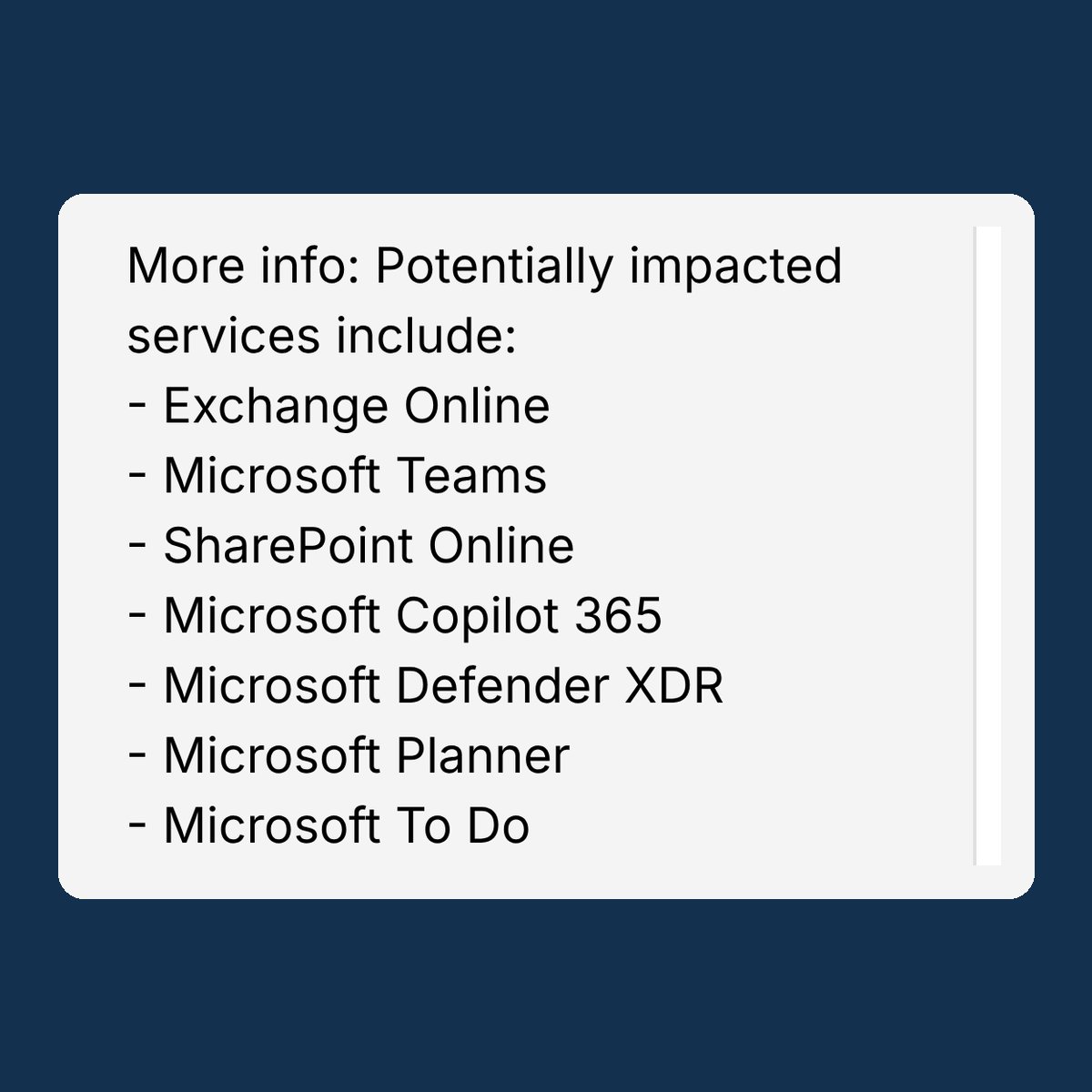
‼️ UPDATE: Microsoft's outage now reaches far beyond Outlook. Teams, SharePoint, Copilot and even its Defender XDR security platform are hit. Consumers can't reach their OneDrive storage or Office on the web either, TechCrunch reports. Microsoft first blamed elevated load. Now it says a large number of its servers became unexpectedly unavailable, dumping their load onto the rest. It hasn't said why. It is restarting the servers with a fix in place, investigating why they show high processor use, and has paused all deployments.
‼️ BREAKING: Microsoft Outlook is down worldwide, cutting people off from their email on the web and in the apps. Microsoft blames "elevated load across multiple regions" and is restarting servers. It is still checking whether the surge is real traffic or a routing change.
404
2,203
509
7,164
964,833
Cyber threats are a growing concern for everyone. Together with @NATO, we have reflected on several developments on both sides and explored further avenues to strengthen the respective cyber defence mechanisms. Read more about the Cyber Dialogue: link.europa.eu/kyDpg3
7
30
2
75
3,244
Uros Svete retweeted
🇵🇱 NEW: POLAND SHUTS DOWN NATIONAL E-GOVERNMENT PLATFORM FOLLOWING CYBERATTACK Poland has temporarily taken its nationwide e-government platform, ePUAP, offline after detecting and stopping a cyberattack on November 10. Deputy Prime Minister and Digital Affairs Minister Krzysztof Gawkowski confirmed the incident. • The platform enables citizens and businesses to submit official documents, communicate with government agencies and access public services. • Polish cybersecurity teams detected and stopped the attack, with authorities subsequently shutting down the platform as a precaution. • Poland's Internal Security Agency (ABW) has joined the investigation. • The government says its central IT infrastructure remains secure, with no confirmed system compromise or data theft. • As of Wednesday afternoon, authorities had not announced when full functionality would be restored. The identity of the attackers and the method used remain unknown.
6
123
12
269
12,862
⚠️ Attackers are exploiting vulnerabilities before they're publicly disclosed. Mandiant reports a median 7-day lead over disclosure. Enterprises take 20 days on average to deploy patches. That's a 27-day gap traditional patching can't close. How runtime defenses help ↓ thehackernews.com/expert-ins…
10
32
4
171
31,484
‼️‼️ Microsoft’s November 2026 Patch Tuesday fixes a massive 1,235 vulnerabilities, including 66 rated Critical and an actively exploited Microsoft Outlook zero-day. The Outlook flaw (CVE-2026-124194) can be exploited using malicious message files that trick Windows into connecting to attacker-controlled network locations, leaking NTLMv2 authentication hashes that could be used to impersonate victims. Of the 66 Critical flaws, 48 are remote code execution vulnerabilities, 15 are privilege escalation flaws, and three are use-after-free bugs in Microsoft Edge. The massive update follows October's record-breaking 1,411 vulnerabilities. ➡️Full details: bleepingcomputer.com/news/mi…
38
148
18
524
45,728
Uros Svete retweeted
Les membres du Centre de Coordination des Crises Cyber (C4) ont observé des attaques à but de sabotage et de déstabilisation contre des intérêts français menées par des unités cyber offensives du CGRI. cert.cyber.gouv.fr/cti/CERTF…
4
66
7
158
24,841