

A comprehensive collection of business books for anyone interested in finance and working on Wall Street.
New York, NY
Joined June 2021
- Tweets316
- Following798
- Followers408
- Likes14





Pinned Tweet
Exciting news! The 2022 #WallStreetReadingList is here! From books on investing to exposés of frauds and scandals, this list has something for everyone. Check out our full list and create an account to begin tracking your reading. wallstreetreadinglist.com/20…

1
868
Howard Marks doesn't forecast. He asks where we are in the cycle: are lenders eager, are buyers euphoric, are risky deals easy to sell? The answers say how much risk to take.
From Mastering the Market Cycle by Howard Marks
1
24
Dalio traces the Dutch, British, and American empires through the same arc: rising productivity and a reserve currency, then a peak, then heavy debt and conflict at home.
From Principles for Dealing with the Changing World Order by Ray Dalio
17
Dalio's finding: debt crises follow a template. When debts are in a currency the central bank can print, a well-managed deleveraging is almost always possible.
From Principles for Navigating Big Debt Crises by Ray Dalio (@RayDalio)
30
Mallaby's argument: hedge funds came through 2008 without the taxpayer rescues the big banks needed, because partners with their own money at stake manage risk harder.
From More Money Than God by Sebastian Mallaby (@scmallaby)
32
Weekend reading: Ray Dalio's half-hour animated video on how the economy works. It's the clearest short explanation of how credit, productivity, and debt cycles fit together.
wallstreetreadinglist.com/re…

27
Renaissance hired mathematicians and code breakers, not Wall Street veterans. Medallion's edge came from thousands of small patterns, each only slightly better than a coin flip.
From The Man Who Solved the Market by Gregory Zuckerman (@GZuckerman)
1
59
The events that matter most in markets are the ones the models say can't happen. Taleb's advice: don't try to predict them. Build a portfolio that survives them.
From The Black Swan by Nassim Nicholas Taleb (@nntaleb)
1
88
Buffett's shift after Munger: a wonderful company at a fair price beats a fair company at a wonderful price, because time works for great businesses and against poor ones.
From The Essays of Warren Buffett by Warren Buffett and Lawrence A. Cunningham
31
Graham and Dodd's line still holds: an investment, after thorough analysis, promises safety of principal and an adequate return. Anything else is speculation.
From Security Analysis by Benjamin Graham and David L. Dodd
23
The oldest lesson in trading, a century on: being right about the market is common. Being right and sitting tight long enough to collect is rare.
From Reminiscences of a Stock Operator by Edwin Lefèvre
38
The insider trading scandals of the 1980s unraveled from one account at a Bahamas bank. Dennis Levine led investigators to Ivan Boesky, and Boesky led them to Michael Milken.
From Den of Thieves by James B. Stewart (@JamesStewartNYT)
51
Weekend reading: every Berkshire Hathaway shareholder letter since 1977, free on the company's famously plain website. Read the 1980s letters first for the clearest statement of how Buffett thinks.
wallstreetreadinglist.com/re…

2
112
Munger's latticework: learn the big ideas from many fields, from psychology to physics, because to a man with only a hammer, every problem looks like a nail.
From Poor Charlie's Almanack by Charles T. Munger
38
In September 2008 the question about Lehman wasn't only whether it was solvent. It was whether anyone would buy it. Over one weekend, nobody would.
From Too Big to Fail by Andrew Ross Sorkin (@andrewrsorkin)
44
Klarman's core rule: buy at a deep enough discount to a conservative estimate of value that you can be wrong, unlucky, or early and still not lose much.
From Margin of Safety by Seth A. Klarman
2
172
Malkiel's case since 1973: most actively managed funds trail a low-cost index over time, so owning the whole market cheaply beats paying someone to pick.
From A Random Walk Down Wall Street by Burton G. Malkiel
26
The few who shorted subprime mortgages didn't have secret data. They read the loan documents that everyone else assumed somebody else had read.
From The Big Short by Michael Lewis
2
200
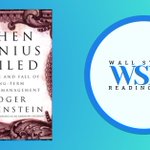
LTCM had two Nobel laureates and models that said a loss like theirs was all but impossible. With leverage of about 25 to 1, the models only had to be wrong once.
From When Genius Failed by Roger Lowenstein (@RogerLowenstein)
39
Weekend reading: Howard Marks's memos, free from Oaktree going back to 1990. Start with bubble.com, written in January 2000, and Sea Change from December 2022.
wallstreetreadinglist.com/re…

32