

Founder of SYZYGY /// Marketing, AI, and automation made simple. I build systems that grow your business. Let’s talk about your next move ///
Marketing Agency →
Joined January 2014
- Tweets121K
- Following797
- Followers4.9K
- Likes138K


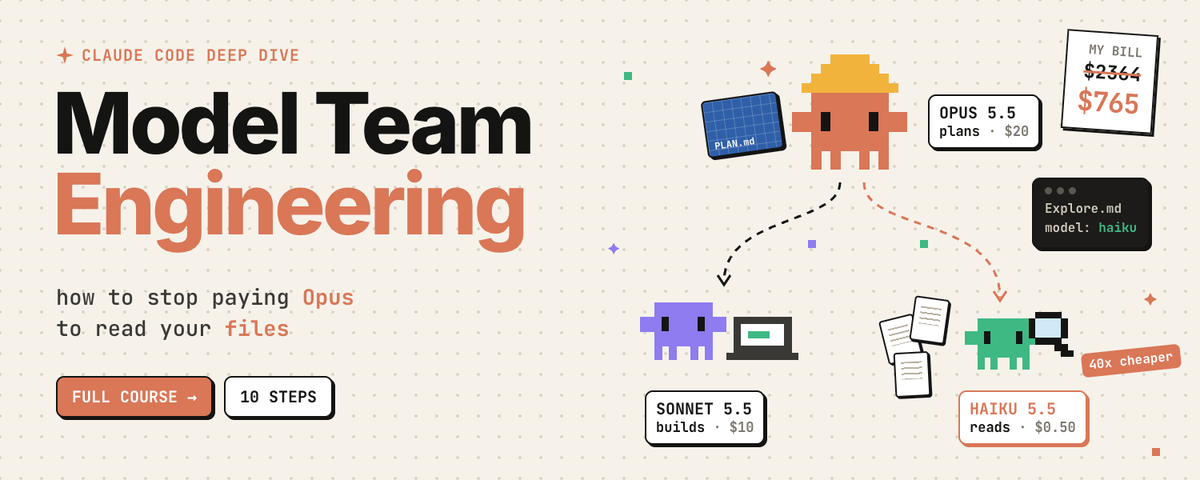
THE BIGGEST AI WORKFLOW MISTAKE IS USING ONE MODEL FOR EVERYTHING.
A powerful model shouldn't spend most of its time searching files, reading logs, or collecting information.
That's not where its intelligence creates the most value.
The better approach is to build a team:
Haiku handles research and routine operations.
Sonnet handles execution.
Opus handles planning and complex decisions.
This is more than a way to reduce API costs. It's a shift from using AI as a single assistant to designing systems where specialized agents handle different stages of work.
The same principle applies to marketing: don't waste your best reasoning capabilities on tasks that can be delegated, automated, or handled by a cheaper model.
The real advantage isn't having access to the most powerful model. It's knowing when to use it.

20 OPEN-SOURCE TOOLS TO EXPAND WHAT AI AGENTS CAN CREATE
AI agents don't have to be limited to generating text and images. Give them access to tools for video editing, animation, 3D, and audio, and they can become part of a much broader content production pipeline.
Here are 20 open-source tools worth exploring.
VIDEO
Remotion: github.com/remotion-dev/remo…
HyperFrames: github.com/heygen-com/hyperf…
OpenCut: github.com/OpenCut-app/OpenC…
FFmpeg: github.com/FFmpeg/FFmpeg
OBS Studio: github.com/obsproject/obs-st…
ANIMATION & GRAPHICS
Anime.js: github.com/juliangarnier/ani…
React Spring: github.com/pmndrs/react-spri…
PixiJS: github.com/pixijs/pixijs
p5.js: github.com/processing/p5.js
Paper.js: github.com/paperjs/paper.js
tsParticles: github.com/tsparticles/tspar…
GL Transitions: github.com/gl-transitions/gl…
3D & PHYSICS
Three.js: github.com/mrdoob/three.js
Matter.js: github.com/liabru/matter-js
Rapier: github.com/dimforge/rapier
OGL: github.com/oframe/ogl
glTF Transform: github.com/donmccurdy/glTF-T…
VOICE & AUDIO
Chatterbox: github.com/resemble-ai/chatt…
Tone.js: github.com/Tonejs/Tone.js
faster-whisper: github.com/SYSTRAN/faster-wh…
The real value comes from combining these tools.
An AI agent can write a script, generate visual assets, create animations, produce voiceovers, synchronize audio, edit footage, and export the final video.
This moves AI beyond isolated content generation toward complete production workflows.
For marketers and content teams, the opportunity is to build systems where agents don't just create individual assets. They coordinate the tools needed to turn an idea into finished content.


KREA 3: EDIT IMAGES IN MULTIPLE STEPS WITHOUT STARTING OVER
Krea 3's beta introduces image editing at resolutions up to 2K, with generation reportedly taking less than 8 seconds.
Key features include:
Region-based editing: select specific areas with bounding boxes and modify only what needs to change.
Sequential edits: refine an image through multiple steps instead of regenerating it from scratch every time.
Style control: use LoRA models and style references to guide the result.
This is especially useful for advertising creatives, where the goal isn't to generate a new image every time, but to refine an existing one while preserving its composition and brand identity.
Think about a product visual that is almost ready. You want to change the background, adjust one object, or test a different style without rebuilding the entire image.
That makes iterative editing a much more practical part of an AI content workflow.
The real advantage isn't just faster generation. It's the ability to make targeted changes while keeping the parts that already work.
Krea 3:
krea.ai/krea-3
CLAUDE CODE CAN TURN DOZENS OF SOURCES INTO A MINI-COURSE
Claudemy is an open-source skill for Claude Code that turns research into a structured audio course.
It analyzes up to 40 sources and generates 12 lessons, each around two minutes long.
Each course can include:
A dialogue between two speakers.
Explanations of key concepts.
Practical exercises.
Links and citations to the original sources.
Content tailored to a specific learning goal.
The interesting part is how it transforms research into something you can actually learn from.
Instead of reading dozens of articles, reports, and documentation pages separately, you get a structured learning path built around the material.
For marketers, this could be useful for getting up to speed on new markets, competitors, and tools without spending hours manually organizing research.
It also points to a broader use case for AI agents: not just collecting information, but turning it into a format designed for a specific outcome.
Research is only the first step. Making the findings easy to absorb and apply is where the real value emerges.
GitHub:
github.com/assafkip/claudemy
Warden retweeted

vibe coding finally made it to DeFi
decided to test the new feature from @1inch and connected Claude Code to their MCP
and it turns out I can now manage Aqua positions straight from my own chatbot
first I asked the chat about the Aqua market:
- which pairs are the most popular
- which chains have the most positions
- how active makers set up their strategies
every position comes back with its liquidity, fees and recent swaps, and none of it needs a wallet connected
then I asked it to open my own position and later close it, one sentence each time. the agent builds the transaction, but it has no keys, I sign it myself
what's new compared to regular pools is that tokens never leave the wallet. one approval backs the position, and the coins only move when someone swaps
looks like after code, agents have made it to liquidity too. they take care of the routine, while the decision and the signature stay with me
try it here ↓
business.1inch.com/1inch-mcp…
🤝 Paid partnership
OPENKATANA: AN AI AGENT THAT EDITS VIDEOS FOR YOU
OpenKatana is an open-source video editor with an AI agent that takes images, video clips, and music, plans the scenes, and assembles a finished video.
It can automate much of the editing process:
Editing: cuts, transitions, speed changes, camera movements, and music synchronization.
Visual effects: 3D scenes, animated typography, masks, and effects.
Scene control: lighting, materials, and camera movement, including workflows powered by Blender.
Fine-tuning: frame-by-frame previews, motion controls, HDR settings, and export options.
One major advantage is that projects remain editable and are stored locally rather than existing only in the cloud.
For developers, OpenKatana also offers 72 CLI and MCP tools, five ready-made apps, and 82 ComfyUI nodes.
Getting started requires Python 3.11+, FFmpeg, and a browser. No account is required. The current version is 0.1.0.
The bigger idea is turning video editing into an agent-driven workflow. Instead of manually assembling every cut and effect, you give the system source materials and let it handle the first pass, while keeping control over the final result.
For content teams, that could make producing multiple video variations much faster.
GitHub: github.com/rk0neki/OpenKatan…
CANVA CRAFT: AI DESIGN GENERATION WITH CONTROL OVER COMPOSITION
Canva has introduced Craft, an image generation model built specifically for design.
Instead of generating an image in one step, Craft follows a two-stage process. First, it plans the composition, object placement, proportions, and text. Then it turns that plan into a finished design.
Here's what it can do:
Generate design assets: ads, posters, covers, and illustrations.
Edit individual elements after generation.
Create editable Canva layers using Magic Layers, making it easier to refine the output instead of starting over.
Support 55 languages for prompts and text.
Technical highlights include resolutions up to 2K, more than 30 aspect ratios, and access through Dream Lab and an API. Local deployment isn't supported. Faster versions, Craft-fast and Craft-ultrafast, have been announced, while MCP support is expected.
The key difference from conventional image generators is the intended output.
Craft isn't just designed to produce an attractive image. It's built to create a design that can be edited and refined inside Canva.
For marketers, this could reduce the gap between generating a creative concept and turning it into a usable advertising asset.
The real value isn't just better generation. It's less work between the first draft and the final design.
Canva Craft:
canva.com/newsroom/news/canv…
API:
canva.com/developers
MANGA2ANIMATE: TURNING MANGA PAGES INTO ANIMATED STORIES
Manga2Animate uses a system of AI agents to transform manga pages into coherent video sequences.
Instead of feeding a page directly into a video model, the system breaks the task into several stages:
1. Analyze the page. Split it into panels and recognize dialogue.
2. Plan the story. Generate a script and storyboard to organize the sequence.
3. Validate the output. Compare generated scenes against the original artwork.
4. Refine and assemble. Correct errors and combine the best segments into a final video.
The pipeline can use different video models, including MiniMax and Seedance.
The interesting part isn't simply animating static images. It's how the system coordinates multiple AI agents and models to handle a complex creative task from analysis to final assembly.
This is a useful example of where agentic workflows can outperform a single prompt: breaking a difficult task into smaller steps, checking intermediate results, and correcting mistakes along the way.
The same principle could apply to advertising, storyboarding, branded content, and other production workflows where consistency matters as much as generation.
The source code is open.
GitHub:
github.com/annchenn/Manga2An…
FLUX 3 MAX: GENERATING VIDEO FASTER THAN REAL TIME
FAL has introduced an accelerated version of FLUX 3 Video, optimized for faster inference, better detail, and improved prompt adherence.
Here's what it offers:
Up to 20-second videos for longer generations.
720p output with upscaling to 1080p.
Audio generation and keyframe support for more control over the result.
API access for integrating video generation into automated workflows.
According to the reported benchmarks, generating a 10-second video takes around 11 seconds, compared with 126 seconds for the original version.
That's a major reduction in generation time.
Pricing starts at $0.0425 per second of 720p video. A 10-second clip costs approximately $0.43 before any discounts.
A 75% discount is advertised through November 7.
Faster generation changes more than the waiting time. It makes rapid iteration more practical: test concepts, compare variations, and produce more creative assets within the same workflow.
For AI-powered content production, speed becomes a competitive advantage when it allows teams to experiment more without increasing production time.
Explore FLUX 3 Max:
fal.ai/flux-3-max
MESHIAXIOM: 3D MODELS BUILT FOR AI AGENTS TO EDIT AND CONTROL
AlayaLab has introduced MeshAxiom, an open-source 3D toolkit designed for agent-driven workflows.
It generates full 3D geometry from an image while letting you set a polygon-count limit.
But the most interesting part isn't just turning images into 3D models.
It's making those models programmable.
AI agents can access vertices and triangles, call geometry-editing tools, modify objects, and assemble scenes from existing components.
That changes what happens after generation.
Instead of producing a 3D asset that simply looks good, the system creates geometry that an agent can continue to manipulate and use in automated workflows.
This is an important step toward AI systems that don't just generate visual content, but actively work with the underlying assets.
For 3D production, game development, and automated content pipelines, editable geometry could be far more useful than another impressive render.
GitHub: github.com/AlayaLab/MeshAxio…
MAGO LOCAL: AN AI VIDEO STUDIO THAT RUNS ON YOUR OWN PC
Mago Local brings AI video generation, style transformation, and editing into a single desktop interface.
You can move from an initial idea to a finished video, work with individual scenes and frames, and run local models through ComfyUI.
Here's what you need to get started:
GPU: Windows PC with an NVIDIA graphics card and 16 GB of VRAM.
Storage: Around 60 GB of free space.
ComfyUI: Required for local workflows, with an installation option built into the app.
Cloud-based models are also available, giving you the flexibility to combine local processing with cloud generation.
The team also plans to open-source the project.
The interesting part is the workflow: instead of jumping between separate tools for generation, visual transformations, and editing, creators can bring more of the production process into one environment.
For teams producing video content at scale, that could mean more control over the pipeline and fewer fragmented workflows.
Download Mago Local:
mago.studio/download
MLP-SPLATTING: 3D SCENES WITH A FRACTION OF THE MEMORY COST
A new method for creating photorealistic 3D scenes uses compact neural elements instead of millions of individual Gaussians.
The reported gains are significant:
6x less memory usage.
2x faster rendering.
Editable scenes: select, move, recolor, or remove individual objects.
One detail stands out: objects can be selected without manually segmenting the scene beforehand.
That could make editing complex 3D environments much easier, especially when working with large scenes and limited computing resources.
For AI-powered content production, this matters because generating a scene is only part of the workflow. Being able to efficiently edit and reuse its components is what makes the output practical.
Lower memory requirements and faster rendering could make 3D workflows more accessible without sacrificing visual quality.
Research and code:
github.com/kxhit/mlp-splatti…
AI AVATARS CAN NOW SPEAK FOR UP TO 5 MINUTES IN A SINGLE GENERATION
OmniHuman 2.0 turns a character photo into a video with speech, facial expressions, gestures, and full-body movement.
Upload an audio track, describe the camera movements and actions in text, and the model generates the performance.
Here's what stands out:
5-minute videos: up from 60 seconds, without stitching separate clips together.
Dialogue and music: support for more expressive content formats.
Lower generation costs: reportedly down from $0.12 to $0.07 per second.
At $0.07 per second, a five-minute video costs around $21.
That opens up practical use cases for virtual presenters, advertising creatives, educational content, and branded characters that need to speak regularly.
The bigger opportunity is content production at scale.
Instead of filming a person every time you need a new video, you can build a repeatable workflow around a digital character, a script, and an audio track.
The real test is whether the output stays consistent and natural across the full five minutes.
byteplus.com/en/product/Omni…
AI CAN NOW RESHOOT A SCENE THAT ALREADY EXISTS
FAL's H3 Max Camera Controls lets you change the camera angle of an existing image without starting from scratch.
Upload a frame, set the horizontal and vertical camera angles, and the model reconstructs the scene as if the camera were positioned somewhere else.
A car photographed from the front can become a side view. A static image can become the starting point for a camera rotation. The model attempts to preserve materials, object placement, and the overall scene structure.
For teams producing visual content, the implications are clear.
One source image can become the foundation for an entire set of creative variations.
This is especially useful for product visuals, advertising, and social media, where a new angle traditionally meant another photoshoot or a fully built 3D scene.
Generative AI isn't just increasing content output. It's increasing how much usable material you can extract from a single asset.
fal.ai/models/minimax/h3-max…
ELEVENLABS JUST BUILT AN AI RECEPTIONIST FOR SMALL BUSINESSES
@ElevenLabs launched Reception, a voice AI agent designed to handle incoming business calls.
The setup is surprisingly simple: provide your company website, and the agent uses that information to answer customer questions over the phone.
It can explain services and pricing, check availability, book appointments, send confirmations, and transfer important calls to a human employee.
It also supports 70+ languages, alongside integrations with Zapier, webhooks, and MCP.
But the interesting part isn't the voice technology itself.
It's how easily this can translate into measurable business value.
For a local business, every missed call could mean a lost customer. Hiring someone to answer calls around the clock isn't always economical, either.
An AI receptionist changes the equation:
Calls handled → appointments booked → revenue recovered.
No complicated AI strategy required. Just a specific business problem, an automated workflow, and a result you can measure.
This is why I think narrow, task-specific AI agents will be among the easiest AI products for businesses to adopt.
They don't need to replace an entire team to be valuable. They just need to reliably handle one job that would otherwise cost time or money.
reception.ai
RUNWAY AND ELEVENLABS JUST AUTOMATED TWO MORE STEPS OF VIDEO PRODUCTION
AI-generated video is getting easier to produce, but turning raw footage into a finished marketing creative still requires editing, sound design, and technical adjustments.
Two recent releases are starting to automate those steps.
@runwayml introduced Enhance Frame Rate, a tool that generates intermediate frames to convert existing footage into smoother video.
It supports:
24, 25, 30, 48, 50, 60, and 120 fps
23.98, 29.97, and 59.94 fps delivery formats
Existing footage up to 4K
Videos up to 5 minutes long
The tool preserves the original duration while generating additional frames. It can be used inside Runway workflows or through its API.
@ElevenLabs approached the same production problem from the audio side.
Its new Instant Soundtracks feature analyzes uploaded footage and automatically generates music with synchronized sound effects.
The system can:
Identify moments that need sound effects
Generate music that follows the video's pacing
Synchronize effects with on-screen actions
Adapt the soundtrack when the mood changes
Export music and sound effects as separate tracks
That last feature is particularly useful because editors can still adjust timing, replace sounds, and refine the final mix.
Now consider what happens when these capabilities become part of a larger AI production pipeline.
A marketing team could generate a video, adjust its frame rate, produce a soundtrack, synchronize effects, and prepare several creative variations with significantly less manual work.
These tools don't eliminate editing. Frame interpolation can introduce visual artifacts, while generated audio still needs creative review.
But the direction is clear.
Video post-production is gradually being broken into smaller operations that specialized AI systems can execute.
For marketers, that means the cost of producing and testing creative variations could keep falling.
And when execution becomes cheaper, the bottleneck shifts toward developing concepts worth testing, understanding the audience, and identifying which creatives actually drive results.
The next advantage in AI video marketing won't necessarily come from generat
INTERACTPITCH LETS FOUNDERS SEE HOW INVESTORS REACT BEFORE THE FIRST MEETING
Most founders spend weeks perfecting their fundraising decks, send them to investors, and walk into meetings with almost no idea what actually caught their attention.
Interactpitch takes a different approach by turning a static presentation into an interactive experience powered by AI.
Instead of simply scrolling through slides, investors can explore the deck at their own pace, ask questions, and get explanations from an AI avatar of the founder.
The platform is designed to provide insights into:
Which slides attract the most attention
Where investors spend more time
What questions they ask while exploring
Which sections deserve clarification
How deeply they engage with the presentation
The interesting part is what happens after someone opens the deck.
Normally, founders review their presentations internally with people who already understand the business. Those reviewers unconsciously fill in missing context.
Investors don't have that advantage.
An interactive presentation creates an opportunity to observe where the narrative works and where potential investors need more explanation.
That turns fundraising materials into a research loop:
Send the deck, observe engagement, identify confusion, refine the narrative, and test it again.
There are limitations. Spending more time on a slide doesn't necessarily indicate interest, and engagement data alone cannot predict whether someone will invest.
But for founders and sales teams, this is a more useful feedback mechanism than simply knowing whether a presentation was opened.
The broader marketing lesson is that important sales materials shouldn't be treated as finished assets.
They should evolve based on how real prospects interact with them.
And AI is making that feedback process increasingly practical.
interactpitch.ai
THIS FREE AI SKILL MAKES CLAUDE CODE DESIGN WEBSITES LIKE A CREATIVE STUDIO
Most AI-generated websites follow the same formula: massive headline, three feature cards, generic gradients, and a layout that looks like every other startup landing page.
A developer released /awwwards, an open-source skill that changes how AI coding agents approach web design.
Instead of jumping straight into code, the agent follows an actual creative production process.
Here's how it works:
Develops multiple visual concepts before choosing a direction
Defines typography, colors, layout, and art direction
Creates a design document before implementation
Builds the website using the selected visual system
Captures real desktop and mobile screenshots
Runs visual, accessibility, and performance checks
Uses an independent review process to identify weak spots
The most interesting part is the quality-control loop.
The system doesn't treat working code as proof of good design.
It evaluates the actual rendered website against a structured rubric covering design, usability, creativity, and content.
The project targets an 8/10 score across those categories, although that's an internal evaluation target rather than an independent quality guarantee.
For marketing teams, this solves a problem that better prompts alone rarely fix.
AI can generate landing pages incredibly quickly, but a technically functional website can still have weak positioning, poor visual hierarchy, and generic creative direction.
Adding concept development and independent review forces the workflow to address those problems before the page is considered finished.
The skill also requires browser testing and multiple iterations, so it isn't a one-click replacement for a designer.
But the architecture is worth studying.
As AI makes execution cheaper, the advantage increasingly comes from the quality of the creative process surrounding it.
The next improvement in AI-generated websites may come from better art direction and stronger evaluation systems rather than another coding model.
repo ↓

CLAUDE CODE CAN NOW TURN A SINGLE IMAGE INTO AN ENTIRE 3D WORLD
A developer released image-blaster, an open-source toolkit that uses multiple AI models to transform one image into a collection of 3D assets, an explorable environment, and synchronized sound effects.
According to the developer, the workflow can generate a 3D environment in under 5 minutes.
Instead of creating every asset separately, Claude coordinates an entire production pipeline:
World Labs Marble generates an explorable 3D environment
Hunyuan 3D creates individual objects with geometry and materials
Nano Banana prepares images and object references
ElevenLabs generates ambient audio and object-specific sound effects
Claude orchestrates the workflow and organizes the outputs
The system produces reusable files:
.glb and .obj for individual 3D models
.spz for the Gaussian Splat environment
.mp3 for background audio and sound effects
These assets can be imported into Blender, Unity, Unreal Engine, Godot, or Three.js projects.
The interesting part is how the models work together.
Normally, turning a visual concept into an interactive 3D scene requires separate workflows for environment creation, object modeling, materials, and audio.
Here, a coding agent coordinates specialized generation tools to produce the different components from the same reference.
The repository is open-source, but the external generation APIs require their own credentials and may involve usage costs. The resulting assets can also need cleanup before production.
For marketing teams, this creates an interesting opportunity.
A campaign concept could become an interactive landing page prototype, a branded 3D environment, or a collection of reusable visual assets without starting every production stage manually.
The bigger shift is moving beyond AI that generates isolated images, videos, or models.
We're starting to see agents that assemble complete creative production pipelines.
And as producing individual assets becomes cheaper, the advantage moves toward art direction, visual consistency, and knowing how to turn those assets into experiences people actually want to explore.
repo ↓
