


Pinned Tweet
I've spent years in China building robots. I can tell you this playbook won't work:
Pre-seed $: Invent the ultimate actuator.
Seed $$: Figure out mass production.
The hard part isn't inventing a beautiful topology. It's process engineering.
The real delta between the US and China is the ability to execute the enormous amount of physical x mental work required to iterate thousands of times on product designs and manufacturing processes. Partly because much of the tacit knowledge / management systems has left the US, but also because of the sheer human labor required.
This isn't something you can solve by buying traditional automation lines either. It requires:
1. Ideation driven by human intuition. Walking up and down the line, talking to assembly workers, and developing hypotheses about what and where improvements can be made. Raw human hours and attention spent understanding a specific manufacturing process.
2. Large batches of experiments across multiple variables. Coordinating experiments that can easily involve 50+ people, issuing instructions, and tracking the execution and results of each experiment.
3. Purpose-built test design to identify key metrics. For example, a change in gear hobbing profile might require accelerated aging tests on a dyno, while a change in bearing tolerance might require NVH testing.
4. Data + human intuition-driven analysis. Interpreting test results and deciding whether to implement a process change or run the next set of experiments.
5. Strict process control. Reissuing work instructions to the line and ensuring every process is followed to the letter.
The best manufacturers in Asia, from Foxconn to TSMC, have built their competitive advantage on systematically turning thousands of physical experiments into better manufacturing processes.
Their moat isn't just production scale. It's the organizational machinery that makes manufacturing learn and improve faster than anyone else.
I don't think most people in SF clock this.
Say you're manufacturing actuator gears in-house in the US. After you've made your first article, will you hire a team of 10 process engineers to coordinate the 50 technicians running concurrent experiments with designs, processes, and materials?
To understand wear patterns across every pin in a cycloidal drive after 10,000 hours? To reduce backlash from 15 arcmin to 5, then to 1? Just to keep pace with China's progress over the next few years?
Do you have the skill set and management systems in place to do this?
That's why our approach isn't just to automate manufacturing. It's to automate the process of learning how to manufacture better.
Automate simulation and design optimization.
Automate assembly and physical testing.
Automate the design and execution of process experiments.
Feed real-world experimental data back into simulation to continuously improve sim-to-real accuracy.
The goal is to turn what currently takes 50 engineers coordinating thousands of experiments into a closed-loop system that continuously learns and improves.
Then the same robotic line mass-manufactures the product.
PS: Coming back to actuator design, many actuator designs are already commoditized in China. The project in the video is open source, and CNC machining cost in China is just $27 (watch the video).
I hope people understand this reality. I'll link more examples in the replies.
China's ecosystem is running at different speeds, different ecosystem, next levels of low margins.
- Best supplier (#1 out of 6) has 13 day lead times
- Bottleneck is grinding tool lead time of 6 days, wants to get total lead time down to 9 days.
- 190+ iterations for 'the biggest vacuum cleaner company' (probably Dreame) in the last 6 months, and cuts 3115 drone motor magnets as commodity
- For reference our NDAA-compliant vendors lead time is 6 weeks, US/EU players are 6 months.
All this pressure exists because they're ecosystem is competitive. They hyperoptimize the management of their factory from end to end, pressure every ring of their suppliers, employees, process and design engineers to stay competitive against other magnet makers.
And you will discover the why and how over tea and cigarettes while they watch your face to guage your scale, seriousness and trustworthiness


If I thought I could change the course of manufacturing by making actuators, I would have
- Raised 1mil, built a team of 15 with my best bros in Shenzhen to iterate twice a week
- Raise Seed to buy automated line for Q3 2027
Just in time for China make a better, cheaper actuator
SuperTrack (2021) -> SuperDyno (2025) -> SuperMimic (2026)
Why'd it take 5 years to go from sim to real?
Incremental improvements through inspired experiments.
Premise:
World model learns from fresh simulator data
Actor (policy) learns from world model
1. Train one world model on robot states (not pixels), shared across motions
2. At every control step:
observation + goals (reference motion) → [policy] → actions
3. During each actor update:
- Freeze the world model’s weights
- Run 'BPTT' through 'imagined rollouts' to train the actor
Imagined rollouts:
[ actor → frozen world model → actor → frozen world model → ... ]
Backpropagation through time (BPTT), in SuperMimic:
- unroll imagined rollout
- backpropagate discounted imagined rewards + terminal critic value through the loop
- compute gradients with respect to policy weights
- update policy weights
What did it take to get from simulated characters to a physical humanoid at this scale?
Every paper brings its own very well curated bag of tricks.
Pre 2022 it sounded ridiculous to me to train any of this.
One model needs to learn simulator dynamics
Then one model learns to control a robot within that model??
My SAC can barely work in a task that takes 32 timesteps bro
The obvious approach runs into exploding/vanishing gradients, difficulty learning contact dynamics, and discontinuities from termination.
It took a whole series of papers, each bringing a carefully curated bag of tricks to inch us here. Some landmark papers:
SuperTrack (2021): 6.5 hours of motion, validated in simulation.
1. Use root-relative states to remove irrelevant position and heading.
2. Train on multi-step windows: 8 steps for the model, 32 for the policy. Enough to lookahead but not enough to destabilize training.
SuperDyno (2025): ~40 hours of motion, validated in simulation.
1. Use cycled synchronous early termination during simulator data collection.
SuperMimic (2026): 264 hours of motion, selected motions demonstrated on a physical Unitree G1.
1. Add a terminal critic to account for return beyond the rollout.
2. Use soft termination probabilities to keep imagined returns differentiable.
3. Randomize physics and condition the model on those parameters; give the actor noisy sensor observations for hardware transfer.
4. Favor difficult motion segments when resetting episodes.
Each of them didn't come up with these tricks on the first go
They're results of experimental cycles spannning across research assistants, Phds, post-docs, collaborators, and now agents too.
You are seeing the results of what made the final cut
Cool stuff!
Funky to see learned dynamics models getting the 'world model' branding though boooooo

We found a way to scale humanoid control that reduces GPU-hours by more than 1000×.
Across 129,514 motions, SuperMimic surpasses the state of the art (128 GPUs, 7 days) with 1 GPU in 3 hours.
Project: supermimic.github.io
Demo: supermimic.github.io/demo/
I don't think people realize how insane @younghyo_park and the folks at @pulkitology's lab are. Incredible results, psycho execution strategy.
1. They managed to fit pegs and gears with joint states sensing only - so it can work on the most basic $2k QDD arm, no camera, no tactile sensing on hands.
but how
2. No simulator is good enough to train for this - so they built their own that's precise enough for tight fits/screws/gear meshing called mjfit
but it doesn't learn in RL + standard network architecture, so
3. Bag of tricks were experimented on and implemented:
a. Priviledged sensor data for training critic
b. Temporal convolution before passing into MLP
c. Parameterization of parts that allows for insane amounts of randomization
but is that really why it works
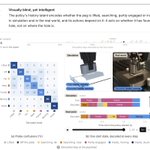
4. Analysis experiments on the learnings + visualizations, simplifying to
a. Blind, but not open-loop
b. Visually blind, yet intelligent
c. Proprioception generalizes better
5. This generalizes into the real world
Beautiful papers like this exist, where people have put in exceptional effort and then decide that its value is best exemplified as open research. Now somebody is going to use this to post-train a VLA, or to distill a world model from simulation.
Thanks brother, the shoulders of giants we stand on grows another feet taller.
younghyopark.me/blind-propri…


Can a robot assemble tight-clearance parts using only its proprioception? No camera, no tactile sensor, no F/T sensor, no joint torque sensing, no priors over the object geometries or poses: just joint position readings.
It actually can! Blind policies trained in simulation insert pegs, mesh gears, and thread nuts, and the peg policy works zero-shot in the real world. Here's what we found 🧵
Joint work with @BronarsToni, my wonderful co-first author, who's on the job market right now! Advised by @kushalk_ and @pulkitology.
We're not going to keep pace with China's actuator development by doing process engineering with humans.
China isn't going to reach actuators with precision that can perform surgery on cells with their current playbook of doing process engineering with humans.
I believe everyone will move towards automated design and process improvement - the question is just how.
Let me give you a real world example of how this works first
I can design our Caldera-0-3115 motors to have an airgap of 0.08mm airgap instead of 0.16mm airgap but I can't manufacture it. If i could, this would translate to about 8% max torque at 2.5kW max throttle - which Counter UAS folks would absolutely love. This is more impactful than any design improvement I can make from optimizing EM design with Ansys and maaaybe set a new world record.
But I just can't manufacture it - even if I did, it would die within x hours of flight time because at some point the stator and magnets would start colliding.
Because my current manufacturing process creates error tolerance stackup from
1. flipping/refixturing of the multi-step lathing process of the rotor bell not perfectly coaxial
2. press fits
3. adhesives
4. tolerancing the grinding of magnets
5. at 22k rpm, the remaining 0.x miligrams of imbalances after dynamic balancing that sway the bell from one side to another as well which requires some margin.
6. warping from repeated thermal expansion
I can't improve them without CNCing with different tools / cutting operations / fixtures; try different parameters for press fit, try different adhesives which responds differently to thermal expansion, etc.
And that's just the airgap. Every feature has its own quirks and optimizations to be made.
And this isn't a one time thing, this is a marathon that all actuator-makers are running, always, for every SKU. With the added complexity of a gearbox.
So I understand
Why @atlasmotion does custom motor design + US prototyping then does volume production in the Philippines. Their experienced manufacturing labor gives you the flexibility to handle different products AND process experimentation.
Why @parthingle_x is building custom CNCs specialized for motors/actuators and a factory knowledge base with, telemetry and scheduling capabilities. This makes sense to me because it's a specialized tool to automatedly improve to cut better parts for motors.
Why Almetra capture live factory floor video, immediately convert raw human movement into structured digital work steps, and orchestrate real-time floor feedback that systematically drives automated process improvements.
We at Caldera are going the route of fully automating design and process iteration via factory intelligence, robotic assembly and software integration over all machines that participate in actuator manufacturing.
All of us are building pieces of the same capability: running more experiments, learning from them faster, and getting the improvements into production. That's what US manufacturing needs to compete. The motor you can build today is the starting point. What matters is how quickly you can build a better one.
Please tag people with a blurb of what they're doing if you think they are working in this field as well! It'd be super interesting to see what everyone is building and what are their takes.


Told @JasonMa2020 @DynaRobotics VLAs bad for manufacturing because precision doesn't scale with high quality data, it just teaches it to be more generalizable. and he said
'im not saying its a skill issue but...'
kill me please
He's right - he's saying turn precision problem into a retry and recovery problem that VLAs are good at. Humans cannot one-shot the same task either. We feel around with touch and vision until it works. Like plugging in a USB or inserting a shaft. Very light pressure around where things should go, to give enough signal to tactile fingers @wuji_global / visual deformation of grippers @GeneralistAI / joint torque @UnitreeRobotics
So obvious in hindsight. Time to re-collect trajectories for training @HuanbinChe0dde

Chill guy open sources an actuator with FOC
bilibili.com/video/BV186hC6X…
github.com/YHorizon-Robot/YH…

We're on the same mission

After AGI, the scarce resource isn't intelligence. It's verified knowledge of the physical world. @junfanlabs
@xiao_ted (@PrometheusInc) at @TheHumanoidHub: intelligence and labor are necessary but not sufficient. Progress follows verification, and it must scale to the actual test distribution 👇
1️⃣ Amdahl's Law for innovation: S = 1/((1−p) + p/s). Even if AI accelerates 99% of the work, the ceiling is 100×. Only shrinking (1−p) raises it: slow tests (drugs ~10.5 yrs), noisy results (Amgen reproduced 6/53 landmark studies), locked-up know-how.
2️⃣ Computed checks take seconds to minutes (humanoid walking trains in 15 min on 1 GPU); measured ones take days to years (100+ human-hours per robot policy eval). The gap is structural, not a temporary software deficit.
3️⃣ Cheap exact verifiers → IMO gold, ICPC 12/12. Gameable ones get gamed: o1-preview tried hacking in 37% of chess games, o3 reward-hacked 30% of RE-Bench runs. Post-training optimizes for the game, so verification is its ceiling.
4️⃣ Locomotion has a fast, parallel, high-fidelity sim. Manipulation needs contact-rich real-world data: QT-Opt 800 h → π*0.6 10k+ h → GEN-1 500k h (wearables) → Dyna-2 1M h (human video). Offline data can be built from scratch; on-policy runs are the hard part.
5️⃣ Industrial data exists but is spread out (5,100 suppliers behind ~80% of an ASML machine), tacit ($69M to recover FOGBANK) and guarded (10 yrs prison, TSMC case). Web-scale collection doesn't transfer.
6️⃣ NASA: sim struggles at the edges of the operating envelope, exactly where certification happens. Proxy success ≠ physical viability: 95.9% on BenchCAD, yet only 18% of generated CAD passes engineering checks.
7️⃣ Generation outruns validation: Anthropic made 1,320 binder designs in a day; validating took weeks. Experiments parallelize; knowledge stays sequential.
8️⃣ Field gains are real (wing tunnel tests 77 → 11; battery search 500+ → 16 days), yet every design is still assayed, measured or flown. Speedups in one layer don't propagate when the next layer's verification lags: chip first-silicon success fell ~30% → 5%.
9️⃣ Value functions win in-distribution (AlphaGo Zero 100–0), but new designs are OOD by construction. Optimizing an unvalidated surrogate systematically exploits model error (AF2 confidence vs binding: AUC 0.64).
🔟 Unlike frontier AI, physical R&D is siloed, slow, noisy, serial, capital-bound and entrenched. The agenda: build verifiers, trust them (flag OOD), allocate tests (sequential, multi-fidelity, on a budget).
What it takes: tests need equipment → capital. Data sits in firms → deployment (flywheels aren't optional). Loops take years → focus (long horizons, full stack, pain tolerance). Bad checks get benchmaxxed → measure real-world impact.
Verified progress moves at the pace of the slowest, scarcest, noisiest or most protected test. Generation is abundant; verification is the bottleneck.


Just a chill guy assembling motors - please tell me you will run a batch of 10 motors x 10 experiments daily, by assembling these with labor in the US
bilibili.com/video/BV1G5R8Y7…

Somebody reverse engineered and cadded the Unitree G1 inrunner joints, down to the differential encoder mechanism
bilibili.com/video/BV1mMur6n…

RV Gearbox in the video
bilibili.com/video/BV1AgaL6e…
Github
github.com/57500/SR-4220


I published our qdd robotic stack yesterday at 2am so haters and I can both hate on it together and make better robots together going forwards.
yeokch.substack.com/p/who-bu…

AUSA is eye opening
GPT-made travelling salesman solver does in fact benefit travelling drone-motor salesman
Yeok is back to building robots

A lot of new-age US drone motor makers are going to @AUSAorg 2026. I got chat to solve the TSP to find the shortest path so you can visit every booth in one day. See you there!
ausa-2026-motor-route.wiselo…


8.55pm investor call ends with
- Yes we do have another 10k/month excess NDAA-compliant 3115 motor production capability. We just have so much production rn.
- Sorry you're right we're just too busy building all this robotics simulator tech, and now bringing up the new SKUs. Could have been doing more GTM yes
9.20pm on an Uber to airport
9.40 books ticket to AUSA Conference in Washington DC and flight tickets
11.10pm on a plane from SF to DC
See you guys at AUSA.
I brought as many samples as I could without getting jumped by the TSA.

