

Photographs Sun regularly, maintains high-resolution solar image depository for Citizen Science. A fellow of the Institute of Physics, Singapore since 29Oct13
Central Region, Singapore
Joined November 2011
- Tweets1.3K
- Following252
- Followers260
- Likes671



16Nov26. Northeast Monsoon season brings stronger winds and lots of clouds. A single scan from #SHG700 during a gap in the clouds produced excellent an #H_Alpha image with amazing #prominences and #filaments. J'Solex processing software generated corresponding negative continuum images, accurately identifying the locations of 6 #sunspots. Do a right click on collage to see the high-resolution details on each image.

4
57
18 Oct26@0348UTC. Singapore remained immersed in its longest stretch of unhealthy air since the 2015 #haze crisis. Impervious to the poor visibility (we can hardly see the Sun through the thick haze), the #SHG700_Spectroheliograph captured spectacular full- disk #solar_images @ 656.28 nm on the #H_Alpha spectral line. It also captured a #redshift animation at Spot A (near the #Active_Region at the centre of the Sun) where the plasma is moving downward into the Sun at a speed of about 68km per second!!. These could be either downflowing #plasma in loops or chromospheric condensation.


1
119
26 Sep 26, Singapore's air quality turned unhealthy with a PSI reading of 104. Despite significantly reduce visibility caused by transboundary smoke haze, the SHG700 Spectroheliograph produced a set of stunning H-Alpha images of the Sun showing amazing #prominences and #filaments. The animation clip shows the intricate evolution of these #solar_features.


1
63
24Sep26. The spectroheliograph is set up, tuned to Calcium-K wavelength to observe the Sun's lower #Chromosphere. Unfortunately #haze and clouds rule the skies. Never mind, will try again tomorrow 😀

2
59
21Sep26. Thick haze filled the Singapore skies for days. #HydrogenAlpha Sun captured this morning with a Borg 76 Achromat refractor fitted with #Solarscope filter. Micro flares and huge filaments were observed. The synthetically-colored image is close to what was observed visually. The other image was post processed to show earth-sized #prominences shooting out of the limbs. Pleasantly surprised to get such good-quality images during this hazy season.


2
103
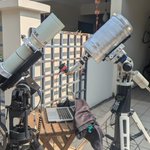
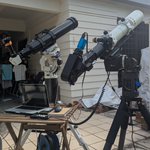
3Apr- AR4405 looks potent four days after it ejected an #XFlare on 30Mar. Close-up #HAlpha photo of AR4405 was taken with a 8" Celstron SCT fitted with an energy rejection filter and a PST etalon. This high-resolution image show the solar features in the #Chromosphere. #Plages (bright patches with hotter denser chromospheric gases ), indicating strong magnetic fields, surround dark the dark sunspots . #Fibrils, the dark, thin, thread-like structures that trace the magnetic field lines formed circular patterns around sunspot's penumbrae. Massive dark, snaky #Solar_filaments (clouds of cooler dense plasma) suspended by magnetic fields above the solar surface. Full disk H-Alpha images taken with a MLAstro SHG700 Spectroheliograph show the location of AR4405 on the solar disk. Both #solar_telescopes were set up side-by-side.


1
8
194

3Feb26. #Sunspot AR4366 has established itself as a #Solar_Flare factory with about 30 large flares and many minor ones over the last 2 days. Yesterday alone, it ejected 1 X-Class and 3 M-Class flares. It is still growing in size, and has magnetic fields harboring energy for X-Class flares. It is so large now (about 163,805km or almost 13 times earth's diameter) that you can observe it using #Solar_Eclipse glasses. For #Eye_safety, do not look the Sun directly without eye protection. I have taken close-up images in #White_light, #H_Alpha and #Calcium_K wavelengths using telescopes fitted with required narrow-band filters. It is a delight to observe the solar features which gives us a hint of the magnetic fields at work around AR4366. Recorded data are made available for citizen science research. Credit SDO for the solar disk with AR4366 flaring.


2Feb26. Out of nowhere, #Sunspot AR4366 appeared and grew rapidly in size. In the last 72 hours it hurled 9 huge #solar_flares in earth's direction. One of these was a X8 flare. This type of flare is the the most intense, largest category of explosion on the Sun, capable of releasing energy equivalent to billions of hydrogen bombs. Half an hour after the X8 flare, I have photographed a close-up image of AR4366 in Calcium-K wavelength showing the aftermath magnetic activities and features like active regions, #supergranulation cells, and bright points associated with sunspots. The H-Alpha solar disk was imaged with a #Spectroheliograph SHG700. It showed the #sunspots and features in the Upper Chromosphere. Credit SDO for the X-flare


AR4274 that generated #auroras in November 2025 came back as #AR4299. While it is significantly smaller compared to the AR4294-96-98 complex, it has produced more than 30 flares, including 1 #Xflare. This high-resolution C4 flare was photographed on 5 Nov25, 0200UTC with a 150mm refractor fitted with narrow-band Calcium-K filter system.

4
178
5Dec25. AR4294-96-98, the largest #sunspotComplex this decade covers a stretch of about 1/3 of the Sun's diameter (464,3000km or about 36 times the earth's diameter), making it visible with naked eyes (only with solar eclipse eyepiece, please). This region has the potential for #XFlares but has remained silent since erupting an X-flare on 1 Dec 25. Attached photos are taken by me using a SHG700 (for #HAlpha full disk at higher #Chromosphere), a 150mm refractor with CAK filter system (magnetic fields in lower chromosphere) and a 120mm refractor (White Light of the #SolarSurface). I am keeping watch as the XFlare forecast is 25%


2
5
319
3Dec25. This image of the sunspot complex 4294-4296 was taken with a 150mm refractor fitted with a narrow-band CAK filter system. It shows the areas of high magnetic activities around sunspots, #plage and large-scale #supergranulation cells. This sunspot complex is comparable in size to the #Carrington sunspot.

4
279
I made these 2 animated GIFs for 1 Dec 2025 AR 4299's #X_flare from #SDO AIA 304 Angstrom and SDO AIA 131 Angstrom channel images. AIA 304 (Red) shows cooler dense plumes of plasma above the visible surface of the Sun, from ionized helium (HE II) @ 50,000K. AIA 131 (turquoise) shows the flaring regions of the Corona @ extremely hot temperature 10 million k. Contrary to earlier prediction, the resultant #CME may not miss earth after all. Credit: NASA/SDO
3
168
1Dec25. AR 4294-96 is one of the biggest #sunspot seen in a decade. AR4294 is growing rapidly and harbours magnetic fields with #X_flare potential. The surprise is the X1.9 flare this morning came not from AR4294-96 behemoth but from the smaller AR4295 sunspot. This X-flare started at 0227, reached maximum intensity of X1.9 at 0249 and ended at 0305hrs. The animated gif was made from SDO/AIA 131 Angstrom images The associated #CME is directed away from Earth. Credit: NASA/SDO

3
774