


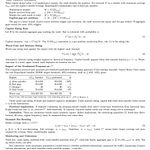
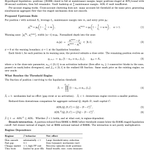
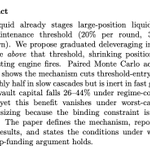


Following GOOGL earnings' price action on @tradexyz (and the loss taken by the backstop liq vault) and @drwconvexity's concerns over ADL, I've studied @HyperliquidX's protocol design and how it could be improved to deal better with these events
github.com/ymsynn/xyz-backst…
In this paper I explore multiple changes @HyperliquidX and @tradexyz could consider to minimize ADL risk and backstop losses
The temporary solution chosen for NVIDIA earnings is one of the explored ideas of the paper
A visualizer can be found here: ymsynn.github.io/xyz-backsto…
with all considered changes effects on real events


NVIDIA is scheduled to report its fiscal Q3 earnings on Tuesday, November 17, after market close.
Ahead of the earnings release, we will temporarily reduce the maximum leverage on xyz from 20x to 10x, effective Sunday, November 15, at 8:05 PM ET.
Maximum leverage will be restored to 20x following the earnings.
With the current design, the mark price (which triggers liquidations) lags the market by about a minute in a crash.
By the time a position is liquidated, and the backstop vault takes it over, the book is already far away: on GOOGL, 156 of 158 positions reached the vault already underwater.

1
1
86
All results and experiments can be reproduced using the repo
Data: @hydromancerxyz and @HyperliquidX's public node archive on s3
1
58
it's hard to stay faithful to systematic trading and not throw some discretionary trades here
2
5
226
reading stuff I've hand coded pre opus4.5 gives me the same feeling as trying to solve math problems from my master's
wtf was I on

This is one of the sickest thing I've read here.
For the ones wondering what was the opportunity like, here is some simple backtest of @Cbb0fe's first described strategy:
executed on a single core/evm pair for a single day.
It consists of:
- monitoring pool price at a block
- if the spread between core price and pool price is > threshold (10bps here), execute on the pool
- if at the end of the block we get executed, hedge on the other leg (disclaimer: no possibility to 100% say that we would have so here we take the whole opportunity and consider that we would have). Only thing to consider on the backtest is that hedge price is taken based on orderbook snapshot at block end and not at opportunity timestamp
- finding the size of the opportunity, with a max size of 20k per trade. This means simulating on both ob snapshots and pool tick map the exec price
This backtest version is obviously only a small portion of the way more complex strategy they used.
We only take the opportunity of arbing HYPE perp vs HYPE / USD₮0 (0x337b56d87a6185cd46af3ac2cdf03cbc37070c30) on hyperswap.
In reality, the arb strat should include every pool on every dex, and every pair available on core.
The pool was chosen as the most liquid pool to date, and the backtested date as a high volume one.
The profit chart, based on our "always executed on evm" assumption, highlights the total part of the pie that all competitors share: an annualised $5M opportunity on a single pool.
In reality, no one would be able to access 100% of the opportunity.
For these results, we took 5bps fees on the pool, 2bps taker fees on the perp (platinum tier4).
The opportunity would be bigger with a lower threshold and lower fees.
If there's some interest, I'll provide backtests for a multi pool arb (the whole opportunity), or the maker perp strat cbb talks about.
Don't hesitate to dm if you want to discuss about it 🫡


1
2
134
attention in the ecosystem is centered around the backstop liquidation vaults since docs update
deployers still need to determine how to fund these vaults to avoid liquidation while minimising idle capital
for hip3 deployers, I derive a mathematical framework for vault funding, and provide a formula to fund the vault with a proportion of the generated fees depending on the current risk faced by the vault

1
1
245
since mid March, hip-3 deployers can create a backstop vault, that acts as the HLP for their cross-margin markets.
a problem they face on these vaults is "how to minimise the idle capital on the vault, while minimising the total ADL volume on the markets, and minimising the risk of liquidation in the backstop vault"
the protocol could help by adding Graduate Deleveraging, which I introduce in the paper.
this would lower the required capital for deployers, while reducing volume that hits ADL.
full research paper and simulation is available here: github.com/ymsynn/Unit-Perps…

1
4
291

it didn't take much time for s&p500 to overtake xyz100 in open interest.
interesting to see that xyz100's OI is still pretty stable, suggesting s&p500's OI comes mostly from new capital and not rotation between both products

for it's first weekend, @tradexyz's S&P500 did pretty well volume-wise compared to other markets' first weekends, becoming the biggest equity launch weekend ever on hip-3

2
307
did some additional research on the subject, for both deployer and trader pov.
full paper available here: github.com/ymsynn/Unit-Perps…
key findings:
- hip4 binary contracts could help traders reduce their weekend funding variance
- they could help them manage liquidation risk at the discovery bound
- deployers could bundle hip3 and hip4 into products (e.g. a weekend-protected perp)
ofc huge assumptions have been taken for hip4 as it's not live yet. the paper uses real hip3 and yahoo finance data.

HIP-4 isn't just a Polymarket competitor. It is also an HIP-3 enhancer.
Hyperliquid perps are split between native HL perps and HIP-3 perps. The latter bring perp mechanics to tradfi markets, with their crypto-specific characteristics: these instruments have funding, and can trade over the weekend.
A few weeks ago, HIP-4 was announced and deployed to testnet. It allows deployers to create binary contracts with expiration. While the main use case appears to be Polymarket-style prediction markets, these new instruments could also enhance existing ones - and further position Hyperliquid as "The House of all Finance.
As an example, let's look at how traders could use them to manage weekend funding risk (disclaimer: there exist more sophisticated ways to do this, like using @boros_fi. This is just a toy exemple of synergies between HIP-3 and HIP-4).
The key difference between tradfi instruments and HIP-3 perps is funding. Many traders avoid holding long-term positions through perps precisely because of funding costs. This is especially true over weekends, during which the oracle mechanisms set by deployers like @tradexyz can generate significant funding.
To reduce this uncertainty, a trader could protect himself by buying an HIP-4 contract asking: "Will total funding this weekend exceed F%?" If he is long the perp and buys the contract, he covers extreme scenarios. His short counterparty, meanwhile, could sell that exact contract. If funding turns out high, the short loses the binary premium but benefits from the funding received. If funding is low, he pockets the contract profit.
This isn't a perfect hedge - it's a variance reduction on weekend funding uncertainty. The trader keeps his directional exposure and reduces his worst-case funding cost, at the price of a premium.
Last week, XYZ:CL drew particular attention. There was risk of escalation in the Middle East, and previous weekends had seen extreme moves. A long could have bought "Will total funding exceed 0.2% this weekend?" to mitigate the risk. With $100k notional, covering 0.2% means a needed $200 payout - the market prices this contract at $0.55 (computation made by opus through a linear regression made on historical funding data).
On the other side, a short with an identical position could want to lock in some certainty around funding, and is willing to sell that same contract at $0.55. The counterparty exists.
Here's a small breakdown of their performance over the weekend:
- As overall funding came in well above 0.2% - realised at 0.406% - the protection didn't cover the full cost. But it still benefited the long.
- For the short, he would have been better off without the contract, though he still collected net funding on the weekend.
January 31 tells the opposite story. Funding went negative that weekend - the short paid instead of receiving. There, the short would have been glad to have bought protection.
This kind of instrument is most useful around specific high-uncertainty events, and its value is highly dependent on the price agreed for the contract.
There is no doubt that sophisticated players will find many more ways to enhance their perp trading with these tools. And that deployers will propose trading tools including baskets of instruments directly on their frontend.
