

Zoo makes CAD truly AI-native with a modern geometry engine, readable code, and an editable feature tree, enabling precise changes beyond chat-only workflows.
Joined April 2021
- Tweets912
- Following20
- Followers15K
- Likes2.4K







Ben’s Build Log #16
With KCL 3.0 released, I asked Zookeeper to migrate the entire project, review the existing code and make sure everything still worked as intended.
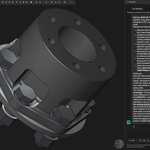
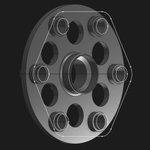
With that done, I finished the propeller spacer, making use of the improved fillet capabilities in KCL 3.0 to smooth out the transitions around the mounting bolts and structural ribs.


Basics of using the Translate, Rotate, Scale, Clone & Mirror functions in Zoo Design Studio.
youtu.be/psq2Dd15mGs
Ben’s Build Log #14
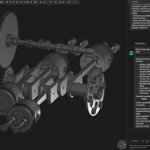
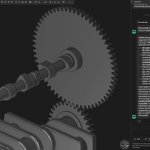
With the rest of the engine components in place, I asked Zookeeper to create a functional linkage between the camshaft lobes and the valves.
The first result already had the basic mechanism in place, but some of the geometry still needed refinement.
After a few adjustments to make the setup cleaner and more realistic, the engine internals were finally complete.


Basics of using the Shell & Hole functions in Zoo Design Studio.
youtu.be/hnhqPUY8tMc?si=nxiS…
Ben’s Build Log #13
While reviewing the engine assembly, I realized there was a deeper logic issue in the way I had arranged the layout.
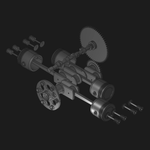
After working through the problem with Zookeeper and exploring a few possible fixes, I reworked the affected geometry to better match the flat-four configuration typical for this kind of aircraft engine.
The result is a more mechanically plausible setup that I’m much happier to continue with.

Basics of using the Fillet & Chamfer functions in Zoo Design Studio.
youtu.be/2X_d_-Sj-e0
Zoo retweeted

KCL 3 is a much saner language, from a PLT pov. Critically, this lays the ground for shipping opt-in breaking changes to KCL, like how Rust editions work. So we can improve our 3D topology algorithms, changing little details (like face/edge ordering) without breaking old models.
Zoo retweeted
Zoo has released KCL 3! This release massively improves Zoo's fillets, and fixes a bunch of little papercuts in the KCL standard library and language semantics. Your KCL 2 files will still work fine, but new files will be created in KCL 3. Read more at zoo.dev/blog/kcl-3


Basics of using the Extrude, Sweep, Loft & Revolve functions in Zoo Design Studio.
youtube.com/watch?v=KRYgKR6i…

Zoo retweeted

One of the biggest questions we get about AI generated designs is "how does the AI know their performance?" The same way humans know, by running FEA.
That's why @zoodotdev built FEA workflows into Zoo Design Studio, Zookeeper, and our APIs.
You can set up and run these directly in Zoo Design studio, no exporting. Zookeeper can iterate on designs based on FEA results.
Via our APIs, these FEA runs can be ran as a service for third party integrations, and by other agentic workflows.
Been in beta internally, and by select enterprise customers, to be released broadly later this year.

Zoo retweeted
We're growing across @zoodotdev, including our factory, computational geometry, and infrastructure teams. Please apply!
zoo.dev/careers


