

oss @langchain. d/acc. build measure learn repeat.
somewhere in california
Joined January 2022
- Tweets452
- Following300
- Followers103
- Likes7.5K


byhow retweeted

3Blue1Brown walked so we could run

skills that have to survive ablation and real-trace regression is pretty interesting. imo most of the industry is still at the write-once-and-forget (pray based skilling) stage. the hard part is making the feedback from real runs cheap enough that people actually turn failures into cases that they re-run


32
to echo on @hwchase17 here from my last post on this agent platform front:
i think we already nailed a lot of the runtime primitives but that’s just the intended behavior. next up is really feeding it into evals and traces so you can see the observed behavior and keep improving it (w/ platforms like langsmith)
imo that’s the next real unlock for rsi or just a better self-improving harness

this is a great article and strongly agree on many dimensions. it is a great vision of the agent *runtime* of the future
but the runtime is just one part of an agent platform. theres two glaring omissions imo:
1/ observability/evals
2/ governance
the future described here (of self improving agents) is spot on. but in order to achieve that, theres three main pillars
first is the runtime, which John nails here. what he describes closely mirrors what we've built in langsmith - agent server (to deploy agents), sandboxes, and of course deepagents as the agent harness
the runtime contains the *intended behavior* of the agent. and as anyone who has built agents knows, they dont always do what you intend
thats why they need to learn/evolve on the job. in order to that, you need:
observability/evals: this is the "observed behavior" of the agent. what actually happens, what tools are called, how it performs in certain scenarios. this is ESPECIALLY important as the agent evolves - you need to keep eyes on how its evolving, and it will probably end up writing tests for itself
governance: no matter how much the agent evolves, there are certain things you want to enforce. who it calls tools on behalf of, how it uses those tools, how much it can spend. this is where governance (best enforced through an llm gateway and tool gateway) are crucial
we're building all of these in langsmith - if youre struggling with any parts of these, plz reach out!
this is a great example of clear thinking on the designs that leads to an agentic future
i think we definitely already nailed a lot of those primitives right and next up is really find areas to feed into evals and polishing it up

Agent platform of 2027.
This is the end game. This is the blueprint for the one and only application layer software that will exist. Every other software will effectively become databases for this layer, the everything agentic operating system for the million agent swarm to work on top of.
This is obviously the end game vision for the application layer of ChatGPT and Claude. I have reasons to believe that an independent company will own this product layer. But most ADE, "enterprise agent platform", or vertical saas companies, are focused on the wrong things far too narrowly, not technically competent, and do not have the product / technical vision to see this inevitable future.
The correct agent platform that wins will function like the base of a garden, from which customers will plant their unique "seeds" to grow their own plants and trees, managed and evolved by agents, humans, and signals from the sensors of the business. This presents a clearer picture than "factory of a factory" imo.


2
57
w/ larger context windows and long horizon tasks, designing goals that support self-verification and continuous learning from human evals becomes the real constraint
we need higher-level primitives that make feedback on those goals cheap and transferable so agents can keep improving without constant re-prompting
as agents move towards working on goals, it becomes important to design those goals correctly
wrote with @mgarimella on some lessons learned at actively!

nothing constructive gets done if we just be wishing for good software

I just finished talks about my software factories at two conferences. Afterwards a bunch of people came up and told me what they were surprised about. Here is a distillation of what people thought were hot takes from my two talks.
First hot take: I tell everyone to slow down. Most speakers go on about how fast they're going, but I strongly believe in pacing AI outputs to human speeds. I regularly tell AI-pilled CIOs and CTOs to chill: almost nobody is _actually_ going fast with AI. Engineering still moves at engineering speeds, and business moves even slower. The ones pushing too hard are starting to see downtime for it.
If you don't pace your AI to human speeds, everything starts breaking around you, even at small operations like my online video game. I only have about a dozen humans working with my factory, and only a few hundred active old-timer players in the community who get along well, and still, introducing AI has still been very rocky.
My agents have, at times, overwhelmed my players with features, my accountant with emails, my merge queue with tickets, and my machines with load. Agents have pissed off my admins, resulting in name-calling, they've made messes in the game, and they've launched broken OSS without permission. The list goes on.
I can get away with all this chaos because everyone involved in my operation is very forgiving. They're excited by the potential. But even so, I had to learn to slow down, real fast. And so that's what I preach.
Hot take #2: Should you buy a software factory? Do you even need one? No. You probably don't need one. Factories take an extraordinary amount of upkeep. They turn into garbage mountains unless you put a frightening amount of time and tokens into curating them. I had to burn my previous five factories down since it eventually became cheaper to rewrite them than to fix them. So I'm not out there advocating for software factories or swarms just yet. If you do want one, be aware that it is a significant commitment of both money and human leadership to keep one running.
Several people told me that I was the only one who stood up onstage, at either conference, and said Build, don't Buy. But my experience is that software factories grow to be highly bespoke to your domain. Mine is super tangled up with my game, and I think that's inevitable. Because the factory is not just building my product, it's supporting it too. It's a company in a box. And they're easy for Claude to build for you.
Third and arguably hottest take: Next year will have a lot of human/agent and agent/agent office drama, resulting from bringing in AI employees, and it will be gloriously funny, but also frustrating.
Many of you are already on this bandwagon, but everyone next year will have a personal chief-of-staff agent. Busy people, even hobbyists, will have whole entourages of helper agents. The hot take is that people will become so dependent on these little private entourages, that they'll bring them to work. Your people will talk to my people, etc. Whole protocols will emerge for private entourages negotiating work between humans, inside companies big and small.
Nearly all humans will wind up having to start working with AI employees next year, and it'll be the beginning of the biggest cultural change we've seen in a hundred years.
So that's the hot takes. Slow down. Only build a factory if you think you really need one. And focus on empowering yourself with your own agentic chief of staff (or team). Your entourage will define how you work with others, so start by perfecting how you work with them yourself.
60
byhow retweeted

langchain's open source powered our seed round, and it's still our foundation at our series c.
we're lucky to have the support of an enormous community, with 200M+ oss downloads a month! this community of builders taught us the hardest parts of building agents, which are non-deterministic in a way traditional software isn't.
we built langsmith to close the gaps we saw in observability, evaluation, and deployment to help folks get agents to production.
with this raise, we'll keep building open source so you can own your intelligence (from model to context to harness)!

Today we announced that LangChain raised $300M at a $3B valuation.
We think agents will transform the economy, and the companies that own their intelligence will build lasting competitive advantages.
That's why we're building LangSmith, the framework-agnostic platform to run, improve, and govern agents.
Still so much left to build! More on what’s next: langchain.com/blog/series-c
2 months in at @LangChain and i think most of agent infra is just making it cheap to be wrong. checkpoints to rewind, approvals so it asks first, sandboxes so it breaks something that isnt yours, traces and evals so you can tell if the fix worked
series c today is kinda the company doing the same thing, somebody clicked approve on the next call and now theres a checkpoint, so if the next bet breaks we resume from here and not from zero
glad to be here for it
Today we announced that LangChain raised $300M at a $3B valuation.
We think agents will transform the economy, and the companies that own their intelligence will build lasting competitive advantages.
That's why we're building LangSmith, the framework-agnostic platform to run, improve, and govern agents.
Still so much left to build! More on what’s next: langchain.com/blog/series-c


this is the sickest product features I’ve seen in a while

A quick demo of floating panes in Rex, some of their features, and how I use them in my daily workflow. I think our implementation of floating panes looks great and feels great and I think you'll love it! These are also all scriptable and API driven, too, of course!
1
99
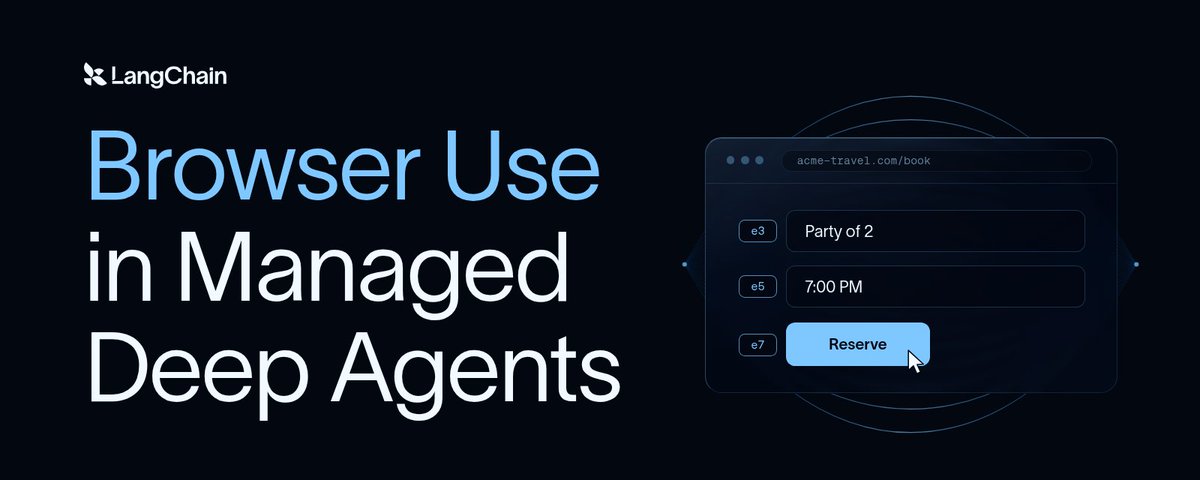
one of the best agent primitives now on deep agents!
in a future where we stop babysitting local agents, browsers in sandboxes become the verification layer: the agent checks its own work, and hands you the browser when it needs a login.
s/o @Stagehanddev for the amazing tools!

byhow retweeted

we've been exploring how to make the knowledge openwiki produces more useful to agents.
our latest experiment pairs the wiki with a lightweight evidence graph, letting agents follow relationships and trace information back to supporting evidence.
on complex, domain-specific questions requiring cross-source reasoning we saw:
👉 5x higher accuracy with openwiki vs. grep alone
👉 27% more accurate with the evidence graph
👉 2x citation consistency
👉 58% lower cost per correct answer with the graph
check out the blog ⤵️
langchain.com/blog/building-…

byhow retweeted

Company harnesses break down knowledge silos
Three in four requests to Content Studio come from people outside marketing. This usage pattern is why I'm so bullish on company harnesses: they allow everyone to get involved in domains they had no business in before. We've encoded our design team's judgment into a set of skills anyone can use, so anyone with a creative vision can execute it with Content Studio
Coding agents brought the same shift to SWE. People who would have called themselves nontechnical a year ago are now shipping PRs
I'm excited to see this happen in every domain

How we built Content Studio, an open-source design agent in Slack that makes on-brand videos, graphics and decks, and the harness that powers it. View article

byhow retweeted
Or don't pay, and use our open-source software factory instead: langch.in/openswe


If your company or startup is running engineering with everyone using their own license of Codex/CC then you're going to be completely left behind by fast moving teams who are using cloud-based agents.
Local dev is like banging rocks together and grunting versus being on a rocket.
Seriously, just pay the money for something like @DevinAI, @AmpCode, @FactoryAI, etc.
Do NOT try to build your own "code factory".
Props to @DaleSpoonemore for taking @HelloUntangle to the next level on this. Fun to watch.
big for tui
I've published a new, general-purpose terminal specification that gives any program a way to tell the terminal what it's doing: idle, working, waiting, finished, or failed, and why. It is easy to implement on both sides. I've written more about why: mitchellh.com/writing/progra…
The problem this solves is generic and applies in compelling ways to all sorts of use cases (e.g. package managers, build tools), but it really rears a hideous head when it comes to AI and the "agentic inbox" problem.
I found over 250 different agent orchestrators (with various goals) that all individually implement a heuristic based approach to detecting whether things like Claude Code are working, blocked, done, etc.
If you look at @herdrdev's commit history, you can see around 10 compatibility changes to detect Claude Code within just the past 3 months. (This isn't a dig at Herdr! They're doing great work with what they have, and everyone else is doing the same thing).
Heuristics are not the way. And over-indexing on agentic use cases isn't the way, because this problem is really interesting for other tools too: Homebrew, Terraform, Cargo, etc. etc.
Proprietary protocols and out of band APIs are not the way. They have an O(N) integration problem and require extra work to work over SSH or within local VMs/containers.
The program status specification (OSC 7501) solves this in a reliable, deterministic way that is general-purpose and can be easily adopted by the entire industry.
Read more: mitchellh.com/writing/progra…
1
57


byhow retweeted

@𝚕𝚊𝚗𝚐𝚌𝚑𝚊𝚒𝚗/𝚖𝚌𝚙-𝚊𝚍𝚊𝚙𝚝𝚎𝚛𝚜 2.0 is out! 🧵
Using MCP with your TypeScript agents up to MCP servers just got a lot simpler: support for the latest stateless version of MCP, tools that can check in with your users when they need something, much easier auth integrations, and a ton of QoL updates.
Here's what's new 👇

