

Committed to evolving human consciousness. Writing on decentralized communities, sovereignty, privacy, human rights and money nobody can print 🇳🇴
Norway
Joined July 2009
- Tweets562
- Following485
- Followers140
- Likes7.7K





J.Richard retweeted

JUST IN: 🇹🇭 Thailand's Supreme Court officially recognizes Bitcoin as legal property.

J.Richard retweeted

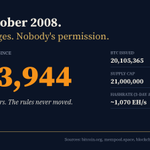
17 years after Bitcoin's creation:
• still 10 minutes per block
• still capped at 21 million
• still adjusts difficulty every 2016 blocks
• still decentralized
• still open source
• still SHA-256
• still 99.99% uptime
• still never hacked
• still immutable
• still growing
Yet most people still think it's going to zero.

J.Richard retweeted

Financial freedom is not about how much you have.
It's about how much you need.
Reduce what you need and freedom gets closer without earning a single extra dollar.
Most people try to earn their way to freedom.
Fewer realise they can also spend their way there.


J.Richard retweeted

Indiana, USA: Another massive solar farm has been reduced to a pile of toxic debris by... the weather. 😳
Imagine making the energy grids of advanced first world economies dependent on this inefficient, intermittent and fragile technology under the guise of solving a "climate crisis" that doesn't even exist. 🤡

J.Richard retweeted

RIP Privacy — AI Glasses Can Now Recognize Anyone, Anywhere.
A Dutch journalist just tested a pair of AI-powered glasses that can instantly identify strangers on the street.
No government database. No police system. Just public data and off-the-shelf AI.
You look at someone and in seconds, their name, LinkedIn, and background appear before your eyes.
The scariest part? You can’t really stop it.
You can ban it, regulate it, add blinking red lights… but once tech like this exists, someone will always find a way to use it.
To me, this marks a turning point.
We’ve officially blurred the line between seeing people and knowing them.
Between being in public and being exposed.
So here’s the question:
When every face becomes a dataset, how do we protect the meaning of being human?
#AI #Privacy #Ethics #Technology #Innovation #Data #Surveillance

J.Richard retweeted

Banned, Broke, and Homeless: The Human Cost of China’s Social Credit System
It began as whispers — a few people under bridges, a few families gone overnight. But soon, it became impossible to ignore. Across China, tens of thousands vanished into digital silence — not criminals, but victims of an algorithm. Behind the promise of “trust,” a hidden system now decides who can live freely… and who disappears from society itself.

Meanwhile tens of thousands young people are becoming homeless in China 😭. Because they are blacklisted by social credit system.
Once you are blacklisted, you are immediately cut off from banking service and digital payments.
——This makes it hard for you to find a job to support yourself, and you will become homeless🚨
J.Richard retweeted

CASH DIES IN 847 DAYS
Europe just legislated the end of financial freedom and nobody noticed.
January 2027: Every euro above €10,000 becomes illegal tender. Every Bitcoin needs government permission. Every transaction becomes a datapoint in Brussels’ surveillance grid.
This is not proposed. This is law.
340 million Europeans will wake up in a cage built from their own bank accounts.
THE KILL SHOT
The EU Anti-Money Laundering package doesn’t just track criminals. It treats every citizen as one. Starting 2027, buying a car in cash becomes a crime. Sending €1,001 in Bitcoin without state approval triggers prosecution. Anonymous wallets vanish overnight.
The Digital Euro arrives 2029. The European Central Bank spent €1.3 billion building what they call freedom. But leaked proposals cap holdings at €3,000 per person. Every purchase tracked. Every pattern analyzed. Every dissent potentially bankable.
THE LIE THEY’RE SELLING
“This stops money laundering.” Europe launders €500 billion yearly, they claim. So they’re building a panopticon for 340 million people to catch the fraction who commit crimes.
China’s digital yuan already programs money to expire, to restrict, to control. The ECB promises Europe will be different.
They promised deposit safety in Cyprus too. Then they seized accounts in 2013.
WHAT HAPPENS NEXT
Privacy coins migrate to the shadows. Black markets replace grey ones. The state gains omniscience. You lose the right to buy bread without permission.
This isn’t about crime. It’s about power. €20 trillion flows through the eurozone. Every cent will soon require approval from Frankfurt.
The infrastructure of tyranny gets built in the name of safety. Always.
THE CLOCK IS RUNNING
847 days until your cash becomes contraband. 1,308 days until the Digital Euro launches. Zero days of mainstream coverage asking the only question that matters:
Who decides what you’re allowed to buy when money becomes permission?
The European Union just made Orwell an instruction manual.
And you heard it here first.


J.Richard retweeted

The banks will fail again.
Nine European banks are teaming up to launch an EUR stablecoin; the 2025 remake of “blockchain, not Bitcoin”.
It failed for R3. It failed for Facebook.
This time is not different.
Consortiums building complex systems cannot succeed. Gall’s Law applies: systems that work evolve from simple, working ones.
Stablecoins will become huge, but not with this committee-built, MiCA-compliant model. Consumers want reliability and freedom, not another slow, closed banking club.
Banks should put clients first, and integrate the stablecoins that already function and start building real Bitcoin and crypto services.
That’s where trustless settlement, global liquidity, and lasting value are headed. That is what their clients have demand for.
Opinion piece coming soon.
J.Richard retweeted

2018: Harvard says Bitcoin is more likely to hit $100 than $100K.
2025: Harvard buys $116M Bitcoin at $116K.
Everyone gets Bitcoin at the price they deserve.

J.Richard retweeted

The EU has completely fucked Europe.
Only one European car makes it into the top 10 best-selling vehicles worldwide. No European company in the global top 10 of tech. No European search engine. No smartphone. No operating system. No streaming platform. No social media giant. No cloud infrastructure. No semiconductor leader.
What Europe produces at scale is paperwork, taxes, and restrictions. The EU turned the continent into a museum of former power, managed by people who fear growth, hate competition, and worship consensus. Innovation is treated as a risk. Success is treated as a threat.
Meanwhile, the US dominates tech, South Korea leads in chips and displays, China builds everything else—and Europe holds panel discussions on ethics.
KURWA MAĆ.

J.Richard retweeted

Jeg synes vi skal være på vakt mot den utviklingen vi ser i verden nå. Eller kanskje mest av alt ta mer plass i debattene. Når vi ikke gjør det, tar politikerne seg til rette.
Vi kan ikke la det være opp til politikerne å forvalte ytrings- og informasjonsfriheten vår. De er FRYKTELIG dårlige til det.
De gjentar bare det samme mønsteret, fordi det ligger i deres naturlov å … POLITISERE alt, hele tiden.
En kanskje uforutsett fare ved denne massivt tilstedeværende ytringsfrihetsdebatten som har pågått de siste 8-10 årene (som har gitt veldig mange økt kunnskap om ytringsfrihet!), er at politikerne også tror dette er oppe for politisering. Dette må vi nå være på vakt mot.
Først tar de eierskap til ord som desinformasjon. Propaganda. Konspirasjonsteorier. Hatefulle ytringer. Men også radikal kjønnsteori. LGBT-litteratur.
Så skaper de politisk marked og mobiliserer mot det. Så kriminaliserer de det. Fordi det er politisk marked for det. Plutselig hadde vi ikke lært så mye om ytringsfrihet, likevel.
Selv om vi diskuterer desinformasjon, propaganda, konspirasjonsteorier, hatefulle ytringer, radikal kjønnsteori og LGBT-litteratur i den offentlige debatten, betyr det faktisk ikke at vi trenger politiske løsningsforslag mot det.
Det er her vi må melde oss på.
Politikerne tror det er deres tur å gjøre upopulære meninger ulovlige, og insentivene ligger der til å bli populære politikere av det. Da trenger vi flere prinsipielle forsvarere av den brede ytringsfriheten, der vi ikke nødvendigvis mener at meninger vi ikke liker, bør forbys.
Gjennom å «definere» og skjære ut deler av ytrings- og informasjonsfriheten vår, som isolert farlige, politiserer de ytringsfriheten vår – og gjør fri meningsdannelse umulig. Men først: farlig, ulovlig, straffbart.
Det er mediene – i sunn konkurranse – som bør gjøre dette. En hygienefaktor er da at dårlige ytringer og feilaktige meninger må være lovlige.
Selv om medier og myndigheter er det samme for mange (jeg kan forstå hvorfor) er det vesensforskjell i å la de frie mediene forvalte ytrings- og informasjonsfriheten vår. Staten skal bare legge til rette for det, gjennom åpenhet og lovlighet.
Desinformasjon, propaganda, konspirasjonsteorier og hatefulle ytringer. Alt sammen kan være skadelig. Men det kan aldri bli så skadelig som den politiseringen av ytringsfriheten som nå pågår. Våre beste verktøy mot nettopp slike størrelser, er mer, og ikke mindre, ytringsfrihet.
Det er naivt å tro at politiske regjeringer er egnet til å vurdere desinformasjon, konspirasjon, propaganda og lignende på noen tilfredsstillende måte. Risikoen for politisering av slike begreper er påfallende. Det er naivt å tro at politiske interesser ikke vil påvirke beslutningene.
Støtter Amrit Pernille Kaur i Rød Ungdom fullt ut her: subjekt.no/2025/07/22/forbyr…


J.Richard retweeted

I did more tests with Google's #Veo3. Imagine if AI characters became aware they were living in a simulation!
J.Richard retweeted

WATCH: BILLIONAIRE JACK DORSEY EXPLAINS #BITCOIN TO THE CEO OF NORWAY'S $1.8 TRILLION SOVEREIGN WALTH FUND
"BTC ALIGNS WITH INTERNET PRINCIPLES." 🧡