

tuomo kiiskinen • md-phd • building ai-powered next gen biomedicine @Stanford • quant genomics x data sci x comp bio
Palo Alto, CA
Joined September 2022
- Tweets10.1K
- Following1.8K
- Followers3.5K
- Likes46.9K




Pinned Tweet
The central problem of biology is the origin of biological organization. In our preprint, “Information-theoretic Limits on Programmatic Specification of Biological Systems,” we show, using information theory, that an organism does not contain enough organism-specific information to specify its own fully functioning microscopic organization.
For over 70 years—since the discovery of the double helix and the cracking of the genetic code—biology has been dominated by the metaphor of the genome as an executable computer script or structural blueprint. Yet, it has remained a central mystery how the genome organizes the entirety of the microscopic, fine-scale molecular biological machinery in space and time.
We wish to put forward a radically different formulation.
We show, as an analogy, that the genome is not a figure-skating program choreographing every molecular movement, but a hockey coach’s game plan : roster, tactics, line assignments. The exact trajectory of the puck is computed by physics at runtime. The game looks like hockey because of the specified ensemble, not because every coordinate was pre-programmed.
The organized machinery of life is not the execution of a fully prewritten organism-specific program under favorable conditions. Rather, it is the compilation of a coarse organism-specific specification by a shared physical background that is constitutive of biological organization.
We establish the threshold as a family of maximal capacity-compatible coarse-grainings, distinguish the proven impossibility below the threshold from the empirically realized coarse mappings above it, and locate the threshold empirically through worked cases of protein folding, E. coli, Drosophila early development, and C. elegans, together with computational verification using AlphaFold-2 (analyzing tertiary structures of 555,846 proteins across 46 AlphaFold-2 proteomes), the JCVI-syn3A 4D whole-cell simulation, and canonical stochastic gene network models. We further show that no known naturally realized environmental channel can close the gap. The result rules out programmed microstate determinism while leaving physical determinism untouched, reframes the genome as a generator specification rather than a trajectory program, and unifies gene-centric, developmental, and field-theoretic (bioelectric, morphogenetic, and related continuum) views of biological specification under a single coarse-graining framework.
It has not escaped our notice that this framework has fundamental implications for understanding evolutionary search, heritability, thermodynamic order, biological modeling, and artificial intelligence in biology, but these will be published elsewhere.
biorxiv.org/content/10.64898…


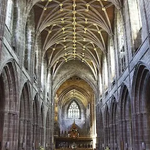
it says that architecture is a discipline. and that the discipline carries more depth than merely building disney land decorations for later era tourists. it is a deliberately unapologetic display of how a building of that time was actually made. the brutalism is not a disney land decoration, but lack of it. ideologically this is not that far from cathedrals where the arcs exist not for decoration but for the actual function to carry the weight of the building to reach to divine heights. but it is an ultimate fundamental mistake to think that a cathedral was built to please the human eye. no offense, btw.


I visited Wurster Hall at UC Berkeley today. It was designed by, and currently houses, the architecture faculty.
The UC Berkeley website notes that "Wurster is often voted Berkeley's ugliest building."
I visited because I was curious about whether it would in person seem as unattractive as it does in photos. And, in short: it does. It's gaunt, austere, and filmed in grime. On an elysian campus, it stands out for its bleak hostility. It reminds me of the German submarine base in Bordeaux.
The UC Berkeley page agrees that it was never designed to be attractive, quoting the curator of their design archives: “Wurster and his handpicked architects didn’t want anything romantic, or sentimental — they hated the idea of ‘making pretty buildings. They wanted a serious building.”
I guess we have to concede success relative to their stated goals, but it does make one wonder what it all says about architecture as a discipline.


tuomo retweeted

Excited to announce COMPASS 🧭!! We use Evo2 to greatly expand the prok noncoding sequence space. It has truly been a pleasure to work with @gwanggyus and @timjhudelmaier through many of the core ideas of this paper like the novel pooling, genome FFTs, and the agentic pipeline!!!

Much of the functional biology encoded in genomes remains hidden in noncoding DNA.
In a preprint out today, @pdhsu and team introduce COMPASS, a genomic language model-based approach to systematically map this underexplored sequence space.

another red pill:
this is art in 2026. not the sign, but everything here.
atlas himself, easy to interpret as a highly skilled flutist who had to pivot to tech commentary cause the current era doesn't appreciate style.
WRONG!
he was conservationist --
now reborn as the artist!


Bravo! Super bullish about Radical Numerics, largely due to their 'omni' focus on life:
-The whole tree of life
-Multimodal approach from the beginning
-Understanding, treatments, synthetic/modified life, and also -- and importantly not as a side note but in the very main focus -- biodefense
This is really needed, brave and humble + everybody in the team is super sharp and focused!

the red pill: in 2026 all these are the counter-culture, the new authentic weird, versus a dude juggling clubs in a park while his friends are sipping yerba mate from their wood gourds coupled with bombillas from rural argentina as the art school dropout documents everything on film with a 70s Contax to hold an autoethnophotographic exhibition in an anarchist bookstore to end both capitalism and the ecocatastrophe


nobody:
sf intellectuals:
'once molecular assembly drives the marginal cost of an atom-for-atom replica to zero, the "n of 1" value of the mona lisa reduces entirely to the unbroken causal worldline of those specific 16th-century carbon atoms. a post-singularity heist isn't stealing a painting, it's just executing an unauthorized spatial update on a physical provenance ledger—which, given asi surveillance of the local lightcone, can only happen if the asi explicitly subsidizes ocean's eleven tropes as enrichment for baseline humans in the enclosure'


tuomo retweeted
one of the most special and most beautiful places in the world, existing not merely as a city but in the very edge between the real and the magical, with an extremely self-aware very special, a bit rococoish architectural style that makes the whole city look like it is floating a bit above the ground echoing its deep embedded transcendental soul


hard truth: something wrong with your workflow if you use codex and still don’t have time to eat (sfo ad)

tuomo retweeted

Excited to share this new result on EVEE, interp generated hypothesis actually reclassifying VUS. Want to share a bit about how this happened 🧵 (1/n)

We identified a gene variant behind hearing loss, a big step for interpretability in medicine.
In April, our interpretability system EVEE scored all 4.2M variants in ClinVar, the NIH's variant database. MEPE c.209_212del scored particularly high, so we built a case and had it successfully reclassified as "likely pathogenic."
~2M variants are still "uncertain," but we believe interpretability can help us understand many more!
A Funny Coincidence:
I collaborated with the great Goodfire team this spring on the EVEE paper, but after this I have had 0 knowledge about the follow-up MEPE work, and most likely the Goodfire team is not aware that I was the second author in the GWAS paper a few years back provided critical evidence for MEPE- Otosclerosis connection. 🤯🚀


We identified a gene variant behind hearing loss, a big step for interpretability in medicine.
In April, our interpretability system EVEE scored all 4.2M variants in ClinVar, the NIH's variant database. MEPE c.209_212del scored particularly high, so we built a case and had it successfully reclassified as "likely pathogenic."
~2M variants are still "uncertain," but we believe interpretability can help us understand many more!
tuomo retweeted

10 remarks on AI and math that can be true all at once:
1. The recent progress is stunning and exciting.
2. The Quasi-Riemann Hypothesis is arguably Fields-medal level.
3. Mathematics is being transformed and there is no way back.
4. OpenAI doesn't give a fuck about the future of mathematics.
5. Half-baked unreadable preprints claiming major results can effectively stall mathematical progress.
6. Some mathematicians are responding with naive, overly defensive comments.
7. The social-media wankers framing this as "OpenAI tramples gatekeeping" have no experience of mathematical research.
8. The product of mathematics is clarity and understanding. Not theorems, by themselves.
9. Mathematics is a critical infrastructure of human cognition. The human need for understanding isn't obsolete and it can't be offloaded to machines.
10. We haven't "solved" mathematics and we won't get there before the Sun burns out.


i don’t think mathematicians will be replaced, only the proofsters, and mathematics will return to its core to invent the next big things equivalent of cartesian coordinates or algebraic geometry then to formalize. maybe we don’t need 100k proofsters but a small number of wizards


tuomo retweeted

We are publishing an update to OpenAI problem #109 Integer multiplication) with another substantial further tightening:
κ = 2⁻⁵⁹ (from OpenAI’s original κ = 2⁻¹⁸²)
Approximately 500 thousand fold improvement over our previous result and a 2¹²³ fold improvement over the original OAI result.
The latest redesigned the finite network to share intermediate computations and scratch space, then tightened the recursion and Gaussian estimates.

We are publishing an update to OpenAI Problem #109 (integer multiplication) with a substantial further tightening:
T(n) = O(n (log n)^(1 − κ)),
With κ = 2⁻⁷⁸ (tightened from κ = 2⁻¹⁸²)
Approximately 570 million fold improvement over our previous result and a 2¹⁰⁴ fold improvement over original OAI result.
Our earlier ceiling applied to a cubic bottleneck in the network. The new witness scales quadratically; we haven't established a new ceiling.
The key was using nonadjacent axis swaps to route around the cubic bottleneck. The original manuscript already supported nonadjacent axis swaps. Using them directly reduces layout routing from O(d²) to O(d) swaps.
tuomo retweeted

A universal predictive model of the cell would dramatically accelerate science, allowing biologists to perform experiments digitally. Today we’re announcing a major partnership with the DOE and NIH. The goal of this partnership is to generate the data that will be needed to build an accurate model of the cell with artificial intelligence.
Isomorphic, Google DeepMind, and Meta are joining us as founding partners in the Virtual Biology Initiative. This is the beginning of a large scale coordinated effort to map cellular biology to power the development of digital models of life. Other leading scientific institutions and consortia including the Allen Institute, Broad Institute, Gladstone Institutes, the Human Cell Atlas, the Human Protein Atlas, the Wellcome Sanger Institute, as well as NVIDIA, are working together as part of this international scientific project.
Creating a predictive model of the cell is one of the most important challenges for the next decade of science. The insights that come from this could unlock a far greater understanding of disease, and open new paths for cures.
We invite the worldwide scientific community and other funders to join us in this effort.


