

Research Scientist @GoogleQuantumAI | PhD in applied physics from @Yale_QI | quantum error correction research with superconducting circuits
Santa Barbara, CA
Joined March 2018
- Tweets224
- Following657
- Followers1.4K
- Likes1.2K





Alec Eickbusch retweeted

Gemini-powered agents are accelerating discoveries across our @GoogleDeepMind Science missions.
Today, our team is sharing how this paradigm is able to increase the efficiency of quantum circuits, bringing forward the implementation of these algorithms on quantum hardware. 💻
Our agents found new algorithms that cut estimated compute costs by 10.9x for a fusion simulation, 8.1x for photochemistry, and 2.5x for simulating a molecule involved in drug metabolism. Similar to our recent software verification breakthrough with AlphaProof, each quantum circuit result is mathematically proved in Lean .
This agentic-powered method compresses work that once took years, and empowers researchers to focus on defining problems and interpreting results.
There is certainly more work to do — practical quantum simulations will require more powerful hardware than first-generation error-corrected machines — but these efficiency gains are promising.
Congrats to @benjaderberg, Johannes Bausch, @SergeyShir994 and the broader @GoogleDeepMind and @GoogleQuantumAI teams who collaborated on this project.
Read our blog for more details and a link to our technical paper: deepmind.google/blog/finding…

Alec Eickbusch retweeted

Nearest-neighbour gates are all you need: High-rate quantum low-density parity-check codes on a planar grid
This is a piece of work I am particularly happy with. It shows that many of the advantages of quantum low-density parity-check (#qLDPC) codes can be realized on planar architectures, such as those available in superconducting quantum computing platforms.
scirate.com/arxiv/2606.19482
High-performance quantum low-density parity-check codes promise substantial reductions in the overhead of #faulttolerant quantum computation, but most constructions require long-range connectivity or qubit shuttling, both of which are difficult to realise in superconducting architectures. Here we introduce a family of qLDPC codes that, for the first time, combines planar open-boundary layouts, finite-size advantages over surface codes, and syndrome extraction using only nearest-neighbour gates on a square grid of qubits.
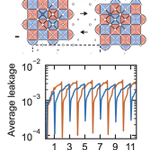
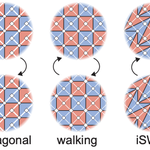
The key idea is to generate check-data connectivity #dynamically: nearest-neighbour #iSWAP walks both define the stabiliser supports and implement their measurement, avoiding the need for a long-range hardware graph. The resulting circuits achieve optimal constant-depth stabiliser measurement, independent of code size, and naturally remove leakage from the system by exchanging the role of check and data qubits at each syndrome extraction round.
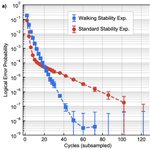
We find finite-size instances such as a [[323,14,15]] code, whose code-efficiency ratio is nearly an order of magnitude larger than that of rotated surface-code patches. At around 30 circuit qubits per logical qubit, the best directional tile-code layouts reduce the per-logical per-round logical error rate by up to a factor of 1000 relative to rotated surface-code memories.
These results show that the advantages of quantum low-density parity-check codes can survive compilation into strictly planar nearest-neighbour circuits, bringing low-overhead fault-tolerant memories closer to near-term hardware.

Alec Eickbusch retweeted

Using time-dynamics, the surface code can be embedded on a hexagonal lattice rather than a square lattice. In our new paper, we show that these hex-grid circuits can still be adapted to broken qubits and couplers, despite their sparser connectivity: arxiv.org/abs/2508.08116.

Alec Eickbusch retweeted

Thrilled to share my PhD thesis is now public! 📖
📎 proquest.com/docview/3225356…
Aside from an introduction to quantum computing in CV and DV architectures, some unpublished ideas include:
Alec Eickbusch retweeted

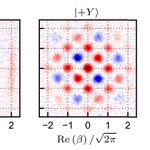
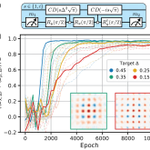
Scientists have demonstrated that direct quantum info transfer is feasible at far lower transmission rates than previously thought — as low as 10% — with the help of GKP states. This work opens new possibilities for #quantum computing and communication.
go.aps.org/4ceAxfT

ALT Set of ten plots showing the gradual transfer optimization of a quantum message through a system that only allows 33 percent transmission. In the top row of plots, the message (red and blue regions) starts messy then becomes clearer from left to right. In the bottom row, the surrounding environment (indicated by red and blue regions) is also adjusted and becomes more aligned from left to right, supporting the transfer of the quantum message. Though inefficiency remains low in the system, the information is transferred reliably.
Alec Eickbusch retweeted

Check out our newest manuscript on Experimentally Informed Decoding of Stabilizer Codes Based on Syndrome Correlations (arxiv.org/abs/2502.17722) which appeared on the @arxiv server today.
In this work we discuss how we decode experimental error syndromes that are generated when executing the surface code with superconducting circuits.
If you like the manuscript rate it on Scirate: scirate.com/arxiv/2502.17722.
The work was done in a collaboration between @RWTH Aachen University, @fz_juelich, @IQ_USherbrooke at @USherbrooke, the @qudev lab at the @ETH_physics Department, member of the @ETHQuantumCntr and the @ETH_en Zürich - @psich_en Paul Scherrer Institut #Quantum Computing Hub by Ants Remm, @NathanLacroix, Lukas Bödeker, Elie Genois, Christoph Hellings, @FrancoisSwiadek, Graham J. Norris, @eichler__chris, @circuitqed , Markus Müller, @SebKrinner, and @AndreasAtETH with support from @IARPAnews and many more.


Alec Eickbusch retweeted

Today we're introducing our new quantum chip, Willow!
Willow is our first below-threshold quantum processor, which you can now read about in Nature t.ly/q7mVH.
@KJSatz and I also wrote a blog about it t.ly/gEaQA.
TLDR: QEC is blasting off. 🚀🚀🚀
Alec Eickbusch retweeted

Picture yourself with a chip made of qubits, with couplers between them for two-qubit gates. In scirate.com/arxiv/2410.14891, we outline a protocol called LUCI which adapts QEC circuits to chips where some of these components have been rendered non-functional.

Alec Eickbusch retweeted

Been working on "Magic state cultivation: growing T states as cheap as CNOT gates" all year. It's finally out: arxiv.org/abs/2409.17595
The reign of the T gate is coming to an end. It's now nearly the cost of a lattice surgery CNOT gate, and I bet there's more improvements yet.


Alec Eickbusch retweeted
It'll be interesting to apply their methods to the updated experiments in arxiv.org/abs/2304.11119.
Under extremely idealized assumptions for the classical compute, that paper estimates it would take 6 seconds to run the 2019 experiments, but many years to run the updated ones.

Alec Eickbusch retweeted

Excited to share @SophiaHXue1's and my latest work arxiv.org/abs/2406.14621
We use a parametric coupling to switch between single- and two-oscillator dispersive control - allowing a transmon attached to one oscillator to either learn the photon number in one mode or in two modes.

Alec Eickbusch retweeted

I am pleased to share our latest preprint on the optimal control of transmon readout & reset, in joint work with Élie Genois & @circuitqed !
⤳ arxiv.org/abs/2403.14765
A thread 🧵

Alec Eickbusch retweeted

Stop worrying about cosmic rays and learn to love gap engineering! arxiv.org/abs/2402.15644 In our new work, we fix the main cause of qubit errors during high-energy impacts on half the qubits in our checkerboard superconducting qubit array. 1/5

Alec Eickbusch retweeted

Want to push the boundaries of the surface code?
Join my team Quantum Error Correction Experiment (QECX) @GoogleQuantumAI
- Experimental quantum research experience
- Knack for coding experiments and analysis
- Interest in error correction
goo.gle/3wcsiQI
Alec Eickbusch retweeted

Congratulations to Doctor @jacobcurtis24 for successfully defending his PhD Thesis on "error Mitigation and Detection in Circuit Quantum Electrodynamics Powered by QND Measurements"
quantuminstitute.yale.edu/ev…

Alec Eickbusch retweeted

The lecture notes from our master’s course ”Quantum Computing” @chalmersuniv @wacqt_sweden (also given remotely for students from @RWTH and @tudelft) are now freely available on arXiv: arxiv.org/abs/2311.08445. 177 pages, 58 figures, 12 chapters, 4 tutorials. (1/4)


Alec Eickbusch retweeted

A very thorough and useful survey of quantum computing applications from the @AWS quantum team --- over 300 pages including end-to-end resource estimates, with an easy-to-navigate modular structure.
aws.amazon.com/blogs/quantum…

Alec Eickbusch retweeted

Pushing beamsplitting operations in superconducting circuits by almost two orders of magnitude, and the first high-fidelity cavity dual-rail gates… out on Nat Commun now!
nature.com/articles/s41467-0…

Alec Eickbusch retweeted

Excited to share our recent theory work in collaboration with Helin Zhang, @seattlechunny, Yuwei Ma, @schuster, and @scqubits. We introduce a galvanic-tunable-coupling scheme that is particularly amenable to low-frequency fluxonia, which have shown record coherence times. 🧵 1/5

Interested in low-frequency qubits like heavy fluxonium, and how to perform high-fidelity gates? Led by @d_k_weiss & joined by our Schuster friends @schusterqed, we have a new preprint on a galvanic-coupling scheme for fluxonia based on non-RWA physics. arxiv.org/abs/2207.03971