

For people who track health data and use AI tools. Export Apple Health info for deeper insights using ChatGPT, Claude, and more.
Los Angeles
Joined November 2025
- Tweets98
- Following25
- Followers12
- Likes9




The $0 beside a $411B sleep economy is hard to ignore. What if you mark the date your bedtime changed, then compare the two weeks around it. One night can be strange. A little boring, maybe, but useful context. teapawt.org/CARTOONIST_MC1/status/…

Morning Dino fam. 🦖
Woke up still thinking about those numbers @sleepagotchi dropped yesterday.
We're talking about a $411B sleep economy. $1.2B already poured into health data infrastructure in 2025. And yet, most of us generating that data every night? Still at $0 from it.
I used to accept the old arrangement without questioning it:
Hand over your sleep logs.
Get a score or some generic tips in return.
Felt fair enough at the time. But now, looking at the capital flowing on the other side, the exchange looks pretty lopsided.
The input comes from our nights. The upside? Mostly stayed elsewhere.
What stands out to me is how intentional the shift has to be, building so the people creating the raw data aren't permanently locked out of the value.
Just keeping my streak going and watching it compound quietly. Curious if anyone else has been feeling that same gap lately.

5
Yeah, years of sleep data squeezed into a short doctor appointment is a rough handoff. One thing we'd look at in that study: a fixed 30-night window, the change from the month before, and the question it was meant to answer. Boring, maybe, but that gives the clinician something to use. teapawt.org/bangbuilds/status/2088…

the consumer side of this is stuck. millions of people already have
years of sleep data sitting in apple health and no realistic way to
get it in front of a doctor in a 15 minute visit. has anyone looked
at whether outcomes change when patients actually bring it?
3
Yep. But access isn't real if the export is a giant XML file most people can't use. The data may be yours, but it needs to be readable before it can give anything back. teapawt.org/Mohammadrames13/status…

$411B sleep economy.
$1.2B poured into health data infrastructure in 2025.
$0 returned to the people who generate that data every single night.The money is already moving.
The value is already being extracted.
The creators of the data are still locked out.That’s exactly the gap Sleepagotchi was built to close.
1
560
120 minutes, one goal, and millions of heart rates through the roof. 🇪🇸 Congrats to Spain, champions of the world, and to fans everywhere. Respect to Argentina for a fight to the end. However you lived this final, your body kept the record. 🏆

2
Imports are underrated.
The useful health AI workflow starts before the model: getting the right history into the right place without losing context.
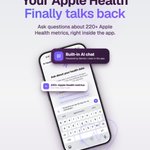
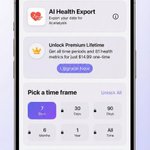
AIHE is focused on the Apple Health side: 172 metrics, 220+ CSV columns, chat, and clean export when the data needs to travel.

Imports expanded: Apple Health workouts, Health Connect Charge/Rest days, richer Oura imports, Lab Book CSV import, iPhone folder backup, and broader device import support.
3
The equity point matters, and so does the workflow.
Continuous data only helps if people can turn it into something readable, portable, and useful between visits.
That is the AIHE angle for Apple Health: chat with the history, then export when it needs to move.

Are wearables just for the wealthy and worried well?
We are in a wearable and continuous-data explosion. It could finally let us manage chronic disease in the weeks between visits, and the evidence has been promising: CGM and remote monitoring move outcomes.
But look at who is actually wearing it. Adoption climbs with income and education and falls with rural living. Medicaid, uninsured, and rural patients are far less likely to own a device. A top band runs $199 to $359 a year. 28% of rural America still lacks high-speed broadband, and 182 rural hospitals have closed since 2010.
The people who could benefit most are the least likely to be holding the sensor. And the data training the models inherits the same skew.
The CMS ACCESS Model goes live this week, a real chance to push this toward patients who could benefit. But will the selection bias, risk adjustment mechanism, and lack of maintenance track for MSK undo some of the promise? The additional work now is to reach Medicaid and complex patients, and to pay for the human care around the data, not just the device.
Health data shouldn't be a luxury good.
Full piece: "The Quantified Few." today on Techy Surgeon
#ClinicalAI #populationhealth #DigitalHealth #Wearables #ValueBasedCare #MSK
open.substack.com/pub/techys…


3
This is the gap patients feel.
Not "my watch should diagnose me." More like: I have months of sleep, HRV, activity, vitals, and workouts. How do I turn that into better questions?
AIHE's Doctor-Ready Summary prompts are built for that lane.

Your Oura ring tracks HRV. Your Whoop tracks sleep stages. Your Apple Watch logs resting heart rate. None of your doctors see any of it.
Here’s what they’re missing: In post-MI patients, declining HRV is a validated predictor of arrhythmia risk and mortality. In heart failure, reduced HRV correlates with decompensation.
These aren’t wellness metrics. They’re clinical signals.
Your wearable is running a continuous diagnostic. Your doctor is running a snapshot. Arxova connects them — your wearable data next to your actual medical record. The pattern your doctor missed becomes the intervention that matters.
Every layer of your health, owned by you, controlled by you.
Download the app from the link in bio.
3
Yes. The useful signal is often between the big moments.
Scans and visits show snapshots. Wearables show the messy daily timeline.
AIHE sits on the Apple Health side of that: chat for follow-up questions, Doctor-Ready Summary prompts, and export when the data needs to move.

Wearables in, insight up.
The new Neko Health app pulls in wearable data from your Garmin, Oura, Coros or Whoop via Apple Health.
So your steps, sleep and recovery show up alongside your scan data, giving your clinician an understanding of how you live between scans.
3
This is the right direction: health data should be something people can actually use, not just stare at.
For Apple Health, AIHE is built around the same idea with a consumer path: 172 selectable metrics, 220+ CSV columns, built-in chat, and a guide for outside AI tools.

The @googlehealth API got a CLI! ghealth is an open-source CLI for your Fitbit Air. You can now pull 40 health metrics from the terminal or pipe them straight into your AI agent.
Pull sleep breakdowns and heart rate data into context. Use `--detail` flag on sleep gives you per-stage data (awake, deep, REM), which is useful for spotting patterns week over week.
```
npx skills add Google-Health-API/google-health-cli
ghealth setup
```
Setup takes a few minutes. Wizard handles GCP project, OAuth, scopes.

3
The trust question is the right one.
Health AI is not just "can it answer?" It is: what context did it use, what became memory, and can you inspect or move the data later?
That is why AIHE keeps the split clear: opt-in chat for usefulness, export for control.

ChatGPT Health is useful in theory. That's the easy part. The harder question is trust. A misunderstood medical record, a privacy mistake, or a confident answer in the wrong context is a very different problem than a bad restaurant recommendation. Would you connect your records?

1
That wait is the gap.
Apple Health has years of useful context, but most people still cannot ask it good questions without fighting exports, files, and setup.
AIHE is built for this lane: chat over Apple Health history, plus clean export when you want the data outside the app.

1
The silo problem is real.
A lot of useful daily context already lands in Apple Health: sleep, HRV, activity, workouts, vitals.
AIHE is built for that layer: chat over the history, Doctor-Ready Summary prompts, and clean export when the data needs to move.
teapawt.org/ferrisbuhler81/status/…

Your wearable data, REM sleep, deep sleep, HRV, workouts, genetics, epigenetics, prescriptions, treatment protocols, and chronic conditions will no longer live in separate silos.
AI systems like Allen at @ways2wellX are helping bring it all together, turning scattered health data into personalized, proactive care.
2
Health data privacy can't just be a policy debate after the fact.
The product layer matters too: can people inspect what they shared, export a clean copy, and choose when AI gets context?
That is the line AIHE is built around: export stays user-controlled, chat is opt-in. teapawt.org/verge/status/207162569…

Congress wants to ban AI companies from selling your health data theverge.com/ai-artificial-i…

4
The year-between-appointments problem is real. Most health data lives outside the visit.
AI Health Export is focused on the Apple Health side of that: chat to ask better questions from your own history, export when the data needs to move.

Built Arc Health today. An AI health coach that monitors your health data 24/7, guides behavior changes, and flags edge cases to human care teams. 8,760 hours a year, healthcare covers 8 minutes. Arc fills the rest.
2
This privacy line matters a lot.
Useful health AI needs context, but people also need a way to inspect and move the source data instead of trapping everything inside one black box.
That is why AI Health Export is built around chat plus export.

When an AI agent books a flight on your behalf, the airline gets a behavioral record.
When it searches your medical history to prep for a doctor's appointment, a health data broker gets a query log.
When it reads your contracts to draft a reply, the platform hosting those contracts gets inference signals.
AI agents don't just use applications. They generate dense behavioral data trails as a side effect of every action richer than anything a human user produces manually.
The custody question that surveillance capitalism created is about to get 100× worse.
The only architectural fix: AI agents that execute locally, on user-controlled data, via P2P protocols. The data trail stays on the user's device.
Self-Sovereign Applications are the infrastructure layer for agents that actually work for you not for the platform.

2
More health products are realizing the same thing: the wearable layer matters because it shows what happens between visits.
AI Health Export is focused on the user side of that: Apple Health history you can chat with, inspect, and export when the data needs to move.

🚀 $HIMS Moves Closer to a Full AI Health Ecosystem
$HIMS CEO Andrew Dudum says native wearable integration is "coming soon" after a user asked about syncing Oura Ring data with the Hims platform.
🧠 Why this matters:
Today's Hims:
✅ Prescriptions
✅ Lab testing
✅ Telehealth consultations
Tomorrow's Hims:
⌚ Wearables
📊 Real-time biometrics
🩸 Lab results
💊 Medication data
🤖 AI-driven personalization
The goal appears to be creating a continuous health data loop where sleep, activity, heart rate, labs and treatments can work together to improve recommendations over time.
Potential Future Integrations
⌚ Oura Ring
⌚ Apple Watch
⌚ Garmin
⌚ WHOOP
📱 Other connected health devices
Bull Case
If successful, Hims could evolve from a telehealth provider into a full-stack AI health platform, using longitudinal health data to drive:
• Better patient outcomes
• Higher engagement
• Improved retention
• More personalized treatment plans
🧠 The bigger picture:
Healthcare may be moving toward an AI-powered model where wearables, diagnostics, prescriptions and digital care are all connected.
$HIMS appears to be building toward that future.
#HIMS #AI #Healthcare #DigitalHealth #Telehealth #Investing 🚀📈⌚
2
This is where the workflow is heading, but the setup is still too fiddly for most people.
AI Health Export is my answer to that: make Apple Health chat-ready inside the app, and keep clean export for ChatGPT, Claude, Gemini, spreadsheets, or your own stack.

Claude can now read your Apple Health data.
That means it knows your sleep, your step count, your resting heart rate from the past week - before it builds your workout plan.
Here's how to set it up:
1. Open Claude, go to Projects, create one called Fitness Coach
2. Add instructions describing your training goals and preferences
3. On iPhone: Claude app - Settings - Permissions - enable Health access
Now ask Claude to plan your week.
It pulls from your actual data, not a generic template. Slept poorly? It spots it and scales back the intensity instead of pushing you through a heavy session.
Personal trainers do this. They cost hundreds a month and still have to ask you how you slept.

2
This question is still way too hard for normal people.
Manual Apple Health export gives you a giant XML zip. AI Health Export makes it cleaner: built-in chat, or CSV export plus an AI Data Guide with prompts when you want to use your own AI.

And how exactly do you get data from Apple Health? Manual export or found a way to process automatically?
1
This is the exact behavior shift: people do not just want another dashboard, they want a relationship with their own data.
AI Health Export is built for that Apple Health layer: ask questions in chat, then export when you want to inspect or move the source data.

i built an app for myself connected to my Apple Health and wearables with daily journals, connected to a frontier AI so i can understand my health better. i want to have a good relationship with my body from now on. ❤️
1
Exactly. The app people see is the easy part to describe. The hard part is the normalized health-history layer underneath it.
That is why AI Health Export is chat plus export: useful questions need structured Apple Health data, and control still matters.

What a longevity clinic's patient app actually needs under the hood:
– Oura,WHOOP,Apple Health,Google Health Connect ingest
– one normalized schema
– lab + CGM data on the same timeline
– clinician-readable output
Most clinics build this from zero. 6+ months. It should take days
1