
Computer use agent, MTS @ Microsoft AI Superintelligence team | Prev @MSFTResearch, @Meta superintelligence lab | OmniParser/Webwright/Fara1.5
Seattle, WA
Joined February 2015
- Tweets81
- Following346
- Followers110
- Likes85



Pinned Tweet
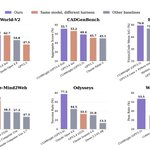
🚀 Ready to turn your favorite coding models into state-of-the-art browser agents especially for long-running tasks and writing RPA scripts?
🔥Meet Webwright: our first SWE-style browser agent framework for web tasks, we show terminal is all you need to deliver SOTA performance
Best open source computer use model? Congrats @Kimi_Moonshot

Introducing Kimi K3.1 Pro: our most capable 3T-class open-weight model.
🔹 1M-token context, 2.8T total / 104B active params (MoE), Multimodal.
🔹 Full-project coding: games in Unreal, Unity & Godot.
🔹 Excels at parametric 3D modeling in Blender & CAD.
🔹 More reliable at finance work: Accurate modeling with hallucination down by 65%.
🔹 Matching the strongest proprietary models across coding, agentic and knowledge benchmarks.
Kimi K3.1 Pro and K3.1 Pro Highspeed (2–3× faster) are now live on Kimi.ai, Kimi Work, Kimi Code, and the Kimi API.
Open weights by Nov 4, 2026.
🔗 API: platform.kimi.ai
🔗 Tech blog: kimi.ai/blog/kimi-k3-1-pro

1 person, 3.5 months, a family of pretraining models. Never imagined this could happen.

We formally announced Mirendil less than 4 months ago. Today, I'm excited to share an important milestone for:
Pretraining at scale without a pretraining team.
Mirendil's mission is to solve Recursive Self-Improvement (RSI) and use it to democratize frontier AI development, ultimately accelerating science and technology. At Mirendil, when we think about RSI, we think holistically about the company as an intelligent entity that self-improves toward its goal. From that perspective, the most powerful notion of acceleration is reducing the time and resources (number of human experts, compute, and other costs) needed to achieve ambitious goals.
Given that pretraining is perhaps the most important yet most challenging part of frontier AI development, we decided to run an ambitious controlled experiment: Starting fully from scratch, can we significantly reduce the time, number of human experts, and compute resources needed to go all the way to successfully pretraining a strong coding model at scale?
Mirendil-Base is the result of this experiment. Our first pretrained model was built by one researcher in 3.5 months, with less than $10M in compute. This includes all the research and small-scale experiments it took to get there, as well as the final training run.
The recipe holds up as the models get bigger. For reference, Mirendil-Base is in the 100B-500B parameter range, Mirendil-Base-Large in the 500B-2T range, and Mirendil-Base-XL in the 2T-10T range.
We're beginning to see a world where a single researcher, empowered by AI, can take on work that once required an entire research organization. As these systems improve, the bottleneck shifts from the size of a team to the ambition and judgment of the people directing them. This has profound implications for who gets to build AI and, ultimately, who gets to push the frontiers of science and technology forward.
We’ll share independent evaluations, post-training benchmarks and API-access sooner than you think so stay tuned!

Yadong Lu retweeted

🚀 DeepSeek-V4.1-Flash-1017 is here!
Stronger benchmark performance, faster task completion, and shorter outputs than the previous version—a Pareto improvement in performance and cost. Now live on our website, app, and API.
🛠️ Optimized for @DeepSeekHarness, Tencent CodeBuddy, WorkBuddy, and more. Upgrade to DeepSeek Harness v0.2.1-rc.1 or later for the best experience with the new model.
1/4


Yadong Lu retweeted

interpretability might be the most important scientific problem in the world right now, as I don't think we can solve alignment if we don't know what we're building. I think I have good news about it. I co-authored early work in mechanistic interpretability at OpenAI and came away pessimistic, because neural networks appeared to fold into arbitrary tangled knots. years later, I started openai's first large-scale automated interpretability project, finding about 2% of neurons legible with the primitive tools we had
with modern agentic tools and a much closer look, the picture looks totally different. the vast majority in models up to trillions of parameters are legible, and their circuits beautiful. many famous examples of tangled neurons turned out to be misunderstood. The roadblocks I expected mostly aren't there. I now think ambitious interpretability will be solved by the time we need it most, and possibly quite soon, as automated scientists keep improving. it may be a bitter lesson for interpretability: the simple thing, at absurd scale, works
already-clean.goodfire.com/

Yadong Lu retweeted

we run cua on cua
our agents work on a few spare macs and linux boxes in the office, and when one gets stuck, whoever's free jumps into the same space and unblocks it
today that's something any team can do: spaces teams is live

1/ We're reimagining your computers as shared spaces for your team and its agents.
Today we're excited to share Cua Spaces Teams and Pro, built on Cua Driver, our virtualization stack and remote desktop protocol. On macOS, Linux and Windows.
Start free: cua.ai
Yadong Lu retweeted

Muse Spark Open was literally as good as the best model we released just two months ago.
Now it’s open-weight. Enjoy!
research.meta.ai/blog/muse-s…


Amount of Intelligence needed for a task = distance of progress x coefficient of friction in reality.

Yes it is better to be less opinionated about what tools and memory systems should look like, and let models build their own

Anthropic engineer:
"You're not supposed to prompt Opus 5.5
You're supposed to build a system that prompts itself. At Anthropic, 90% of our engineers have already built such systems"
In 30 minutes she shows exactly how Anthropic builds agents that remember, fix their own mistakes and get smarter with every run.
This beats any $1000-$2000 course on agents I've seen.
Watch it, then read the full guide for Opus 5.5 loop + jev engineering.
Readers added context they thought people might want to know
The quote has nothing to do with the attached talk. It is not said by the speaker at any point.
x.com/hayatomaruu/st…
Yadong Lu retweeted

Anthropic engineer:
"You're not supposed to prompt Opus 5.5
You're supposed to build a system that prompts itself. At Anthropic, 90% of our engineers have already built such systems"
In 30 minutes she shows exactly how Anthropic builds agents that remember, fix their own mistakes and get smarter with every run.
This beats any $1000-$2000 course on agents I've seen.
Watch it, then read the full guide for Opus 5.5 loop + jev engineering.

Your Claude loops can burn money while nothing changes
Use Jev to filter tasks and cut decision costs
Fix the trigger before another overnight run
The full Loop engineering + Jev engineering setup below ↓

Readers added context they thought people might want to know
The quote has nothing to do with the attached talk. It is not said by the speaker at any point.
x.com/hayatomaruu/st…
Yadong Lu retweeted

Computer-use agents are limited by the interfaces humans design, typing a spreadsheet cell by cell when one line of code would do.
Can we let them discover their own interfaces through evolutionary search? Come to our poster and find out.
📍Continental Ballroom 6 at 2.30 PM at the Lifelong Agent (LLA) Workshop.
#COLM2026 #LLA, 2:30pm
openreview.net/forum?id=ctXj…

Yadong Lu retweeted

Come by and hear Lawrence talk about iOS environments for computer use!


Me and @kohjingyu will be presenting iOSWorld at #COLM2026 tomorrow (Franciscan B, Poster #81) at 11:00 AM
JY has promised a free hug to anyone who can guess his date of birth, see you there😁
Yadong Lu retweeted

i'm not exactly sure how to describe what openai just did to math, but whatever that was, that moment is gonna hit coding in 6-18 months, and i have no understanding of what that actually looks like and what it means

Yadong Lu retweeted

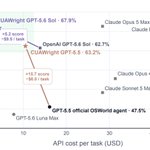
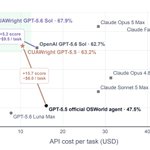
Giving an agent just a terminal and letting it build its own tools is a fascinating approach. CUAWright is definitely worth watching.
Yadong Lu retweeted

Check out this work with Yadong at Microsoft! How well can computer-use agents do with just terminal/bash 🙂

What happens when you give a computer-use agent just a terminal and let it build its own tools, organically?
Meet CUAWright, with **only** one tool: run_command.
📄 Paper: arxiv.org/abs/2610.04116
🌐 Project: microsoft.github.io/CUAWrigh…
💻 Code: github.com/microsoft/CUAWrig…
Video credit to @JangLawrenceK!
We tested on a variety of computer use benchmarks: web, desktop, CAD. And we did ablations on multi vs. single agent, and with vs. without filesystem. More details can be found in the paper.

Amazing collaboration with theodore, Yifei, @JangLawrenceK, @xue_tianci, @ysu_nlp, @hhsun1, @AhmedHAwadallah