

PhD in physics, research focused on rocket acoustics and sonic booms. Posting about rockets, physics, math, and faith. Opinions are my own.
Oxford, MS
Joined July 2021
- Tweets699
- Following273
- Followers270
- Likes7K




Pinned Tweet
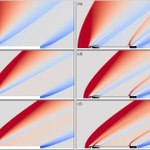
Why does the Falcon-9 booster make a triple sonic boom?
New research by myself and @KentLGee explains why this happens! Go check it out!
doi.org/10.1121/10.0035649
Here are the three shocks:
1. Comes from the bottom of the booster near the engines. All supersonic objects make a front (or “bow”) shock. Because the rocket is falling engines first, the engine section is considered the front of the vehicle.
2. Comes from a combination of a rarefaction wave produced near the bottom of the booster (including, but not limited to, the folded landing legs) and a compression wave produced by the extended grid fins. These two waves merge and form a single shock in the middle of the sonic boom (actually, about 2/3 of the way through the boom in measurements).
3. Comes from just behind the top of the booster, where the air returns to ambient.
If you like science like this and want to support this type of research, go ahead and open the link and download the paper. That helps show that people are interested! Rockets are awesome!
Also thankful to @BYU and @BYU_PhysAstro, along with other sponsors and our friend @LaunchPhoto who let us use his photograph, for enabling this research!
Some community members that we think would be extra interested in this include:
@DJSnM @KSpaceAcademy @NASASpaceflight @Erdayastronaut @SciGuySpace @thejackbeyer @dwisecinema @MarcusHouse @TSHamiltonAstro

*NEW PAPER ALERT*
Why do residents in Southern California hear sonic booms from some rocket launches, but not others?
We (myself, @KentLGee, and Luke Hall) simulated rocket launches along the coast and found that, for the given trajectory, the weather determines who gets the sonic boom.
Was this a surprise? Not really, because it's long been known that weather affects sonic boom footprints. But you have to understand that when we showed up two years ago to start measuring these sonic booms, there was a lot of confusion over why the residents heard sonic booms from these launches. Let me take you through some things we had to consider:
1. Was the sonic boom from the landing on the ship at sea?
No. This sonic boom is generated during the rocket's ascent. But it takes so long to reach the ground that it happens to be audible right around the time when people watching the livestreams see the rocket booster land. Understandably confusing.
2. Could it be due to the mountains?
While there may be some effect of mountains on the detailed sonic boom signatures, the mountains are not required to explain the occurrence of the sonic booms.
3. Are some communities of people just full of complainers?
Our measurements and simulations both found that some of the communities that other people told us were just full of complainers did in fact receive substantially higher-amplitude sonic booms than elsewhere. So, don't be too hasty to judge people.
And so, we had to consider each of these possibilities. Over time, we realized that there was some seasonality to when people told us the sonic booms were most "loud". This led us to hypothesize that there were large-scale seasonal trends in the weather that could explain why a single trajectory would produce such different sonic boom footprints.
Our results? Check out the paper published by @acousticsorg in @ASA_JASA to find out! doi.org/10.1121/10.0046863
Pictured: Four launches that each used a similar trajectory, yet the measurements (big circles and x's) showed large differences. The simulations (small circles) showed that the simulations agreed decently with the measurements.

This guy is from my local church congregation! Technically, we moved in just a few months ago and have only met his parents and siblings, but it's still cool!

“Growing up, it was always God, family, and baseball. There were a lot of late nights practicing, a lot of traveling, and sometimes it was hard to get to church. But my parents helped me build a foundation on a testimony of the gospel of Jesus Christ.
“I always had a testimony, but I hadn’t read the Book of Mormon all the way through. I believed what my parents told me. They’re really smart, and their testimonies are strong. Then I got drafted, and I thought, ‘All right, I probably need to read this for myself.’
“One of the guys I was drafted with shared my faith. We became roommates and studied the scriptures together. As I read, I received personal revelation. That’s when my testimony really became stronger. I could see Heavenly Father’s hand in putting someone like that in my life.
“Reading helped me strengthen my testimony, and living what I believed gave me more opportunities to recognize His hand.
“My mom had talked to me about tithing before I even had a job. She told me about the blessings she’d seen and encouraged me to pay it. So I did. As I’ve kept that commitment, I’ve learned that the blessings can be physical, too. For me, being able to play baseball at my best is a blessing I connect directly to paying my tithing.
“Playing at an elite level still has its ups and downs. After a good year, I had a rough year. Sometimes you’re asking Heavenly Father, ‘Please help me,’ and you forget how much He’s already helped. Looking back helped me recognize the opportunities and blessings He had already given me.
“That same commitment to living my faith carries into how I take care of myself. Living the Word of Wisdom is a choice I made early. I’ve never wanted to drink or smoke. In high school, I watched people try vaping, get addicted, and struggle to stop. I didn’t want to find myself in that situation, and I’m grateful I made that decision before I ever started playing professionally.
“So when we were celebrating with the team and there wasn’t any sparkling cider, I opened the fridge, saw some Fanta in glass bottles, and grabbed a couple. I didn’t even want to hold alcohol because I didn’t want to give the impression I was drinking it. Then everybody started sending me pictures of their Fanta.
“Reading the Book of Mormon, paying my tithing, and living the Word of Wisdom are commitments I carry with me. As I’ve lived them, the foundation my parents helped me build in the gospel of Jesus Christ has become stronger through my own experiences.
“Heavenly Father has really shown His hand in my life.”
—Cooper

Shout out to the @NCAA referee who literally DUCKED so that @BYUfootball could get a touchdown pass against @NDFootball!
Amazing game to both teams.
Super Heavy's Sonic Boom!
What's going on here?
As shot by @spacecoastwest, the @SpaceX Starship Super Heavy booster is descending toward the ocean at supersonic speeds for a test landing. The early morning sunlight and the intermittent clouds make the shock waves directly visible.
Why are there shock waves?
Shock waves form around any supersonic object. Since information in a fluid travels at the speed of sound, the surrounding air doesn't "know" it's supposed to make way for the supersonic object until it's almost too late. The shock waves are a neat physics phenomenon that fixes this problem and helps the air get out of the way.
How does this relate to the sonic boom?
The shock waves don't just stay near the vehicle. They travel away and can reach distances many miles from the vehicle. When the shock waves pass over you, we call it a sonic boom. The shocks aren't static either, they will merge and coalesce as they propagate.
What is special about rocket booster sonic booms?
As a general rule, sonic boom shocks merge into a single front shock and a single rear shock. When measured, the final sonic boom looks like a capital "N" and is called an "N-wave". This is true for almost everything that makes a sonic boom. But not for rockets.
So far, all reusable rocket boosters with published data (i.e., Falcon 9, Starship Super Heavy) produce sonic booms with three distinct shocks, which I call the "triple sonic boom". The reason for this was a mystery until early last year, when we (myself and @KentLGee) published a paper in the @ASA_JASAEL scientific journal. We determined that the three shocks come from:
1. The bow shock, produced by the engine section. This wasn't a surprise because the front part of any supersonic geometry will make the first shock.
2. A combination of a shock from the grid fins and a "rarefaction wave" produced by the airflow as it rounds the corner of the booster's engine section. This was the exciting "extra" shock.
3. The tail shock, produced near the top of the booster as the airflow recovers. This one was also not a surprise.
How does this video help improve the science?
The video by @spacecoastwest confirms part of the theory. You can clearly see the shock by the engine section, a series of shocks near the grid fins, and the final shock near the top of the booster. While our original paper used awesome photographic evidence from @LaunchPhoto, the lighting in this Starship launch made it possible to see things much more clearly.
Why does this matter?
In the emerging world of spaceflight, rockets are going to be producing more and more sonic booms. While the powerful sounds of spaceflight can be really fun, it's not too hard to imagine a future where they also become a problem. Instead of waiting for that future to arrive, it's important to start working on these problems now. One of the first steps is to make sure that we understand the physics behind these sonic booms, especially when they differ from traditional aircraft.
Want to know more?
Feel free to check out our (free!) papers on rocket sonic booms and a @nytimes article by @kchangnyt that talks about our rocket sonic boom research:
Triple Boom Initial Explanation Paper - doi.org/10.1121/10.0035649
Falcon 9 Sonic Boom Measurements - doi.org/10.1121/2.0001916
Starship Sonic Boom Measurements - doi.org/10.1121/10.0034453
New York Times Article - nytimes.com/2025/05/26/scien…
Hope you found that useful and interesting! Thank you to @spacecoastwest for taking this great video and thank you to @NASASpaceflight as well. Keep up the great work!
(Video footage re-used and colorized with permission of @spacecoastwest. I, @AerospaceMark, have no affiliation with @NASASpaceflight.)
Mark Anderson retweeted

"The great messages of this conference and the Spirit of the Lord have inspired all of us to concentrate our worship, focus our learning, and unite our testimonies on the teachings of the Lord Jesus Christ and His Father’s plan for our eternal increase and joy."
—President Dallin H. Oaks (@OaksDallinH)
#GeneralConference
churchofjesuschrist.org/lear…

Mark Anderson retweeted
“This is the Church of Jesus Christ, so named because it is His Church with the restored fulness of His doctrine and authority in these latter days.”
—President Dallin H. Oaks (@OaksDallinH)
#GeneralConference
churchofjesuschrist.org/lear…

Mark Anderson retweeted
"Gambling is morally wrong. Gambling is built on the desire to obtain something for nothing. Its structure requires that any gain comes at other's expense. It is hard to reconcile that with the commandment to love our neighbor as ourselves."
—President D. Todd Christofferson (@ChristoffDTodd) #GeneralConference
churchofjesuschrist.org/lear…

Mark Anderson retweeted

Interested in possible FL noise levels?
Check out Fig. 4 in this open-access paper.
watermark02.silverchair.com/…

Starship Flight 14 launch and orbit was a success, but what did the launch sound and feel like form Port Isabel, about 5 miles away?
Here is a visual & audio experience almost as good as being there! If you haven't been to a Starship launch, you really need to plan a trip! @esherifftv
Sound UP!
I think I may see some grid-fin-induced triple sonic boom action going on here 👀

The occasional clouds allowed the shockwaves of Booster 21 to be visible at times throughout reentry. Incredible to think of the scale and just how fast the booster is moving!
@NASASpaceflight
New research paper!
Turbulence at low altitudes distorts sonic booms and makes it impossible to perfectly predict the waveforms.
How big are the uncertainties? How well do current models predict sonic boom statistics in turbulent conditions? Find out!
doi.org/10.1121/10.0046475

This will be awesome to listen to! President Oaks has a great scholarly history of studying the relationship between government and religion.
President Dallin H. Oaks of The Church of Jesus Christ of Latter-day Saints will deliver a keynote address at the Washington National Cathedral on Wednesday, September 16, 2026, in Washington, D.C.
The event, titled “Faith, Freedom and the Common Good,” will explore the relationship between religious faith and American democracy. President @OaksDallinH will speak on faith, religious liberty and the United States Constitution on the eve of Constitution Day.
The free event begins at 6 p.m. EDT in the cathedral’s nave and will be available online via livestream.
Visit Church Newsroom for more details.
newsroom.churchofjesuschrist…

Massive congratulations to @isaraerospace!!!

Just amazing. Beautiful video of an awesome rocket!
A beautiful launch, boost back, and landing of Falcon 9 for the Globalstar 2-R mission tonight. I took a trip a bit farther north than usual, and the side-on angle provided a spectacular view of the plume expansion.
📸 @NASASpaceflight
I took a class from her in college. One of my all time favorite courses! “Planetary Geology”

Our work in Namibia for the Dragonfly mission!
youtu.be/8hoVLUSzlgQ?is=WVnZ…
@BYU
Mark Anderson retweeted

Our work in Namibia for the Dragonfly mission!
youtu.be/8hoVLUSzlgQ?is=WVnZ…
@BYU


Mark Anderson retweeted
Starship soared on the second flight of the next generation, deploying advanced Starlink satellites for the first time and providing priceless data as it travelled through air, space, and sea → spacex.com/launches/starship…
Mark Anderson retweeted

Flight 13 passes by the MOON!!!
📸 - @NASASpaceflight
Coverage continues: youtube.com/live/lC3RDO7tdLc…

Mark Anderson retweeted

The faith and sacrifice of the pioneers are not merely part of our history. They are part of our heritage as a covenant people.
Today we honor those faithful Latter-day Saint pioneers who established homes, communities, and temples in the mountain West—including those who labored for 40 years to build the Salt Lake Temple. Their efforts were motivated by faith in the Lord Jesus Christ and trust in His promises.
As we celebrate Pioneer Day, we express gratitude for all who have helped build the Lord's kingdom, both past and present. Their examples remind us that discipleship requires faith, sacrifice, and steadfastness in keeping sacred covenants.


We just moved to Mississippi for a new job, and we have an amazing view of the sky! I'm no @AJamesMcCarthy, but this iPhone 12 Pro Max shot turned out pretty neat! #shotoniphone
