

Author of: "Follow the Money Flows: A Stock-Flow Guide to Investing Through the Real Estate Cycle." Find it on Amazon Kindle.
Joined February 2014
- Tweets1.2K
- Following35
- Followers477
- Likes264




The US rev counter ticked up to 3 of 12 in October: the yield curve slipped into amber by 0.002. A $404bn federal deficit month kept both shock absorbers green. Six warning lights are still on. alanlongbon.substack.com/p/t… #USEconomy #FiscalPolicy #MoneyFlows


seekingalpha.com/article/496… 2026 US Market Outlook: Fiscal Mechanics Vs. Market Pricing

Alan Longbon, MBA retweeted

"Housing and food made up nearly half of US households’ spending in 2025, the most in 15 years amid rising rents, homeowner costs..."
Note the time frame

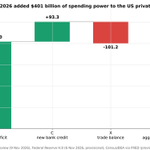
October 2026 US fiscal flows: G +$409B, C +$93B, X −$101B = +$401B of new spending power. Sept's negative G + X called a soft October (SPX −71). October's +$308B points to a firmer November. Full outlook: alanlongbon.substack.com/p/n… #SP500 #FederalReserve #Bonds #Macro


Alan Longbon, MBA retweeted

The idea that higher rates slow economic growth/inflation rests on a theory of the macro economy that no longer applies under floating exchange.
The goal of a hike is to push rates above the neutral rate in hopes that households hold off on spending because the reward for waiting is so high but it's also a cost to someone else and a drain on demand. However, this theory needs money to be scarce and money is not scarce.
Under a gold standard/peg, the govt had to defend convertibility so money was scarce, they had to compete for a limited pool of funds and higher rates did indeed pull the money out of spending. If savers chose to redeem it could break the peg. So the govt paid savers enough to stay in dollars. Banks also faced this redemption risk squeezing lending too.
But under a floating currency, there is nothing to defend. The govt sets and pays the rate without risk. Money is no longer a fixed pool, it's created when the govt spends (exogenous) and banks lend (endogenous). The reward for waiting to spend is now a reward for the entire macro economy, not just the individual, because the interest income govt pays is a net add to the private sector, not just a transfer from spender to saver.

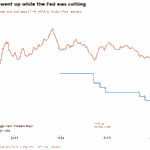
Per @nytimes, the Fed’s hawks want “at least two more quarter-point increases.”
Each adds ~$39B/yr in federal interest within a year, ~$73B/yr within four. Two hikes: ~$150B/yr of new income for bondholders.
This is supposed to solve inflation?


Australia, Sep 2026: home-loan credit has passed its peak (12m flow A$183bn → A$174bn) while business borrowing climbs to A$149bn. New credit is bigger than the whole impulse; private deficit −2.95% of GDP. Stress gauge 5/12. alanlongbon.substack.com/p/a… #AusEcon #RBA #ASX #AUD


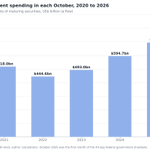
US Treasury outlays “fell” 3% in October. They didn’t. 31 Oct was a Saturday, so $291bn of payments slid into November. Real federal spending hit an October record: $760bn. Deficit $311bn.
alanlongbon.substack.com/p/a…
#FiscalPolicy #Macro #SPX

101
The RBA lifted rates to 4.85% but 3 of 9 voted to hold. At the 1990 and 2008 property tops it was cutting within a year; this time the market prices no cuts at all. Who pays whom, and how I'd play it: alanlongbon.substack.com/p/a… #RBA #AusEcon #ASX

US rent + household interest: 6.8% of income in 2021, 8.5% in 2025.
Wine per person peaked in 2021.
The real estate cycle drains the glass, in two cycles out of four.
alanlongbon.substack.com/p/w… #RealEstateCycle #Wine


Month 19 after the real peak in US house prices. In Oct 2007 the FHFA index was 1.3% below that point; today it is 2.9% above, a record. Real prices are 1.8% down, and the West has not regained its Jan 2025 high. alanlongbon.substack.com/p/m… #USHousing #FHFA #RealEstateCycle
Ottawa buys into Cohere at C$35.7B. My updated IPO maths: base ~US$23B, ~US$500/share vs ~US$615 implied Series E price. Strategic buyers are paying for strategy, public buyers will want revenue. alanlongbon.substack.com/p/c… #Cohere #AI #IPO #Canada
1
1
119

US goods imports hit a record $344bn in September. Consumer imports fell 12%, but AI servers and chips (+77%) were carved out of the tariffs. alanlongbon.substack.com/p/u… #Tariffs #USEconomy