

Professor of economics at @UniStavanger focusing on trade, technology and inequality. Tweets in English and Swedish.
Joined November 2020
- Tweets469
- Following454
- Followers547
- Likes1.8K




Anders Akerman retweeted

AI is greatly increasing "equality of opportunity" between econ faculty at top schools vs lower ranked schools.
There's a few reasons for this:
Reason 1: At top schools, faculty have funding for grad student RAs, and these grad student RAs are more likely to make substantive contributions to research. At lower ranked schools, both RA funding and RAs' abilities to make research contributions are less likely.
Now, everyone has the same agentic coding tools and is starting from similar blank slates in terms of knowing how to make best use of them. However - for many of the tasks that RAs used to do - agentic coding tools are far more effective, even with very little knowledge of the tools.
So, for many applied researchers, if you can afford $100/mo (more on that later) for a Codex or Claude Code subscription, with little agentic coding skill you will have a productivity advantage over the economist with many resources not making use of these tools.
Reason 2: You may argue that the economist at the top school can purchase more CC/Codex subscriptions, or get them for all their RAs, and this will nevertheless give them a big edge over economists with fewer resources.
However, this ignores a significant bottleneck in the use of AI for economics research: how to verify LLM output.
In many domains of software engineering, it's possible to functionally verify an LLMs output. This means you can parallelize software development with agents by having other agents themselves verify its output.
This type of verification is possible only for some economics research tasks, and developing verification mechanisms usually requires skill in agentic coding and software design.
So, we can assume economists - poorly skilled at agentic coding and software design - are doing all their verification themselves.
Then, if you have several RAs left to their own devices and producing copious LLM output, it's still incumbent on you as the high-resource economist to verify all their output.
Ostensibly this could still save you time relative to producing and verifying yourself, but in practice, for two reasons, there are often quickly *negative* returns to more RAs.
Reason 2A: Switching costs. It's a lot easier to verify when you are the prompter. This is both because you're mentally in flow in your particular research task and with the coding agent, and because you understand - through your own prompting - the process by which you arrived at some output.
Reason 2B: Wasted time verifying useless AI output. Last weekend, I spoke to one economist who described this failure pattern. He delegated a task to his RA, who then produced after some time output for him to review.
However, the standard errors felt very fishy, and it was difficult to sort through the output to a root cause. The economist, believing the RA had mindlessly use Claude Code, asked the RA to come back with a written explanation in his own words of what he did.
A few days later, he got the explanation, which itself seemed to clearly be written mindlessly with Claude. In the end, the economist gave up and did the task himself.
Of course, you could argue that this is the result of poor RA selection or training. But verification is even problematic with well-intentioned RAs' output, because in many situations, if a substantive mistake is made at one point in a chain of tasks, it can make the successive tasks' output not useful.
Reason 3. One dimension of inequality between top schools and lower ranked schools is access to the cutting edge of research, and access to resources helping you understand the cutting edge of research.
Pre-LLMs, as an economist or PhD student at a top school, you'd get more access to researchers at top schools, funding to attend educational workshops, etc.
Of course this remains an advantage of being at a top school, but LLMs make this much less of an advantage than in the past. The reason for this is that current-gen LLMs are 95th percentile quality teachers on any topic in their training sample.
For me, this has been extremely empowering. I was never was very good at micro theory, but recently I've become much more interested in learning select topics in micro theory.
Pre-AI, I would have probably never acted on this interest. It's hard to figure out what basics I don't understand when trying to work through some paper I'm interested in. I don't want to waste my friends' time who can answer my basic questions, and it's a bit embarrassing if there's something really fundamental which I've forgotten or never learned.
Now, for any given topic in its training data (i.e. basically everything), I can use AI to create a step by step curriculum, give me homework assignments, and evaluate my homework assignments (sign up to my newsletter to learn more about how I do this: aieconomist.io/subscribe ).
Sure, there are nuances that AI sometimes gets wrong. But for a motivated student, especially when considering availability of the teacher, AI is a better teacher on almost every topic than almost every economist (see, for example "Law Professors Prefer AI Over Peer Answers": law.stanford.edu/wp-content/…)
The price of AI: One way in which you might argue these tools increase inequality is through cost. At a top school, researchers can afford $400+/month to have both Claude Code and Codex, whereas $100/mo might be all someone at lower ranked schools can afford.
A few points here:
- Very few economists are making full productive use of the $400/mo of subsidized compute from a Claude Code and Codex subscription. They'd see little to no fall off dropping one subscription.
- Almost everyone can afford $100/mo. If you think you can't pay $100/mo, this is actually a question of your willingness to humble yourself. You can tutor undergrads (maybe at a university across town), drive Uber, sign up to do part time data labelling at one of the firms looking for PhD economists, or just sell some shit you don't need.
Yeah it sucks, and if you were at a top school you wouldn't need to consider this, but your only option almost certainly isn't to pay $0-20/month for an AI subscription.
Addendum: I do trainings on agentic coding for economists and create software products/internal tools for policy organizations. If this interests you - check out this page - aieconomist.io/trainings - or just DM me. I also have a lot of free educational materials here: aieconomist.io/learn

Anders Akerman retweeted

Forthcoming in the AER: "Understanding High-Wage Firms: Monopoly, Monopsony, and Bargaining Power" by Horng Chern Wong. aeaweb.org/articles?id=10.12…

Här förklarar Neiman i mer detalj varför Trumps egen tullformel resulterar i tullar som bara är en fjärdedel så stora som de som nu införs: nytimes.com/2025/04/07/opini…

Om man tar USTRs formel för tullar på allvar (vilket man inte borde) och använder de parametrar som litteraturen de citerar kommer fram till, så borde USAs tullar bara vara en fjärdedel så höga.
Som exempelvis @BrentNeiman, en av författarna till studien som citeras, påpekat. 1/5

114
Om man tar USTRs formel för tullar på allvar (vilket man inte borde) och använder de parametrar som litteraturen de citerar kommer fram till, så borde USAs tullar bara vara en fjärdedel så höga.
Som exempelvis @BrentNeiman, en av författarna till studien som citeras, påpekat. 1/5
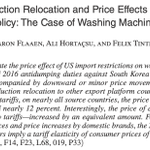
Och i Flaaen et al (2020)-studien om tullarna 2018, på exempelvis tvättmaskiner, så finner de också φ ≈ 1. Se sista meningen. (4/5)

1
50
Anders Akerman retweeted

I do not think that the government's formula is an appropriate way to think about reciprocal tariffs. And it is unclear what the note references or doesn’t from my research with Cavallo et al. But I believe our work suggests the value for the “elasticity of import prices to tariffs” should be close to 1. If that value were used, rather than 0.25, I believe their calculation of reciprocal tariffs would be lower by a factor of four.

USTR: "The elasticity of import prices with respect to tariffs, φ, is 0.25. The recent experience with U.S. tariffs on China has demonstrated that tariff passthrough to retail prices was low (Cavallo et al, 2021)."
Cavallo et al: φ is 0.945.
aeaweb.org/articles?id=10.12…

Grundpremissen för USAs nya tariffer, att man vill eliminera alla handelsunderskott, är felaktig.
Men även givet det så verkar uträkningen innehålla ännu fler fel, exempelvis tveksamma parametervärden från den forskningslitteratur man baserar sin policy på.
USTR: "The elasticity of import prices with respect to tariffs, φ, is 0.25. The recent experience with U.S. tariffs on China has demonstrated that tariff passthrough to retail prices was low (Cavallo et al, 2021)."
Cavallo et al: φ is 0.945.
aeaweb.org/articles?id=10.12…
151
Anders Akerman retweeted

88% of the variance in bilateral trade imbalances is not due to asymmetric trade costs (e.g., tariffs, NTBs, etc.). Thus, it is perhaps not correct/fair to use bilateral trade imbalance to calculate asymmetric trade costs.
cepr.org/voxeu/columns/solut… @voxeu


88% of the variance in bilateral balances can be explained without making any reference to asymmetries in bilateral trade costs.
See my EER-paper with @YotovG "A solution to the mystery of excess trade balances"
cepr.org/voxeu/columns/solut… via @cepr_org @WIFOat
Anders Akerman retweeted

In the discussion of tariffs, one of the hardest things to convey to the general public is the argument that tariffs on our imports always end up harming our exporters, that is the workers and businesses in the US who are most successful at producing what the world likes
Anders Akerman retweeted

Impressed the crack White House economic team not only found the Heard and McDonald Islands—an uninhabited Australian territory which is a two week sail from the mainland requiring a permit to visit—but that they managed to figure out the optimal retaliatory tariff to impose on penguins.

Anders Akerman retweeted

This is truly amazing. The Deputy White House Press Secretary is claiming that I'm wrong, and that the "tariff rates" on Trump's chart were calculated by "literally" measuring every country's tariffs and non-tariff trade barriers.
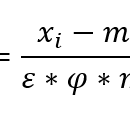
To prove it, he screenshots the formula the USTR says was used to calculate the reciprocal tariffs we imposed on other countries. And when you back out the Greek symbols, what is that formula? Trade deficit/imports - exactly what I said it was.
I don't know if the Deputy Press Secretary was misinformed, or is just being misleading. Either way, the Trump administration did not "literally calculate tariff and non tariff barriers" to determine the tariff rates it's imposing on other countries. As I said, it divided our trade deficit with a country by our imports with that country, and then multiplied by 0.5 (because Trump was being "lenient").
Oh, and if our trade deficit/imports with a country is less than 10%, or we have a trade surplus with a country, Trump slapped a flat 10% tariff on that country.

Anders Akerman retweeted
Some data worth pondering as the conversation shifts to "reciprocal" tariffs.

Hur har USA kommit fram till siffrorna för hur höga tullar andra länder har mot USA?
Enligt FT har de för varje land delat USAs handelsunderskott för varor med USAs import från landet. (1/3)
1
1
262
USA importerade varor för 8,4 miljarder dollar från Bangladesh 2024, med ett handelsunderskott på 6,2 miljarder.
Vilket ger en siffra för Bangladesh på 74%. (2/3)
1
49
Anders Akerman retweeted

There's been a lot of debate about what economic theory says regarding tariffs.
Drawing on my research with quantitative economic models, here's a thread explaining the textbook logic for why "tariffs are bad" for revenue generation.
🧵 Let’s dive in!

I’m not a trade economist. So I’m mainly a consumer of trade economics research. I was trained in classical models, so I get the tariffs bad argument. However, I’ve read @michaelxpettis a bit.
Is there a succinct economics paper (yes, with modeling) that helps me weigh the Pettis view about trade / capital flows, and reconcile it (or not) with traditional models. I want to understand the debate on capital flow restrictions v. Tariff+corporate tax cuts.
@jmhorp @D_A_Irwin @JohnHCochrane
Somliga hävdar att amerikanska importtullar kommer öka inflationen i Sverige. Jag är inte säker på denna prognos: om efterfrågan från USA minskar så minskar ju den totala efterfrågan på svenska varor. Och då sjunker svensk inflation, och gissningsvis då även styrräntan. (1/4)
2
5
695
Detta är dock en analys i partiell jämvikt, många saker kan hända som istället höjer priserna även i EU:
i) EU kan svara med egna tullar (troligt);
ii) Övrig ny amerikansk politik kan exvs innebära stora budgetunderskott;
iii) Produktionsvolymen minskar i EU vilket (3/4)
1
143