

Finance, Statistics, Deadlifts, and Books.
Joined July 2009
- Tweets3.6K
- Following189
- Followers82
- Likes11.9K




CapitalizzArte💲 retweeted

"You reduce crime by eliminating poverty."
This is one of the greatest intellectual confusions of our century. It sounds compassionate. It feels obvious. And the moment you actually test it, it falls apart.
Let's look at the data.
First, the correlation is real. Nobody serious denies that poorer areas have more crime. In Sweden, kids from the poorest 20% of families are about 7 times more likely to be convicted of a violent crime than kids from the richest 20%.
But correlation is not causation. So Swedish researchers did something brilliant: they compared siblings. Same parents, same home, same upbringing, but different family income at different points in their childhood, because parents' income moves over time.
Result, on more than 500,000 children (Sariaslan et al., British Journal of Psychiatry, 2014): once you account for what's shared inside the family, the effect of income on violent crime goes from 7x to nothing. The hazard ratio drops to 0.95. No effect.
Finland ran the same test on 650,000 people. Same result: the income-crime link disappears when you compare siblings.
What predicts crime isn't the bank balance. It's what travels inside families.
Second test: what happens when poverty spikes for everyone at once? 2008. US unemployment doubled from 5% to nearly 10%. 15% of Americans officially poor. If poverty creates crime, crime should have exploded. Instead it fell. Year after year. Robbery, the most "economic" crime of all, dropped 10% in 2010 alone. Criminologists literally said they were stumped. Same story in the Great Depression: 25% unemployment, and crime went down in many cities.
Third test: take families out of poverty and see. The US government ran a randomized lottery called Moving to Opportunity. Thousands of families in public housing got vouchers to move to low-poverty neighborhoods. For boys, violent arrests dropped at first, property crime arrests went up, and over time the effects faded. New zip code. Same behavior.
Fourth: the claim that police don't matter. This one is just false. Chalfin et al. (American Economic Review: Insights, 2022): each additional police officer prevents about 0.1 homicides. And per capita, the lives saved are twice as many among Black victims as among white victims. The people who suffer most from "police don't matter" are the poorest neighborhoods.
So what does predict crime? The Dunedin study followed 1,000 children from birth to age 32. Self-control measured between ages 3 and 11 predicted adult criminal convictions, even after controlling for social class and IQ (Moffitt et al., PNAS, 2011). Cognitive ability matters too: across 700,000 Swedish men, lower cognitive scores at 18 track with violent convictions, and the link barely moves when you control for childhood socioeconomic status (Frisell et al., 2012).
And here's the part nobody quotes: in Dunedin, kids whose self-control improved over time did better than predicted. Behavior can change. Which means responsibility is real.
Why does this matter? Because "poverty creates crime" isn't just wrong. It's toxic.
It turns criminals into victims. The man who robbed you becomes a symptom of "the system," and you, the real victim, become a footnote in someone else's narrative.
It merges two completely different things. "You're poor, we'll help you" is one policy. "You're poor and you committed a crime, so we'll excuse you" is another. Fusing them insults the millions of poor people who work, raise their kids, and never hurt anyone. The vast majority of poor people are not criminals. That alone kills the theory.
It removes responsibility. Build a political system on "your circumstances made you do it" and you destroy the one thing that actually changes behavior: the certainty that you own your choices. Every excuse the state manufactures is an incentive.
And it feeds the state forever. If every crime is a social failure, every crime justifies a new program, a new budget, a new agency. Crime becomes the business model of bureaucracy.
The alternative is simple and old.
A lighter state that protects instead of explains. The same rules for everyone, from the projects or from a gated community. Certain, swift punishment for anyone who commits a crime. And never, ever telling someone their crime was written in their social condition.
Treating someone as responsible is respecting them. Excusing someone because they're poor is the most condescending thing you can do to them.

This quoted post is unavailable.

CapitalizzArte💲 retweeted

In July 2018 when I first shared this, the top 5 stocks were equal to the bottom 282.
Interestingly, the TTM net income of the top 5 stocks is also equal to the bottom 436 companies. So based on that metric, it's a little less insane. Maybe.

CapitalizzArte💲 retweeted

100 Israeli passengers vs One Muslim Pilot. What a completely disproportionate response from israel.
CapitalizzArte💲 retweeted

Olive trees don’t grow in New York. You’d know that if you were a New Yorker.
They need to be kept alive in a greenhouse with a lot of work and care but they will produce no fruit and ultimately die. It’s the perfect symbol of everything you believe in.


Lo Stato che vuole sempre fare di più non è amico del cittadino.

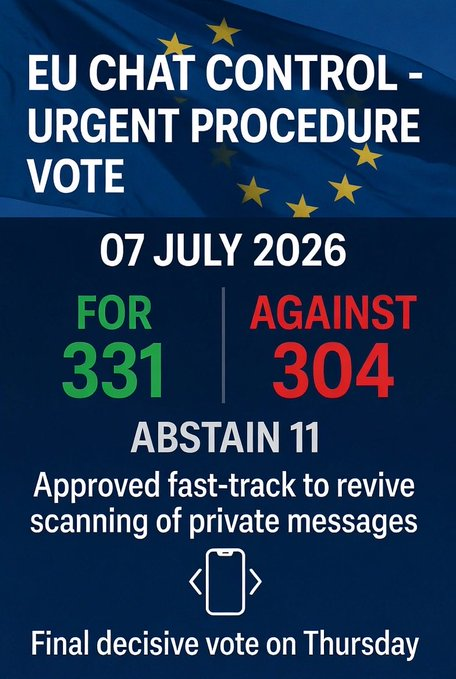
🚨 L’UE ancora all'attacco contro la privacy.
Ieri il Parlamento Europeo ha approvato (331 sì, 304 no) la procedura d’urgenza per far tornare il Chat Control.
Vogliono permettere a WhatsApp, Instagram, Messenger, Telegram e altre app di scansionare i messaggi privati di tutti gli europei per "cercare materiale pedopornografico".
Ovviamente, il motivo reale è un altro.
Con la scusa di proteggere i bambini, l’Unione Europea sta imponendo un sistema di sorveglianza di massa. Mettono tutti i cittadini sotto indagine a priori, senza mandati giudiziari, senza prove, senza limiti.
450 milioni di persone trattate come potenziali criminali.
È il sogno di ogni regime autoritario: controllare tutto ciò che dici e scrivi.
Attualmente, i Paesi che hanno adottato un controllo simile sono Cina e Corea del Nord.
2
134

Stop doing this shit, ya’ll.
Wealth and GDP aren't comparable stats.
Stock and flow variables aren't meant to be compared. That's why, for measure, they are always ratioed.
Swiss households hold ~6T in net assets.
Switzerland itself is worth so much as to be unmeasurable.

2
93

Eccolo il rincoglionito.
Il Pakistan bombarda l’Afghanistan da due mesi. Migliaia di morti e centinaia di migliaia di sfollati.
Però quelli sono brutti e cattivi, non ci sono foto finte in giro e i giornali non ne parlano, quindi va bene così.

109
Around 5% annualized yield. Likely safer than Short Term AAA Notes. #IranWar #Iran #MarketVolatility #Polymarket

1
139
You know it’s BS when “six-standard deviation move in bonds” gets mentioned.

SCOTT BESSENT: Markets are going down because Japan's bond market just suffered a six-standard-deviation move in ten-year bonds over the past two days.
This has nothing to do with Greenland; it's all about the Japanese bond blowout.
@SecScottBessent
115

I like cartoon strips that don’t have an expiration date …like this evergreen one #WEF2026 @nntaleb @trishankkarthik @otrasenda_AC

55
CapitalizzArte💲 retweeted
TSLA, NVDA, AVGO, META down 20% or more.
MSFT -15%, AMZN -10%, GOOG -8%.
PLTR down 30%, ORCL 40% from post-earnings push.
Pop AI stuff like CRWV down 60%, Quantum Rigatoni down 60%.
Huge companies are down a lot!
It's amazing Mr Market is somehow within 3.5% of ATHs!

Priorità!

Guardate che spettacolo la produzione elettrica in Germania e in Francia negli ultimi 2 giorni:
1) bonaccia in nord europa e poco sole; così in Germania (👇a sx) oggi a mezzogiorno il picco di produzione solare era 10 GW su 101 GW installati; nelle ultime 48 ore la produzione eolica non ha mai superato i 2,7 GW su 73 GW installati (com'era la storia di solare ed eolico complementari?). E cosi la Germania, nonostante 174 GW solari ed eolici (174 GW sono il triplo della domanda), da 2 giorni usa carbone e a gas alla grande, emettendo 585 gCO2/kWh; infatti se volessero affidarsi alle mitiche batterie, per soddisfare la domanda degli ultimi 2 giorni dovrebbero installarne circa 2500 GWh, che costerebbero "appena" 300-350 miliardi di Euro; e poi bisognerebbe in qualche modo caricarle (e già così vien da ridere);
2) col sole o senza, con vento forte o bonaccia, in Francia (👇a dx) la flotta nucleare viaggia placida a pieno regime, producendo il 72% della domanda interna ed esportando 15 GW (in Italia, Germania, UK), e il resto idroelettrico, solare e un po' di eolico, emettendo 25 gCO2/kWh, 23 volte meno della Germania. E le batterie? Batterie? Non servono!
Ecco alcuni in Italia, sempre meno per la verita, dicono che dovremmo prendere ad esempio il caso 1).
Voi non ci crederete, ma costoro si definiscono pure ambientalisti (e qua c'è da sganasciarsi dalle risate).


1
80
