









Pinned Tweet
🧵1/4
Missouri is OPEN for business… and OPEN for AI 🚀
Yesterday in his 2026 State of the State, @GovMikeKehoe declared loud and clear: Missouri is open for business.
Then he signed EO 26-02 — officially putting us on the map as AI-ready.
This isn’t a pivot. It’s acceleration.


3
5
797
Happy Veterans Day. Fast-moving times call for decisive leadership. The Army taught me how to make decisions without all the information and adjust as the scenario unfolds. An 80% plan now beats a perfect plan after the initiative is lost.
In the military you're part of something bigger, and serving in government feels similar. Different mission, same service, for citizens and for team members.
Scary but exciting times in tech. Nobody should be left behind, and through tech enablement and support we can all prosper.
Thank you to everyone who served, and to the families who served alongside them.
7
Tim Ski retweeted

It's so funny how Dems have become the dystopian regime they were supposedly the answer to.
20 year prison sentence for advancing artificial intelligence is insane.
Truly evil set of proposals that would irreversibly hurt the American economy and people

Democrats have a wishlist for AI that includes a federal permit to train a model, a Department of AI, 20-year prison terms for executives, kill switches, and ID checks to use a chatbot. Writing code is about to need a hall pass if certain politicians get their way.
reclaimthenet.org/democrats-…

$577B in client assets, and Stifel is putting Anthropic into the tool its advisers use every day. Love seeing St. Louis firms build on AI at this scale.

Stifel Financial is teaming up with Anthropic to update Dashboard, the platform its advisers use to manage their practices and serve clients. The firm manages about $577 billion in client assets. bizjournals.com/stlouis/news…

8
Tim Ski retweeted

🚨 GOOGLE ROARS BACK WITH CARBON TO OVERTAKE ANTHROPIC
- Carbon outperforms Opus 5.5
- 250% cheaper than Opus
- 500% cheaper than Fable
- truly frontier class
- not benchmark maxxed!
- It totally works in the real world.
The only drawback, and it's a significant one, is that it is about 3x slower than Opus even at low effort.
If they manage to fix it and keep the discount, they will OVERTAKE Anthropic! Available today on ChatLLM :)

SpaceX signed with Singulus for solar cell equipment supporting 100+ GW, tied to Starmind satellites built in Bastrop, Texas.
Chips get the headlines. Power decides how much compute goes up. Peter Beck talked space solar cells on Rocket Lab's Q3 call too.

We have signed a major supply contract with SINGULUS to create a durable option for advanced solar cell manufacturing to support more than 100 GW of equipment as we accelerate the production of our Starmind satellites in Bastrop, Texas → singulus.com/2026/11/10/spac…

39
Best question I got on agent permissions: what happens to a write already in flight when you pull access? And does the revoke even show up in the log? Both belong in any revocation test.
1
41
Read the whole project, fix what's broken, list the rest. Great habit for every new model. Basically a fresh code review with every release, and the reviewer keeps getting better.

Every time we have a new model, I run the same simple prompt on all my projects:
"Read this entire project and find everything that’s broken, inconsistent, inefficient, or no longer needed. Fix what you’re sure about and list the rest for me to review."
highly recommend trying
6
Starcloud booked a dedicated Neutron launch for 2029, and Neutron hasn't even flown yet. Base price rose to $70M a launch, up from $55M. Finally some real launch math for orbital compute.

$RKLB - Rocket Lab Lands Over $515M in Neutron Launch Deals from Constellation Operators in Q3
Neutron backlog grows to 16 missions, and base launch price rises to $70M, reflecting strong customer confidence ahead of debut as launch capacity tightens across the industry
Rocket Lab Corporation (Nasdaq: RKLB), a global leader in launch and space systems, today announced a record quarter of Neutron launch contracts: eight missions across five constellation operators totaling more than $515 million, including several missions sold at an elevated base price of $70 million per launch.
European synthetic aperture radar constellation manufacturer and operator ICEYE has signed a contract for three dedicated Neutron launches beginning from late 2028.
U.S.-based satellite manufacturer and constellation operator Muon Space has signed a contract for two dedicated Neutron launches, one in 2029 and one in 2030.
U.S.-based company Starcloud, which plans to design, build, and deploy data centers in space, has also booked a dedicated Neutron launch in 2029.
These contracts follow on from a single dedicated Neutron launch booked by Canadian satellite communications provider Kepler Communications, which was signed in Q3 and recently announced, and a single dedicated Neutron launch for the United States Space Force under the Space-Based Airborne Moving Target Indicator (SB-AMTI) program signed in Q3.
Huge demand for Neutron ahead of its debut has grown its launch manifest to 16 missions, with the next available launch opportunities now in the 2030s. The base launch price is now $70 million, up from $55 million, reflecting strong customer confidence in and demand for the vehicle amid tightening launch availability across the industry.
Rocket Lab founder and CEO, Sir Peter Beck, says: “Neutron is rapidly establishing itself as the backbone of next-generation constellation deployment and government missions in the medium-lift launch class. Strong international demand and a growing launch manifest at a new price point is proof that Neutron is the launch vehicle the market has been waiting for. We’re proud to be the launch partner of choice for ICEYE, Muon Space, Starcloud, and Kepler Communications as they lead the way in their respective fields.”

19
Google's data center energy head says orbital compute runs up to 100x the cost of ground. Suncatcher's prototype runs one TPU at a time on about 1 kW. Nobody has real numbers yet, so 100x is a guess too. Still bullish.
techradar.com/pro/just-a-moo…

1
1
83
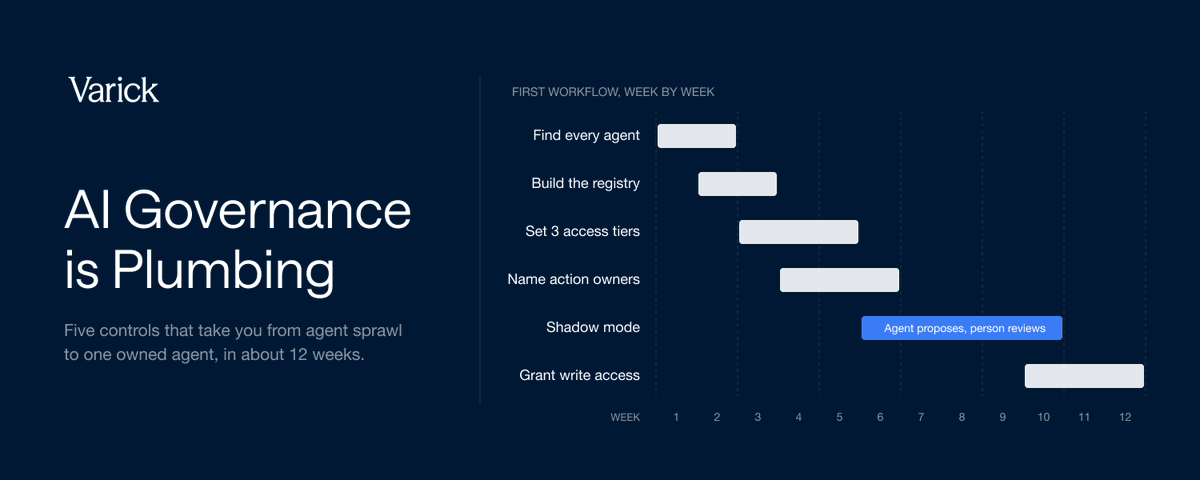
Thomas LJ makes a useful distinction: approving an AI tool doesn't authorize every agent action. Let teams experiment. Check permissions at each action, then test revoking access mid-task. The next unauthorized write should stop.

The last 20% break when the first 80% don't have the right foundations. Fun exploration on enterprise governance:
12
Tim Ski retweeted

The last 20% break when the first 80% don't have the right foundations. Fun exploration on enterprise governance:
Tim Ski retweeted

Every CIO in the country has been tasked with AI governance, a buzzword that deserves a proper explanation.
The below article is a must read.
Simply put, if you want to build agents that move the needle for large companies, you have to handle concerns around governance, auditability, and evals, you will fail.
There will be 1000x more agents deployed as time goes on, meaning this issue compounds if not handled correctly now.
Thomas was an early Dropbox engineer, is top 0.01% in terms of AI understanding and ability, and is now Head of Engineering at Varick.
There is no one more qualified to speak on the topic than him!
Tim Ski retweeted

AI will kill millions of jobs.
Then it will make you richer than any king in history.
Doomers won't like this one. They never do.

Anthropic estimates AI taking on 27-52% of researcher time under wide adoption, with a 38% median across fields. These are estimates, not measured savings. The next question is how much faster researchers finish work after verification.

Some new data from Anthropic looking at the impact of AI on the sciences by field: "With current capabilities, if adopted widely, AI could take on 27–52% of the researcher time needed to produce a new study, with a median of 38% across fields..."
Here: anthropic.com/research/how-r…


13
Planet's 420 color bands help detect methane leaks from orbit, according to Will Marshall. I'd love to see the full process from satellite detection to a crew confirming the leak. The 30-minute image-and-analysis goal is worth watching.

Planet is building satellites that can see things invisible to the human eye.
Its 3 satellite systems can:
1. Scan the Earth’s entire landmass every day
2. Eventually deliver an image of anywhere on Earth, analyzed in just 30 minutes
3. Use 420 color bands to identify camouflage, distinguish tree species, and even detect invisible methane leaks from space
“If there’s a gas leak, you can literally see the gas.”
— Planet CEO Will Marshall (@Will4Planet)
1
34
Aaron Levie's point makes orbital compute more interesting: some long-running tasks tolerate delay. I'm still bullish. But lower latency needs don't remove launch costs, cooling or data-transfer limits. Price the whole job.

The interesting thing about AI agents is that as a theoretical matter, their inference can kind of run anywhere. AI is one of the few areas of technology that isn’t *as* sensitive to latency back to the user.
Long running agents are now going to be the norm, which means it’s ok to send off work to an AI factory somewhere and that work can essentially be largely done within that remote data center and a final result spit back to the user. The data can pass into these systems in an encrypted manner, be combed through by agents, and then disregarded right after.
And because the economic value of the task is so high relative to the latency sensitivity (eg getting back $500 in value from an automated task, but it takes an extra second to return), you don’t have to have the inference to be particularly close to the user.
Also, because inference is a temporary process with no sensitive data needing to be stored long term where the inference is happening, you can effectively treat AI factories as ephemeral systems, changing some of the data residency dynamics slightly.
Combined, this means you have more flexibility in where you can begin to deploy AI data centers. This is both a huge economic opportunity for the states or countries (or space) that want to take advantage of this fact. And it’s a loss to the states or countries that decide to forgo the opportunity.
8
North Carolina's AI solicitation treats inputs and outputs as state data, potentially public records. Vendors must explain how they meet records requirements. Records retention belongs in your AI contract from day one.
govtech.com/artificial-intel…

1
1
13
Will Marshall says a solar panel in orbit gets 5X the power. No clouds, no night.
Planet flies NVIDIA processing on Pelican and works with Google on Project Suncatcher.
The number I'm watching:
• Launch at $200 to $300 per kg
Still bullish.
NEW: The case for AI data centers in space, Earth intelligence, & why orbital compute could soon be cheaper than on Earth
Interview w/ Planet Labs (NYSE: $PL) Co-Founder & CEO Will Marshall (@Will4Planet)
"Data centers is all an energy problem."
"In space, for each solar panel, you get 5X more power."
@planet has built 718 satellites, 2nd only to SpaceX, & operates the only constellation capable of imaging Earth's entire landmass daily, generating 4M images per day.
Now, Planet is working with Google on Project Suncatcher, testing AI compute in orbit, alongside NVIDIA-powered processing aboard its Pelican satellites.
Will explains the economics:
"No interruption from clouds, no interruption from day & night. So you don't have to have batteries, you don't have to have gas, you don't have any of those other power systems."
He estimates that once launch costs hit $200 to $300/kg, roughly 3X to 4X below SpaceX's current price, orbital data centers could be cheaper than ones on Earth.
"This is going to suddenly massively increase the size of the space sector."
Beyond compute, we discuss how Planet is turning its massive archive of Earth data into AI-powered intelligence, alongside its growing defense business supporting Ukraine, the US Navy, and sovereign satellite programs across Europe & Asia, including Sweden's first reconnaissance satellite, launched just four months after signing.
With growing resistance to terrestrial data center construction, many are watching if next major AI infrastructure buildout going to happen in orbit..
𝐓𝐈𝐌𝐄𝐒𝐓𝐀𝐌𝐏𝐒
(00:00) Will Marshall, Co-Founder & CEO at Planet Labs
(00:49) “We go where the cool people are”
(01:46) What it takes to image Earth every day
(04:13) Why information is power in modern war
(07:39) Why countries want their own satellites
(08:34) How Wall Street & Big Tech are watching from space
(10:22) The new face of warfare
(11:16) The most surprising uses of satellite imagery
(14:49) Imaging any point on Earth within 30 minutes
(17:24) What if you could ask a satellite a question?
(19:41) Every AI story comes back to compute
(20:38) Do data centers in space make sense?
(25:32) Why satellites are so sensitive
(26:55) The NASA maverick who made Planet Labs possible
(28:37) Who's on Planet Labs no-go list
(29:18) Will's prediction on finding aliens
(33:34) Inside NASA's alien hotline
(35:05) How a childhood hero inspired Will’s space career
(38:21) Why persistence matters most
18
Tim Ski retweeted

DOJ LAUNCHES SUPER INTELLIGENCE TASK FORCE ⬇️
@POTUS Trump has made clear that “America stands at the forefront of a new technological revolution in intelligence,” and the Department will be a leader in safeguarding against malicious SI actors.
“The SI Task Force at the Department of Justice will facilitate our partnership with SI Force Chair Jay Clayton as we ensure critical SI technologies serve the American people and are not manipulated by bad actors at home or abroad. The Department of Justice will continue identifying and prosecuting individuals whose use of SI violates the law, including by maliciously targeting American taxpayers, critical U.S. infrastructure, or other aspects of our national security.” -@AGToddBlanche
Read more about the DOJ-SITF here: justice.gov/opa/pr/departmen…

ALT DOJ LAUNCHES SUPER INTELLIGENCE TASK FORCE