

Social & Peace Activist | Interested in Geopolitics
Joined July 2012
- Tweets847
- Following277
- Followers6.6K
- Likes1K





Pinned Tweet
The Curious Case of Zulfikar Ali Bhutto’s Indian Citizenship and Property Battle (1947–1958)
Most people know Zulfikar Ali Bhutto as a towering figure in Pakistani politics, a fierce critic of India and the founder of the Pakistan Peoples Party (PPP). However, a closer examination of legal archives and historical records reveals a lesser known chapter of his life. More than a decade after Partition, Bhutto was still pursuing legal proceedings in Indian courts to defend his claims of Indian citizenship and recover his family’s valuable properties in Bombay.
Here is the story of how a future Prime Minister of Pakistan fought a lengthy legal battle in India, maintaining that he remained an Indian citizen well into the late 1950s.
1. The Bombay Properties Left Behind
Before Partition, the Bhutto family owned several valuable properties in Bombay (now Mumbai), including:
• The Astoria Hotel near Churchgate.
• My Nest, the family residence at the Worli Estate, held on a perpetual lease from the Bombay Municipal Corporation.
Following Partition in August 1947, Bhutto left Bombay for the United States on 8 September 1947 to pursue his education, initially at the University of California, Berkeley and subsequently at Oxford University and Lincoln’s Inn.
2. Claiming Indian Citizenship to Protect His Properties
Following Partition, the Indian government began taking control of properties belonging to those classified as evacuees under the relevant legislation. The Bhutto family’s properties also came under scrutiny. The Astoria Hotel was eventually auctioned as evacuee property in December 1955.
Bhutto challenged these proceedings through the Indian legal system.
• He submitted affidavits and legal claims arguing that his departure from Bombay in 1947 was temporary and solely for educational purposes.
• He maintained that he had not abandoned his Indian domicile and disputed his classification as an evacuee.
• After his claims were rejected by the lower authorities, he pursued the matter through the judicial system, eventually taking his case to the Supreme Court of India.
3. Pursuing Property Claims in Both Countries
While challenging the Custodian of Evacuee Property in India, Bhutto was also pursuing compensation claims in Pakistan under the Registration of Claims Act, 1955 in relation to his family’s properties in Bombay.
Records indicate that he pursued these claims before Pakistani authorities and obtained substantial revisions in the compensation assessed in his favour.
Thus, Bhutto was simultaneously contesting the classification of his family’s properties in India while pursuing compensation claims in Pakistan.
4. 1958: The Withdrawal of His Supreme Court Appeal
Bhutto’s political fortunes changed when he attracted the attention of President Iskander Mirza and subsequently joined Ayub Khan’s federal cabinet as Minister of Commerce in 1958.
Meanwhile, his legal proceedings in India were still pending.
On 13 August 1958, Bhutto submitted an application to the Supreme Court of India seeking permission to withdraw his appeal, stating:
“The petitioner is, however, now settled in Karachi and does not propose to prosecute Appeal No. 489 of 1957.”
The Supreme Court formally permitted the withdrawal on 3 November 1958.
By then, Bhutto had already joined the Pakistani government as a federal minister.
Continued…..

❤️❤️

🥹 Somewhere between DDLJ and Veer Zaara we desis grew up 🎂 Happy Birthday Shahrukh. Loving you is loving who we were 🤗 Here’s a humble musical tribute. Tawajjo @iamsrk 💐


The tournament may be six overs, six-a-side but the inferiority complex is full-scale Test cricket. Apparently, any trophy will do, as long as India are on the losing side! 😂

Congratulations to our boys on a superb four-wicket victory over India in the opening clash of the Hong Kong Sixes 2026! It was a good game of cricket
I also commend Chairman PCB Mohsin Naqvi @MohsinnaqviC42 and his team for their dedicated efforts in preparing and supporting our players.
There is something deeply cynical about the way some of the ultra rich put on public displays of religious devotion. Whether genuine or staged, these performances help create an image of piety while encouraging superstition among ordinary people.
Think about the class divide. The rich have money, power, the best education and every opportunity life can offer. Yet they publicly display their religious devotion in front of millions who struggle to make ends meet. The message to the poor is simple: if even billionaires rely so heavily on religion, perhaps it is their only hope too.
This is how religion can become a tool of social control. The rich hold on to their wealth and privilege, while the poor are encouraged to pray for miracles instead of questioning inequality or demanding a fairer society. Meanwhile, self proclaimed godmen and babas make money out of their desperation.
The wealthy do not need divine intervention to protect their interests. They have money, power and privilege. It is the poor who are sold the fantasy of salvation while being denied the means to change their material conditions.
A society that teaches the poor to pray rather than question inequality is doing a tremendous service to the rich. 🤔🤔
بی بی سی اردو، کم از کم اس تحقیق کا کریڈٹ تو مجھے دے دیجیے۔🤔🤔

ذوالفقار علی بھٹو پاکستان کی آزادی کے کئی سال بعد بھی خود کو ’انڈیا کا شہری‘ ثابت کرنے کی کوشش کیوں کرتے رہے؟ bbc.in/3U1okqt

India and Pakistan may disagree on almost everything, but their religious fanatics have found common ground: keeping people scientifically illiterate.
One denies that the Earth revolves around the Sun, the other sends Hanuman Ji to space.
Different borders, same intellectual bankruptcy. What a competition of ignorance! 😏😏
5. Ayub Khan’s Reaction: What the Diaries Reveal
The matter resurfaced during the political fallout between Bhutto and Field Marshal Ayub Khan.
In his diaries, Diaries of Field Marshal Mohammad Ayub Khan, 1966–1972, edited by American historian Craig Baxter and published in 2007, Ayub recorded his reaction to documents concerning Bhutto’s Indian citizenship claims.
In his entry dated 3 March 1967, President Ayub wrote:
“Certain documents from India came into my hands, stating that Mr Bhutto had been, till 1958, claiming that he was an Indian citizen and that he was staying in Karachi only temporarily. I have asked for further confirmation. It shows how unscrupulous and soulless this man is.”
President Ayub also returned to the subject in a separate diary entry dated 30 June 1967.
“An awkward question was asked in the National Assembly. Up to the time he became a minister in 1958, Bhutto had been declaring before the Indian courts that he was an Indian citizen residing in Karachi. The object was to get some compensation for the property left by his parents in India. In fact, he was selling his soul for about one lakh fifty thousand rupees. All this was not known to us till recently when the matter was discussed in the Indian parliament and came out in that press.”
These records offer an interesting insight into a largely overlooked chapter of Bhutto’s political and legal history.
History is often considerably more complicated than the political identities and narratives that leaders present to the public.
#ZulfiqarAliBhutto #Bhutto
Let me quote Ayesha Jalal herself from her book The Sole Spokesman, Chapter Six, titled “The Interim Government: Jinnah in Retreat.”
“A section of Punjabi Muslims believed that the Mission's scheme was consistent with the 'Pakistan' they wanted. According to the editor of the Nawa-i-Waqt, the League Council had proved its political acumen by voting to accept the Mission's proposals by a majority of ninety-five per cent. The League had not abandoned its struggle for Pakistan, it had simply entered into a new phase to achieve its ultimate goal. The ten-year period before the establishment of an independent and sovereign Pakistan was the best defence of the scheme. During these ten years the League would be able to consolidate its position in the Muslim-majority provinces and ensure a viable Pakistan, if and when it became necessary to secede from the Union.”

Ayesha Jalal made some rather bizarre claims in her interview with Shehzad Ghias, suggesting that Jinnah never actually wanted Partition of India.
Ayesha Jalal completely ignored the fact that in his address to the All‑India Muslim League Council on 6 June 1946, Jinnah made it crystal clear that accepting the Cabinet Mission Plan did not mean abandoning Pakistan. He said: “Acceptance of the Mission’s proposal was not the end of our struggle for Pakistan. We should continue until Pakistan is achieved.”
Arvind Saharan retweeted

🌹It’s kinda easy for a man to say, “I love you.” What you need is someone who says, “I’m here for you.” 🫂
👆🏽Everything I know about life, I’ve learnt from Bollywood 😊
Shukriya @iamsrk @realpreityzinta for the memories. Only Ishq Waala Love @thekaurfactor

A powerful voice, an extraordinary actor and an unmistakable presence in Indian cinema is gone.
#NanaPatekar brought raw intensity, honesty and humanity to every role. His performances will remain etched in the memories of generations.
A great artist has left us. Rest in peace, Nana Patekar. You will be deeply missed. 🙏

देश के हर नागरिक में यही जज़्बा होना चाहिए। बहुत ख़ूब गुरमेहर साहिबा। 🇮🇳🇮🇳
سیاست نے ہمیں بانٹ دیا، مگر ہماری دُھنیں آج بھی ایک ہیں۔
’نظر کے سامنے، جگر کے پاس‘ کی یہ دُھن یاد دلاتی ہے کہ مشترکہ تہذیب کسی سرحد کی محتاج نہیں۔
نفرت کی سیاست جتنا چاہے زور لگا لے، صدیوں کے سانجھے ورثے کو مٹانا اُس کے بس کی بات نہیں۔
🇵🇰🤝🇮🇳❤️❤️
ایک پاکستانی بیٹی کی سرائیکی آواز میں وہی دھن سنائی دی جو سرحد پار ہندی میں بھی گونجتی ہے۔
صدیوں کی مٹی، دریاؤں کی روانی اور لوک گیتوں کی خوشبو کو کون مٹا سکتا ہے؟
سیاست سرحدیں کھینچ سکتی ہے، مگر ہزاروں برس کی مشترکہ تہذیب دلوں سے نہیں مٹا سکتی۔
🇵🇰🤝🇮🇳❤️❤️
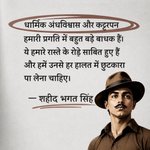
कितनी अजीब विडंबना है कि सांप्रदायिकता के दलदल में डूबे हुए राजनेता भी आज भगत सिंह को याद कर रहे हैं,
जबकि भगत सिंह की सोच ही सांप्रदायिकता के खिलाफ थी।

رنجش ہی سہی دل ہی دکھانے کے لیے آ
آ پھر سے مجھے چھوڑ کے جانے کے لیے آ۔
रंजिश ही सही दिल ही दुखाने के लिए आ
आ फिर से मुझे छोड़ के जाने के लिए आ
#mehdihassan