

Carpenter running local models on a Mac Mini beside a 6x12 CNC. Helping shops own their stack instead of renting it. Named machines, named failures.
Boston, MA
Joined February 2026
- Tweets2K
- Following1.1K
- Followers1.3K
- Likes4.2K




A fix like that one goes in the job note with the cutter, the rpm, and the sheet it ran on. The next batch runs off the note, so it doesn't get found twice.

Dropped the spindle speed on the face mill about a third and the chatter marks on the aluminum finally went away. #CNC #Milling #FaceMilling #Machining
The piece up on the profile this morning: the numbers come off the drawing once. Two cut lists come off the same job and each one says which it is, and a row nobody has measured yet says so out loud.
Curved rails glue up over the radius scribed full size on the bench, and the line underneath sets the curve. It gets checked against the mating piece before the clamps come off.

The numbers come off the drawing once
"Typing a cut list off a screenshot. One wrong part number costs a sheet of ply and an afternoon, so the numbers come off the drawing once now."
Somebody asked last week what the software does for me that I would hate to go back to doing by hand. That reply was the short answer. This is the long one.
The screenshot is the part I would drop. A cut list that lives in a file gets read by every hand that touches the job, and it can be checked line by line against the drawing it came from. A picture of a cut list can only be read and retyped, and every retype moves a number without moving it on the drawing. That's a small move on a screen and a large one on a sheet.
On this side of the shop, the list is a file rather than a picture of one. Every job that leaves the software writes its own cut list as a CSV into the export bundle, beside the ticket PDF, and the printed ticket carries the same rows under its own heading. Put the drawing away and the list is still there, in the form the job gets run from.
The ticket is where the record gets honest, and it's the part I would hand anybody who asks what this is for. Two cut lists come off the same job and each one says which it is: one headed for the sheet parts, and one for the dimensional rails, marked not CNC sheet parts, so nobody walks a rail list to the machine and wonders where the panels went. Every row on that rail list carries its own provenance. A row taken off the board in hand says measured. A row nobody has put calipers on yet says NOMINAL - measure before cutting. The record tells you which numbers came off your own stock and which ones are still the print's promise, and nobody has to remember.
Under that list the ticket states what it doesn't cover. Rear screws are a shop operation, and the shop picks the screw, the pilot, the length and the edge distance. No drill geometry is generated. Wall anchoring and load capacity are unverified. Lumber cost is excluded. A record that names its own edges earns more trust than one that sounds finished, and a screenshot can't do that, because a screenshot doesn't know what it left out.
Then there's the half that isn't on the drawing at all. A cut list gets you to the second-to-last panel. The panel that lands in the corner is ripped to the wall it meets, because a corner never runs true, and the piece that takes that error is the piece that keeps the reveals even. Nobody can measure it in the office and nobody can predict it in software. What the record can do is take the number the minute it's found, so the next hand reads it instead of finding it again.
The far end of the same record is the bed of the 6x12: a curved frame on it, the moulded profile already cut into it and the curve run in one piece, off the numbers that were in the file. Nothing was retyped between the drawing and the cutter.
All of it runs on a Mac Mini in this shop, next to that machine. A customer's drawing stays on this floor, and it doesn't have to travel to somebody else's service to become a cut list. That's the half I wouldn't give back.
So the rule is one line. Enter the number once, whoever holds the job, and after that every hand reads. The second transcription is where the sheet of ply and the afternoon go.

Bottom a router bit in the collet and it never seats square, so the cut runs out at the tip. Seat it, then pull it back a hair before you tighten.
Five toggle clamps on the panel edge and six more along the bed, every one of them outside the toolpath. A clamp in the cut costs a cutter and a part that moved on the last pass.
An arch frame comes off the machine in one piece, with the profile cut following the curve. No joint lands in the sight line, and there's nothing on it to line up by hand.
I hold it by drawing the flip fixture before the first toolpath. Whichever order you pick, the part has to be gripped on the last cut, and that's what decides the order.

Bradley has this one programmed and ready to run, but no matter the order of operations, it's going to get questionable. 😅 How would you hold it? From marvelmachining on Instagram.
#machining #cncmachining #machiningtips #manufacturing #practicalmachinist
On the shaper, the fence is cut to the same radius as the part, so the wood stays supported end to end. If the two radii disagree, the part rocks and the profile goes uneven.

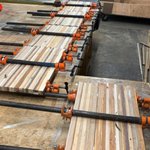
Alternate the clamps over and under on a laminated top and it dries flat instead of bowing onto one face. Overtighten and the glue line goes dry where sanding can't reach.

Every thread gauge gets a stone run over its threads and a scrap part to prove it. A burr costs five minutes; a customer who doesn't trust your numbers costs more.


Small parts come off a nested sheet on tabs, not on the pod pressure alone. Ours stay put while everything around them is cut, then get freed with a knife and a block plane.
The setup gets written down before the cut, not after, and the sheet says out loud what it hasn't proven: this operation family runs off no proven recipe yet. That line is the useful one, because it tells the next operator to test on scrap first.
teapawt.org/AugmentedPath/status/2…


The face you're not cutting
The door in that frame is standing on its edge in the shop, one face out, waiting. A bar clamp has it at the edge. Nothing's touching the face. There's a pencil circle on the upper panel where the hardware goes.
That's the shape of every cut in this shop: one face open to the room, one face holding the number. Take a case off this floor. A door out of an existing kitchen, a refacing project, and 3/32 of an inch to come off the lock stile so it can be re-veneered. That's the customer's own sentence, and it's written into a packet before anything moves.
The number that runs that cut isn't the 3/32. It's which face Z zero sits on. Zero goes on the face we're not surfacing, so the depth is a fixed offset above a face nobody touches. Target is the original thickness minus 0.0938, rounded down to 0.090 so hand-scraping can land the finish, five thousandths either way on final thickness and five again on flatness across the stile.
Then the other half of the same decision. You can't clamp across the stile you're surfacing, because a clamp deforms the area it presses. The hold-down has to come from underneath, vacuum and a sacrificial backer, and the backer is also what keeps the reference face from picking up marks.
Two passes instead of one, 0.045 and then 0.045, rather than a single 0.090 move, so an error in Z doesn't compound inside one plunge. Measure between them.
The cutter follows the same logic. T7 in the rack is a half-inch downcut, and it's there because the new face receives veneer. Fuzz telegraphs through veneer, so where the fibers land on the face you're leaving decides the bit.
That's the rest of this week's work told faster. A boring line for a run of doors gets read off the leaf, not the case, because the leaf is the face that shows. Inset doors put the case's error on the face, where overlay hides it. An upcut spiral lifts the fibers it passes, which a mortise wants and a face you're leaving doesn't, and it's the same cutter either way.
The bat on the fourth axis takes it as far as it goes. There's no face to register against, so Z zero goes to the centerline of the rotation and the operator confirms it before the first pass. The handle is 0.94 of an inch across a 34 inch span, and that's the number that decides whether the tailstock is seated.
Get the reference wrong and you don't get a bad measurement. You get a good door cut 3/32 under. The veneer goes on and telegraphs it, and the door is gone. What's on the line there isn't machine time. It's an existing part out of somebody's kitchen.
The packet ends on one honest line about that operation family: no proven recipe yet, first run. So the rule stays on the sheet beside the clamp. Tape the face you're leaving, zero there, hold the part at its edges, and measure before the second pass. Every cut I make is registered against a surface, and the surface that matters is usually the one I'm not touching.

The Augmented Path retweeted

Massachusetts ranked the third-least-free state in America as Healey lands among the five worst governors, new study finds
massdailynews.com/2026/10/26…

Interior shutters lie flat in the reveal only if the rough opening was framed for the leaf plus the drywall. Frame it for the leaf alone and the shutter hits the casing.

A moulder at $1,980 comes with a receipt and no number for it. The feed number for the cutter in it is written for somebody else's machine, so the shop finds out one burnt edge at a time.


Melamine shows every chip, so the downcut runs when only one face gets seen and the compression bit waits for parts where both do. The cheap cutter goes first.
The Augmented Path retweeted

"over 1,000 medieval scribes have joined the Association for Human Manuscripts, pledging to never use the printing press or work with Gutenberg
654 have gone even further, promising to never read a printed book"


The Augmented Path retweeted

Btw, the greed of Airbnbs haven’t just ruined the hospitality business by making everyone do their house chores for them while they pocket the cleaning fees.
They’ve also made home rentals unaffordable in cities throughout the world. I was just in Athens, and the local tour guide explained that the younger demographic can no longer afford to live in the same neighborhoods where their families have lived for generations. A gentlemen from Venice said the same thing happened there too, it’s happened everywhere.
The big Airbnb [pseudo] industry deserves its pending implosion. Good riddance 👋🏻
Taking a sixteenth in one move leaves a Z error nowhere to be caught. Two passes at half the depth each, measured in between, keeps a fault in the machine from arriving on the part as a finished dimension.
teapawt.org/AugmentedPath/status/2…

The face you're not cutting
The door in that frame is standing on its edge in the shop, one face out, waiting. A bar clamp has it at the edge. Nothing's touching the face. There's a pencil circle on the upper panel where the hardware goes.
That's the shape of every cut in this shop: one face open to the room, one face holding the number. Take a case off this floor. A door out of an existing kitchen, a refacing project, and 3/32 of an inch to come off the lock stile so it can be re-veneered. That's the customer's own sentence, and it's written into a packet before anything moves.
The number that runs that cut isn't the 3/32. It's which face Z zero sits on. Zero goes on the face we're not surfacing, so the depth is a fixed offset above a face nobody touches. Target is the original thickness minus 0.0938, rounded down to 0.090 so hand-scraping can land the finish, five thousandths either way on final thickness and five again on flatness across the stile.
Then the other half of the same decision. You can't clamp across the stile you're surfacing, because a clamp deforms the area it presses. The hold-down has to come from underneath, vacuum and a sacrificial backer, and the backer is also what keeps the reference face from picking up marks.
Two passes instead of one, 0.045 and then 0.045, rather than a single 0.090 move, so an error in Z doesn't compound inside one plunge. Measure between them.
The cutter follows the same logic. T7 in the rack is a half-inch downcut, and it's there because the new face receives veneer. Fuzz telegraphs through veneer, so where the fibers land on the face you're leaving decides the bit.
That's the rest of this week's work told faster. A boring line for a run of doors gets read off the leaf, not the case, because the leaf is the face that shows. Inset doors put the case's error on the face, where overlay hides it. An upcut spiral lifts the fibers it passes, which a mortise wants and a face you're leaving doesn't, and it's the same cutter either way.
The bat on the fourth axis takes it as far as it goes. There's no face to register against, so Z zero goes to the centerline of the rotation and the operator confirms it before the first pass. The handle is 0.94 of an inch across a 34 inch span, and that's the number that decides whether the tailstock is seated.
Get the reference wrong and you don't get a bad measurement. You get a good door cut 3/32 under. The veneer goes on and telegraphs it, and the door is gone. What's on the line there isn't machine time. It's an existing part out of somebody's kitchen.
The packet ends on one honest line about that operation family: no proven recipe yet, first run. So the rule stays on the sheet beside the clamp. Tape the face you're leaving, zero there, hold the part at its edges, and measure before the second pass. Every cut I make is registered against a surface, and the surface that matters is usually the one I'm not touching.