CoinBerlin retweeted

Is Bittensor bittensor:native the Bitcoin of AI?
I laid it all out in today's video 👇
🤖 Made with AI

CoinBerlin retweeted

🚨 BİTCOİN’İN 87.000$’LIK BOĞA TUZAĞI SADECE UYARIDYDI.
Bir hafta önce, $BTC’nin 87.000$’ı reddedeceğini ve 81.000$’a doğru yöneleceğini uyarmıştım.
Şimdi grafiğe bakın.
Ama bu düşüşün bittiğini düşünüyorsanız, bence BÜYÜK bir hata yapıyorsunuz.
**Bir sonraki hedeflerim:**
81.000$ → 78.000$ → 72.000$ → 67.000$ → 53.000$
İlk birkaç düşüş zararsız görünecek.
Bir düşüş daha. Bir sıçrama daha. Almak için bir neden daha.
Sonra 72.000$ kırılacak.
İşte o zaman GERÇEK paniğin başlayacağını düşünüyorum.
Ve Bitcoin 53.000$’a ulaşırsa, bugün “DÜŞÜŞTE AL” diye bağıran aynı insanlar muhtemelen ona dokunmaya korkacak kadar dehşete kapılacak.
**İşte tam da bu, beklediğim fırsat.**
Önceki tahminlerimi hatırlayın:
2022 → 17.000$ DİP
2025 → 126.000$ TEPE
2026 → 58.000$ YEREL DİP
Şimdi bir sonraki büyük hedefimi harekete geçmeden ÖNCE açıklıyorum.
Bu grafiği kaydedin. BTC 53.000$’a vurduğunda geri dönün.
Takip edin + bildirimleri açın.
Bir sonraki büyük dip oluşumunu gördüğümde, tahminimi BURADA İLK olarak paylaşacağım.
Açgözlülüğün seni tepeyi almaya itmesinden sonra, korkunun seni dipte satmana izin verme.

CoinBerlin retweeted

Let me tell you something. Anyone targeting a $1,000 or $1,200 top for $TAO this bull market is an idiot.
I’ve been here since 2016, and I’ve never seen a hot coin peak at just 7x to 8x from its bear market low.
At the very least, we’re talking 40x to 70x from the bottom before you can even start talking about a bull market top.
I’m not making this up. Go check the charts of the hottest altcoins from previous bull runs yourself.
CoinBerlin retweeted

$QNT will NEVER just do a 10x-30x 🚨‼️
Why?
It will reprice to 100 even 300x between this and the next cycle. ($100-300B)
🔸$1.2B market cap
🔹Solving trillion dollar problems (Patented)
🔸95% of tokens already in circulation
The math isn’t speculation — it’s inevitability.
Its technology is patented and cannot be copied/replicated by any other project.

CoinBerlin retweeted

Was für ein Timing.
Ich war heute beim OKX Now-Event in Singapur, bei dem unter anderem OKX CEO @star_okx und Vitalik Buterin eine Rede gehalten haben
Jetzt folgt die nächste große Meldung:
OKX sammelt frisches Kapital bei einer Bewertung von 25 Mrd. US-Dollar ein.
Mit dabei sind Circle, Ripple, Standard Chartered und Qube Research & Technologies.
Bereits im März investierte ICE, der Mutterkonzern der New York Stock Exchange, rund 200 Mio. US-Dollar bei derselben Bewertung.
Nachdem gestern bereits die Pläne für tokenisierte US-Aktien bekannt wurden, folgt heute direkt die nächste Meldung.
Bei OKX passiert aktuell einiges. TradFi und Krypto wachsen immer enger zusammen.
Hier gibt‘s über meinen Webelink noch für wenige Tage einen 8% Einzahlungsbonus & mehr.
-> my.okx.com/join/41818443


CoinBerlin retweeted

Most millionaires could never own 1 full $QNT at the same time.
UBS estimates there are roughly 57.5 million USD millionaires worldwide including approximately 3,300 billionaires.
There are only 14,612,493 $QNT
That is nearly FOUR millionaires for every ONE $QNT in existence.
Even under perfect distribution, only 25.4% of the world’s millionaires could hold one complete $QNT
Now watch what happens when the desired allocation increases:
If just 2.54% wanted 10 $QNT each…
Demand would equal the entire supply.
If just 0.254% wanted 100 $QNT each…
Demand would equal the entire supply.
If only 14,612 people wanted 1,000 $QNT each…
Demand would equal the entire supply.
And this assumes every single token is available for purchase.
It isn’t.
Circulating supply is not sell-side liquidity.
Existing holders own multiple tokens.
Long-term holders reduce what is available to the next buyer.
$QNT doesn’t need all 57.5 million millionaires to want it.
It doesn’t need 10%.
It doesn’t even need 3%.
The supply shock begins when a tiny percentage decides that one $QNT isn’t enough.
$QNT will not disappear.
The opportunity to own one whole $QNT cheaply can.

CoinBerlin retweeted

There are more millionaires on Earth than there will ever be $TAO.
57.5 million dollar millionaires.
21 million $TAO, ever.
Only about 11.3 million exist today. The rest trickles out at roughly 3,600 a day, and that rate halves again.
Nearly three millionaires for every coin that will ever exist.
Most people will never run this math. They check the candle and scroll.
But a hard cap alone pays nobody. It only bites if subnets keep producing work people pay real money for.
If that holds, one whole $TAO puts you in a smaller club than the world's millionaires.
The people who skipped the math will call it luck.


CoinBerlin retweeted

Quant hat heute Nacht nochmal ordentlich aufgedreht. Ehrlich gesagt überrascht mich das kaum, irgendwann holt der Preis die fundamentalen Entwicklungen ein. Und heute startet auch die @Sibos.
Einen möglichen Katalysator sollte man dabei nicht vergessen: Staking kommt noch. Und nach allem, was Quant bisher andeutet, könnten die Rewards direkt an echte wirtschaftliche Netzwerkaktivität gekoppelt sein.
Genau das wäre spannend: kein rein inflationäres Staking, sondern potenziell Erträge aus realer Nutzung der Infrastruktur.😯

CoinBerlin retweeted

If you're wondering why $QNT price pumped 3x this week, this list is probably a good place to start ↓↓
• Quant was just chosen to build the next generation of US bank money. The Clearing House, owned by 25 major US banks like Chase, Bank of America, HSBC, and Citi settle more than $2 trillion per day and selected Quant to connect its new on-chain money network.
• Quant is now powering the largest banks in the UK. Barclays, HSBC, Lloyds, NatWest, Santander and others are now executing live customer transactions on infrastructure built by Quant.
• Quant is directly integrated into Murex’s MX.3 platform. MX.3 is the financial software engine powering 65 of the world's 100 largest banks, and Quant gives them crypto-ready infrastructure without requiring them to rewrite existing infrastructure.
• Oracle has put Quant inside its enterprise digital-asset stack. One of the world's largest enterprise software companies has certified Overledger to provide cross-ledger orchestration for settling transactions across different ledgers and off-chain databases.
• Quant is shaping the standards that will govern value movement across the internet. SATP is designed to let digital assets move safely between separate networks, and the protocol is now in the IETF's final community-review stage before a decision on publication.
• Quant has built technology for the Bank for International Settlements and the Bank of England. Project Rosalind tested 33 API functions and 30+ real-world use cases, with Quant supplying blockchain infrastructure, smart contracts and interoperability.
• The European Central Bank picked Quant to help experiment with the Digital Euro. Quant is testing how programmable payments could work directly with central-bank digital money, putting it inside one of Europe’s most important future payments projects.
• Quant has already integrated with Nexi’s European payments infrastructure. The underlying SIA network spans 580 nodes across 208,000+ km of fiber, connecting banks, payment providers, and financial institutions across Europe.
• Quant has been working on blockchain infrastructure spanning 12 countries across Latin America. The LACChain network gives Quant exposure to cross-border payments, tokenized money and interoperability across multiple national markets.
• Quant has a direct route into Japan’s banking system through Dentsu Soken. Dentsu Soken builds mission-critical systems tied to BOJNET, SWIFT, CLS, internet banking, and core banking, and the partnership includes a joint go-to-market plan for Japanese banks.
• Quant has been granted multiple patents across the US, Europe, Japan, and China. This gives Quant a defensible IP position in one of the hardest problems in digital finance — enterprise-grade multi-ledger technology.
• Quant’s founder helped launch the ISO standard for blockchain and distributed ledger technology. Gilbert Verdian was instrumental in establishing ISO/TC 307, the international committee for blockchain and distributed ledger standards, going on to lead its interoperability working group.
• Quant isn't betting the company on just one product. Overledger, Quant Flow, PayScript, QuantNet, and Fusion give it multiple products around interoperability, programmable money, payments, and multi-network settlement.
• Gilbert was working on this problem before most people had even heard the word “interoperability.” Before Quant, he spent 20+ years in cybersecurity and senior technology roles across the Federal Reserve, Bank of England, HM Treasury, Mastercard, PricewaterhouseCoopers, HSBC, Ernst & Young, and other major institutions.
• $QNT is unusually scarce for an asset servicing a global market. Its maximum supply is just 14.88 million tokens, giving it one of the tightest supply profiles in large-cap crypto. As we've seen this week, when demand spikes, upward moves can be violent.
• Staking could create an even more powerful supply-and-demand loop. Likely arriving in 2027, Quant's staking mechanism could see millions of $QNT tokens locked away, while participants earn rewards and growing network usage competes for the same fixed supply.
• All of this is only what we're allowed to see. Quant is built to operate behind the scenes as white-label infrastructure; we actually have no idea how many more integrations are already live, being tested, or sitting in the pipeline waiting to be announced.
So when people ask me why $QNT suddenly ran this hard this week, I think they're asking the wrong question.
The better question is why the market ignored all of this evidence for so long.
CoinBerlin retweeted

$Qnt at 1 Trillion market cap is $68,000 and people laughed at me when I told them that #Qnt can easily hit $1000 to $10,000..
Remember its even scarce than $Btc
#bitcoin total supply = 21 million
$Qnt total supply = 14 million
Plus the #btc OGs already acknowledging $Qnt
🚀

$QNT could literally go to $1 Trillion
There has never been a more bullish coin.
Do you understand how big this is?

CoinBerlin retweeted

The funny thing is seeing people keep asking the same questions and also want proof that I keep buying $RIO every week as long as the price stays below 0,1$.
Instead of asking too many questions and seeking reassurance, they should carefully take a look at this weekly $RIO chart.
I think only blind people wouldn't see similarities compared to the end of 2022.
Furthermore, as I've said several times, the ETH/BTC and OTHERS charts seem to speak very clearly for this cycle.
I'll say it again: the $RIO hack was just a small incident that temporarily slowed the rally, but my ultimate goal for $RIO remains the same.
When things start to accelerate, there will be no one left to stop $RIO.
The @realio_network team is truly ready to tokenize everything, and then the real FOMO will kick in.
Knowing how to position yourself early isn't everyone's cup of tea, so I understand.
See you later next year or maybe in 2028. High, but much higher than in March 2024.
It will be a jaw-dropping spectacle, especially for all the doubters and blindfolded skeptics.


CoinBerlin retweeted

Si acabas de entrar en $TAO, siéntate.
Esto es lo que necesitas entender antes de mirar un solo gráfico:
1. $TAO no es “otra IA”.
Bittensor intenta crear un mercado abierto donde cualquiera pueda competir produciendo inteligencia útil.
2. Las subredes son las fábricas.
Unas compiten en cómputo. Otras en visión, modelos, robótica, genómica, agentes…
Existen más de 100.
3. Los mineros trabajan. Los validadores corrigen.
Imagínate un examen mundial permanente donde hacer mejor el trabajo significa capturar más incentivos.
4. dTAO convierte el capital en una señal.
Cada subred tiene su propio token Alpha.
Cuando haces staking ahí, no solo buscas rendimiento:
estás diciendo con tu TAO qué infraestructura merece más recursos.
5. TAO y Alpha NO son lo mismo.
$TAO es exposición al ecosistema.
Alpha es apostar por una fábrica concreta dentro de él.
6. Solo existirán 21M de TAO.
Y el primer halving ya ocurrió.
La escasez está programada.
7. Y esta es la tesis importante:
Bittensor no necesita construir “la mejor IA del mundo”.
Necesita construir el mercado donde miles compitan por construirla.
Eso es muchísimo más grande.
Bienvenido.

CoinBerlin retweeted
21 bittensor:native costs less than $5,000 today.
Accumulating 21 TAO today positions you to own 1-millionth of a fixed-supply network.
If just 100,000 people each decide to buy $5,000 worth of TAO, that's 2.1 million TAO of demand.
I broke it all down in today's video below 👇
🤖 Made with AI

CoinBerlin retweeted

ethereum:0x7420b4b9a0110cdc71fb720908340c03f9bc03ec showing signs of breaking out again and after the previous breakout, a move could be absolutely MONSTROUS!
We target $0.2785, a >50X...
(JasmyCoin)

CoinBerlin retweeted

🚨BARRY SILBERT: INVESTORS WILL CONNECT THE DOTS TO BITTENSOR!
@BarrySilbert says the rush to buy open-source AI will eventually point people to $TAO.
That comes as Stripe has been reported buying OpenRouter for about $7.5 billion, Nvidia struck a roughly $6 billion Poolside deal, and The Information says Nvidia agreed to buy Hugging Face for $12.9 billion.
CoinBerlin retweeted
I truly believe this is the first real cycle for $RIO
@realio_network built something that projects with hundreds of millions of Mcap are forgotten
I'm sure that even today $RIO is one of the best low cap coins to have in your portfolio
In the previous cycle it touched 3.3$ with only the mainnet active
Now that it has EVERYTHING already active to tokenize and considering the ETH/BTC chart I believe it will have a senseless run in this cycle
Just the beginning for $RIO 🤝
CoinBerlin retweeted
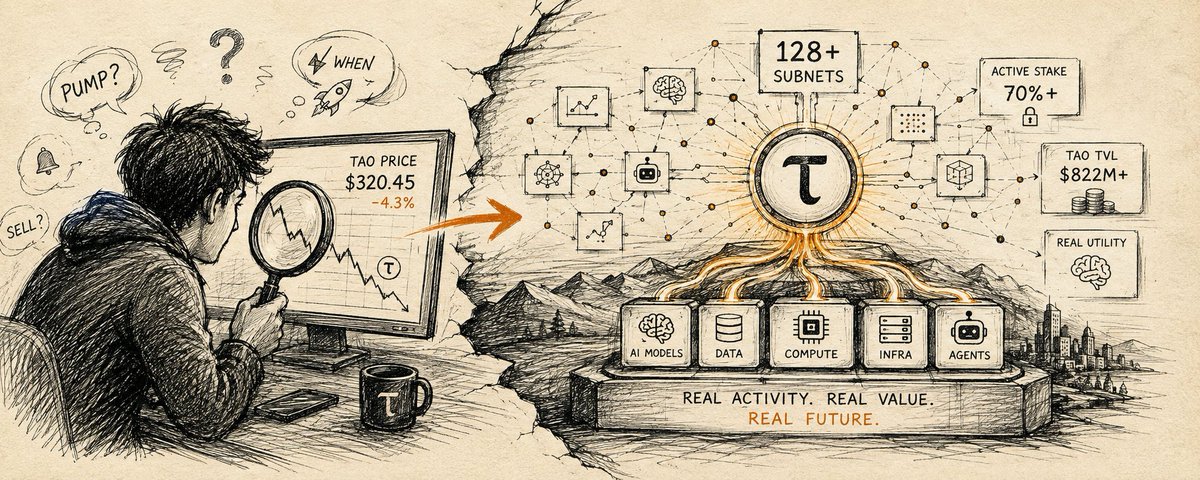
$TAO is down 70% from its 2024 high, and most of the conversation around it is stuck on the wrong question.
Everyone is debating the price. Cycle bottom or dead coin.
Meanwhile, the more important story went almost unnoticed: while the chart bled, Bittensor rebuilt its core economics.
What actually changed in 2026:
The December halving cut block rewards in half.
dTAO turned every subnet into its own live market with its own token.
Root Reborn rewired how nearly half of all staked TAO behaves, easing the automatic sell pressure that weighed on price for months.
Grayscale and Bitwise began filing for TAO investment products.
TAO expanded cross-chain onto Base.
Real, structural progress. But none of it answers the question that matters most.
There is one number Bittensor's transparent chain still cannot show you: how much real revenue, from real paying customers, its subnets generate from the outside world.
The chain proves value moves within its own economy.
It does not yet prove value is flowing in from outside it. Emissions are an incentive expense, not revenue.
A rising subnet token reflects investors allocating capital, not customers paying bills.
The clearest example: a widely circulated "$43M in customer revenue" figure was excluded from serious analysis because it could not be verified.
That single detail captures the entire TAO thesis.
This is neither a bull case nor a bear case. It is a case for watching the right variable.
I wrote the full breakdown: the halving mechanics, how dTAO works, what Root Reborn changed, the subnet leaderboard, the ETF reality check, and the six signals worth tracking instead of the price.
If you hold TAO, or you're considering it, this is worth reading before your next move.
Video credit @const_reborn @Jason @Lons